



Two labs can share a pattern that no ordinary pair of sealed envelopes can explain. Move the labs far apart, turn their detectors in different directions, and the strange link remains in their results.
That is the heart of quantum entanglement explained without the science-fiction shortcut. The link is real. The faster-than-light messaging often attached to it is not.
Imagine two researchers watching separate screens. Each sees a stream of random results. Neither can control the next result, yet comparing their records reveals a deeper order. That gap between a local view and a shared view is where the wonder lives.
What does entanglement actually mean?
Entanglement means a shared quantum state cannot be described as separate, independent states for its parts. Measurements of those parts can show quantum correlations that depend on how the measurements are made. It describes the whole system, rather than a secret message traveling between two tiny objects.
A quantum state is a mathematical description used to predict measurement results. It is not a miniature portrait of a particle carrying a list of fixed answers inside it.
When two systems become entangled, the best description belongs to them together. Scientists can prepare such links between photons, atoms, and other systems under carefully controlled conditions.
This does not mean every entangled pair acts in the same way. The pattern depends on the state and the measurement. Claims that observing one particle always reveals everything about its partner are too broad.
A useful analogy is a duet. Studying one voice alone can miss something that exists only in the relation between both voices. The analogy captures the shared description, but it cannot reproduce the full physics.
The important step is to resist turning a helpful picture into a literal mechanism. Entanglement is not an invisible string, a tiny radio, or two particles that feel human emotions. It is a property of the state scientists prepare and test.
Why sealed envelopes are not enough
A pair of envelopes can contain matching answers before anyone opens them. Entangled particles show stronger and different patterns across chosen measurement settings. Bell tests examine those patterns, allowing researchers to test a broad class of local hidden-variable explanations rather than simply celebrate two matching results.
Suppose a friend writes red on one card and blue on another. You take one sealed envelope to New York and send the other to Paris. Opening yours tells you the other color instantly.
Nothing traveled between the cities when you opened it. The answers were fixed earlier. This is an ordinary correlation, and it cannot explain every quantum experiment.
In a Bell experiment, researchers can choose different measurement settings. They ask whether a model built from local, preassigned answers can match the full set of results.
The answer depends on a statistical limit called a Bell inequality. Quantum theory predicts circumstances in which that limit can be exceeded, and experiments have observed such violations.
This is subtler than catching two particles doing something odd once. Researchers collect many trials, account for the equipment, and compare the pattern with a specific mathematical bound.
Some experiments must address gaps involving detection or communication between the measurement stations. Closing those gaps makes the test more demanding and the resulting evidence more persuasive. A striking result becomes science through careful controls, not through a dramatic headline.
Why you cannot send a message faster than light
The no-signaling theorem is the key limit: one observer cannot choose a local outcome that transmits a readable message to the other. Each local record remains random. The useful correlation becomes visible when the observers compare their results through an ordinary channel that respects the speed of light.
Imagine trying to send a yes-or-no message by measuring your particle. You would need to force a result for yes and a different result for no.
An entanglement measurement does not give you that control. Changing how you measure also does not produce a locally readable signal at the distant station.
The other researcher still sees a record that, by itself, does not reveal your message. To identify the shared pattern, both sides must later exchange information about their measurements.
That exchange uses a normal communication system. A radio transmission, fiber link, or physical record cannot outrun the light-speed limit.
This distinction also explains why quantum teleportation does not teleport a person or deliver a message instantly. It transfers a quantum state using an entangled resource and classical information, under specific conditions.
The name sounds like a shortcut across the universe. The protocol is a carefully defined procedure, with ordinary communication built into it. Its achievement is remarkable enough without adding a power that the method does not possess.
What the experiments earned their reputation for
The 2022 physics Nobel recognized experiments with entangled photons, Bell inequality violations, and work opening quantum information science. These achievements established much more than a curious laboratory trick. They helped turn a deep argument about nature into tools that researchers can prepare, manipulate, measure, and build upon.
Albert Einstein and his collaborators challenged whether quantum mechanics offered a complete description of reality. Their questions helped expose a problem that later researchers could test.
John Bell made the discussion experimentally sharper. Rather than debate only what reality should feel like, scientists could compare measured results with a precise limit.
Researchers including John Clauser and Alain Aspect developed influential experiments. Anton Zeilinger and collaborators advanced the use of entanglement in quantum information.
The path was not a single photograph that suddenly proved everything. Different experiments answered different questions, and improvements in sources, detectors, and timing strengthened the record.
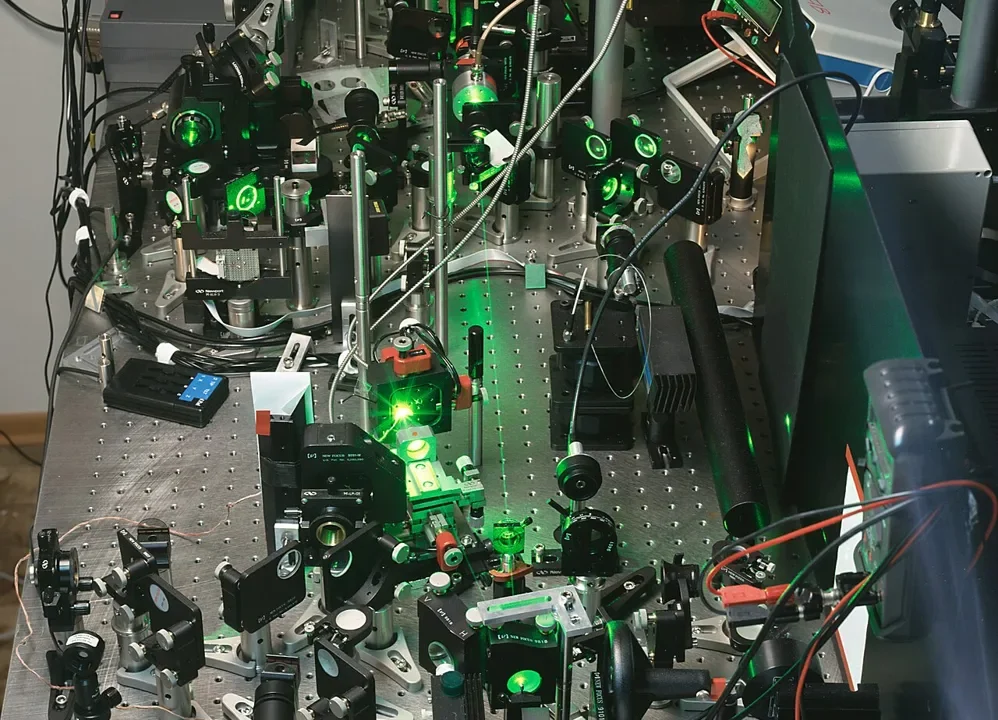
Photographs of laboratories can show the optical benches, lasers, and equipment behind the work. They do not show a visible thread joining distant particles.
That is part of the appeal. The effect lives in recorded outcomes and their relationships. To understand it, you must move from the picture of a machine to the pattern of its measurements. The science rewards patience with a view of nature that everyday experience never prepared us to expect.
Where quantum networks may be useful
Quantum networks aim to distribute quantum states and entanglement between locations. Potential uses include connecting quantum processors and supporting communication protocols with new security properties. These systems still face loss, noise, storage, and engineering challenges. Entanglement is a resource to manage, rather than a promise that every network becomes unhackable.
A fragile state can lose the very relation a network needs. Heat, unwanted interactions, imperfect devices, and lost photons all create practical trouble.
Sending a signal through a long fiber is not the same as preserving a useful quantum resource through that distance. Scientists need ways to generate, distribute, check, and sometimes store the resource.
This is why a successful demonstration may involve a small number of nodes. It can still establish an important step without delivering a worldwide service.
Security also belongs to the entire system. A sound quantum protocol cannot automatically fix faulty software, compromised endpoints, or a careless operator.
When a report announces a breakthrough, ask what was actually achieved. Was an entangled link established, a state transferred, or a complete task performed reliably?
Those questions make progress easier to see. They replace a vague promise of future magic with specific engineering milestones. A network that works better over a measured distance is a real achievement, even when it remains far from the polished service described in a promotional image.
A stranger reality without a magical shortcut
The strongest explanation keeps two ideas together: entanglement changes how shared systems can be described, while ordinary signals still obey relativity. The mystery lies in the structure of the correlations. Removing the faster-than-light myth leaves a more precise question about what nature allows and how we can use it.
The most misleading accounts begin with a true surprise and then jump to a false conclusion. Entanglement is real, therefore every imagined application must be possible. That leap is where understanding breaks down.
A better route begins with the experiment. Identify the systems, the measurement choices, the recorded outcomes, and the statistical pattern.
Then separate the demonstrated result from the proposed application. A new source of entangled photons may help a future network, but it is not the same thing as an operating network.
Finally, keep the limits in view. Science is not weaker because it states what cannot be inferred. Those limits are the rails that keep an exciting idea on a useful path.
You can leave the laboratory with the original wonder intact. Two distant records can share a relation that defeats a simple local picture of prewritten answers.
Yet neither researcher has a button marked send instantly. The universe has offered something more subtle: a new way to describe a whole, and a demanding invitation to learn what that description can do.
Frequently Asked Questions
Does entanglement prove faster-than-light communication?
No. Entangled outcomes can share a distinctive statistical pattern, but a distant observer cannot read a chosen message from that pattern alone. Comparing the records still requires ordinary communication.
Are entangled photons the only systems that can be linked?
No. Researchers can create entanglement in several kinds of quantum systems, including atoms and other laboratory platforms. The methods and limits depend on the system and the experiment.
Does quantum teleportation move matter across space?
The usual protocol transfers a quantum state, not a person or a physical object. It needs both an entangled resource and classical information, so it does not provide an instant communication channel.


.jpg)