A thunderstorm fades, but the light does not. A witness reports a bright sphere near the ground, moving for a few seconds before it disappears.
That image sits at the center of the ball lightning mystery. It is also the start of a difficult scientific problem. A brief event is hard to measure, and a frightened observer may not know what happened.
Researchers must sort reports, instrument records, and laboratory look-alikes without treating them as the same kind of evidence. The result is more interesting than a simple claim that science has solved the glowing ball, or that the ball must be supernatural.
What witnesses mean by ball lightning
Ball lightning is a name for reported, short-lived luminous objects often linked with thunderstorms. Accounts differ in size, color, motion, and sound. Some may describe different phenomena. The label organizes an observation, but it does not establish one proven physical mechanism for every glowing orb reported across history.
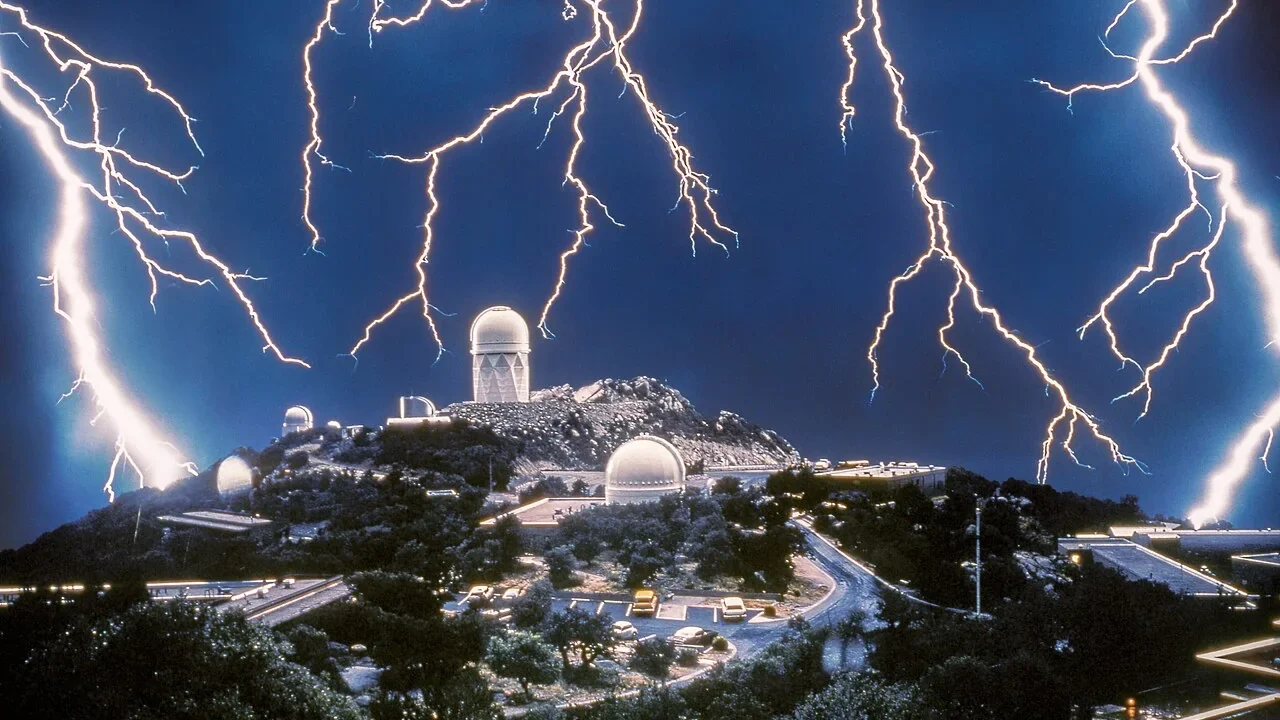
Ordinary lightning is a rapid electrical discharge. It can branch across the sky and vanish before your eyes adjust. A reported glowing sphere that lasts for seconds presents a different puzzle.
How does the light remain visible? Where is its energy stored, and what gives it a rounded shape? These questions guide physical explanations.
The reports do not answer them automatically. A description of a ball drifting across a room is not a measurement of its temperature, electrical charge, or composition.
Nor does a familiar name guarantee that every witness saw the same thing. Electrical arcs, afterimages, reflections, and other bright effects may enter the record beside a genuine unusual event.
The first challenge is therefore classification. Scientists need to ask which features recur and which appear only in retellings.
That careful sorting can feel less thrilling than a legend. Yet it is the only way to discover whether the name refers to one phenomenon, several related effects, or a mixture of unusual events and ordinary mistakes.
Why old reports are both valuable and difficult
Historical accounts preserve experiences that modern instruments missed. They can identify recurring descriptions and show how people interpreted storms. They rarely provide controlled measurements, however. A church chronicle, a sailor's recollection, and a contemporary instrument recording have different strengths and should not be treated as interchangeable scientific evidence.
A strange light inside a church once invited a religious explanation. At sea, an unfamiliar electrical effect could become an omen. The setting shaped the account before anyone tried to build a physical theory.
A modern reader should not dismiss those observers as foolish. A violent storm, darkness, and sudden light would confuse people in any century.
But respect for a witness does not require accepting every detail as exact. Estimated sizes and distances can be unreliable when a scene changes quickly.
Later writers may also combine different sources. A modest report can acquire a smell, an explosion, or a dramatic escape as the story travels.
Useful questions include who wrote the account, how soon they wrote it, and whether they actually witnessed the event. Independent descriptions can strengthen a record, although shared rumors are not independent evidence.
Historical material can reveal what observers thought they saw. To identify what produced the light, researchers still need physical clues. Keeping those tasks separate protects both the history and the science.
What a spectrum can reveal
A light spectrum separates visible radiation into features linked with its source. A reported instrument observation of ball lightning detected emissions associated with soil elements after a lightning strike. That supports particular chemical explanations for that event, but one recording cannot prove that every historical account had the same cause.
A camera tells you where a bright object appeared. A spectrometer can tell you something about the light it emitted. Those are related but different forms of information.
Chemical elements can produce characteristic spectral features. If an unusual glow includes signals associated with silicon, iron, or calcium, researchers can compare those clues with materials near the strike.
That makes the ground part of the investigation. Lightning carries enough energy to alter material at its impact point, providing a possible source for a later luminous effect.
The useful result is not simply a glowing shape on video. It is the connection between the shape, the timing of the strike, and measured features of the light.
Even then, interpretation needs caution. Instrument limits, background light, and the geometry of the scene affect what can be concluded.
A strong observation narrows the choices. It does not require scientists to declare the entire category solved. Rare natural events may demand years of collecting a small number of good records.
Why silicon is part of the discussion
One proposed mechanism begins when lightning heats material containing silicon. Fine particles produced by the strike could react with oxygen and emit light as they change. Laboratory experiments have produced luminous objects with some reported features. Similarity is useful evidence, although a laboratory look-alike is not a complete identification.
The idea connects a strange atmospheric sight with ordinary ground materials. Instead of assuming an unknown energy source, it asks whether a powerful strike can turn soil into a brief luminous cloud.
Fine particles behave differently from a large lump of rock. Their surfaces offer many places for chemical reactions, and those reactions may release heat and light.
A model must also explain the event's lifetime. If all the energy escapes at once, the light becomes a flash. If it escapes gradually, a visible glow could persist longer.
Shape and motion are harder questions. A rounded object that remains together must have a physical reason for doing so, rather than a shape added only to fit the story.
Laboratory work lets researchers test parts of this proposal. They can change a material, measure the glow, and compare the result with observations.
The experiment becomes most useful when it states precisely which features match and which do not. A partial match can advance the science without turning a promising mechanism into a universal answer.
Other ideas, and the tests they must pass
Other proposals involve plasma, electromagnetic energy, or optical effects. A workable explanation must account for brightness, duration, size, energy, and the conditions of formation. It must also make testable predictions. An imaginative story that explains only the round shape leaves much of the scientific problem untouched.
Plasma is often mentioned because it involves charged particles and can emit light. Yet using the word does not explain how a small glowing object could persist in cool surrounding air.
An electromagnetic model must identify how energy enters and remains in the system. An optical explanation must show why the witness or instrument recorded the particular appearance.
Different proposals may fit different cases. That is not necessarily a failure if the original reports describe more than one physical effect.
The difficult step is deciding what would rule an idea out. If a model can be adjusted to fit any color, lifetime, and movement, it becomes hard to test.
Researchers therefore look for measurements that distinguish possibilities. Composition, temperature, and changes in brightness may be more valuable than a dramatic silhouette.
A convincing explanation must survive contact with evidence beyond the detail that inspired it. The ball lightning mystery is a reminder that naming a mechanism is only the opening move in explaining a natural event.
How to observe without chasing the danger
An unexplained glow during a storm does not make the storm safe. The useful response is to follow normal lightning precautions and record details only from safety. Reliable observations include timing, setting, weather, and instrument files. A report should distinguish what was seen directly from interpretations added afterward.
Do not approach an unusual light to test whether it is hot or electrical. Its uncertain identity is a reason for caution, not an invitation to conduct an improvised experiment.
If a recording already exists, preserve the original file. Editing a clip can remove timing information or visual context that an investigator needs.
Describe nearby ordinary sources of light, the camera position, and whether a strike occurred just before the observation. These details help separate a physical event from a reflection or imaging effect.
Also state what you could not judge. An honest description of uncertain distance is more useful than a confident estimate invented afterward.
The best account may sound plain: a light appeared, moved across a particular part of the scene, and vanished after a measured interval. That plainness is a strength.
Some of the world's most intriguing events begin as a short, incomplete record. Scientific care gives that record a chance to become something more than another story told after the thunder has passed.
Frequently Asked Questions
Has ball lightning been completely explained?
There is no single widely accepted mechanism that explains every reported case. Instrument observations and laboratory studies have strengthened some proposals while leaving important questions open.
Is a photograph of ordinary lightning proof of ball lightning?
No. Ordinary lightning provides context for the environment, but it does not document a glowing sphere. A caption should make that difference clear.
Should I approach a glowing object during a storm?
No. Follow normal lightning safety guidance and stay away from the object. Scientific curiosity does not justify exposing yourself to a dangerous storm or an unknown electrical effect.