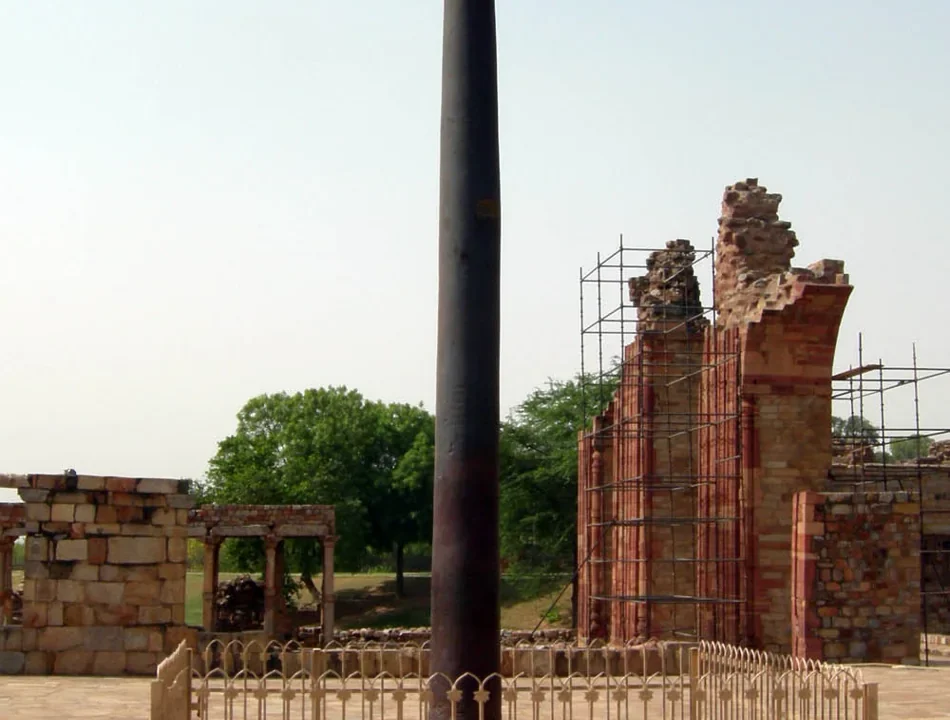


A tall iron column stands among the stone remains of Delhi's Qutb complex. Rain has touched it, generations have passed it, and the metal still holds together.
The surprise is not that it has never rusted. It has. The real puzzle behind Delhi iron pillar rust is why corrosion has progressed so slowly across much of its surface.
The answer brings ancient craft into a modern materials laboratory. Chemistry, the way the iron was made, and the environment all matter. Once you look closely, the famous pillar stops being evidence of impossible technology and becomes evidence of skilled people working with a material that behaved in an unusually durable way.
What the pillar actually is
The Delhi pillar is an ancient wrought-iron monument now standing in the Qutb complex. Its inscription belongs to the Gupta-era historical setting and honors a ruler called Chandra. The surviving structure shows remarkable corrosion resistance, although descriptions claiming it is entirely rust-free simplify what researchers and visitors can observe.
The column is impressive before you know its chemistry. It rises above a courtyard whose surrounding buildings belong to later periods, placing different chapters of Indian history in one view.
Its survival is striking because iron usually reacts with its surroundings. Many familiar metal objects develop loose rust, flaking surfaces, and deep damage when left outdoors.
The pillar does not behave like a neglected garden tool. But that comparison can mislead if you ignore differences in composition and manufacture.
Wrought iron is not modern stainless steel. It may contain slag and other features left by historical production methods. Those features can influence how its surface changes over time.
The inscription adds a different kind of evidence. It speaks to royal memory and religious dedication, rather than explaining the workshop process.
Both lines of study matter. A column can be a political monument and a materials case study at the same time. Neither role requires inventing a lost civilization with machines beyond the reach of its neighbors.
How a surface layer can protect iron
Corrosion resistance does not always mean a metal refuses to react. Sometimes reactions build a surface layer that slows further attack. Researchers have linked the pillar's durability to a protective layer and its unusual iron composition. A stable surface can limit damage even while some corrosion has already occurred.
Think about the difference between a wall that sheds dust and one that develops a firm skin. The first loses material as the weather works on it. The second may resist what comes next.
Rust can take different forms. A loose, porous layer lets moisture and oxygen reach deeper metal. A more adherent layer may slow their access.
That is why the color of a surface alone cannot tell the whole story. Researchers need to study what the layer contains and how it connects to the metal underneath.
The pillar's protective oxide layer is therefore not a contradiction. Corrosion may help create the barrier that limits later corrosion.
This is a useful lesson in everyday language. Saying a material is resistant does not mean it is immune. It means the rate or extent of damage is lower under particular conditions.
The distinction replaces an absolute claim with a physical explanation. It also helps explain why careful examination can reveal rust without destroying the pillar's reputation as an extraordinary example of ancient metallurgy.
Why phosphorus and slag matter
The pillar's iron differs from many modern structural steels. Its chemistry and slag inclusions reflect historical production, and phosphorus is central to discussions of its corrosion behavior. These properties affect the developing surface. The explanation depends on the actual material, rather than the vague idea that all ancient iron was superior.
Modern factories control steel chemistry for particular uses. Historical smiths worked with ores, furnaces, fuel, and methods that produced a different kind of metal.
The resulting iron could contain more phosphorus and visible traces of slag. Those were not decorative additions. They belonged to the route from ore to finished object.
In a monument like this, such features can influence the reactions that occur outdoors. A detail sometimes treated as an impurity may play a part in long-term behavior.
That does not make every impurity helpful. Nor does it prove that the makers understood the modern chemical explanation for the pillar's survival.
Craft knowledge often develops through experience. A smith may recognize which materials and processes work well without describing them in the language of contemporary materials science.
The fairest conclusion gives the makers credit for what they achieved. It does not assign them laboratory measurements they never recorded, and it does not dismiss their skill because their knowledge took a different form from ours.
Building a large column without a modern factory
Forge welding joins heated pieces of iron through pressure and skilled working. The pillar is commonly studied in relation to such historical methods. Producing a large, coherent monument required control of heat, material, and labor. Its existence demonstrates substantial craft organization, even though many details of the workshop remain uncertain.
Imagine the practical problem rather than only the finished silhouette. A large object requires more than finding iron. Workers must prepare pieces, heat them, handle them, and join them reliably.
Temperature is crucial. Too little heat can leave a weak join. Poorly managed heat can damage material or waste fuel.
The work also needs coordination. People moving and striking heavy hot metal must act together, and a project of this size depends on supplies arriving when needed.
Surface marks and internal features can offer clues to the process. They are not a complete diary of the workshop, but they constrain what explanations are plausible.
An exact claim about the number of workers or days would need specific evidence. Repeating a neat estimate does not make it a witnessed fact.
The monument already establishes something important without that precision: ancient metalworkers could organize and execute a demanding project. Their achievement belongs in the history of engineering, not only in a list of objects labeled unexplained.
Reading the inscription and the changing setting
The inscription connects the column with royal praise and dedication to Vishnu. Its historical interpretation is separate from questions about corrosion. The pillar now stands among structures built later, so its present surroundings should not be mistaken for the complete story of its original setting, movement, or intended use.
A visitor sees a single place, but the objects within it may have arrived from different times. That layered setting is part of what makes the courtyard compelling.
The later mosque and the older pillar do not share one construction date. Reading the site as though they do would blur important historical differences.
The name Chandra in the inscription is often associated with Chandragupta II. Such identification depends on historical arguments, including script, wording, and the wider political setting.
It is safer to distinguish an inscription's wording from a historian's identification. The text survives; some details of its interpretation remain matters of scholarship.
Questions about movement are equally specific. Establishing where an object stood earlier may require records, comparisons, and archaeological evidence beyond the column itself.
The setting gives us a rich story precisely because it is layered. A monument can outlive the people who commissioned it, move into a new environment, and gain meanings that its first makers never imagined.
What the pillar teaches about durable materials
The pillar shows how manufacture, composition, surface chemistry, and environment can combine to produce long survival. No single slogan explains that combination. Modern engineers study such examples to understand corrosion, while historians study the skills and institutions behind them. The strongest explanation respects both kinds of evidence.
A durable object is the result of a system. Material alone is not enough; the surrounding conditions influence how that material ages.
Moisture, pollutants, damage, and changes in exposure can all matter. A process that protects one outdoor monument may not protect another object in a harsher setting.
This is why the pillar does not prove that modern metalwork has simply forgotten a universal secret. Contemporary engineering solves many different problems, from bridge loads to chemical processing.
The column offers a narrower and more interesting lesson. A historical route to iron produced a monument whose surface developed unusual resistance over centuries.
Visitors can appreciate the result without treating the site as a place to test the metal by touching, scratching, or applying substances. Preservation keeps future study possible.
Look once more at the iron against the pale stone. Its quiet endurance is not the absence of chemistry. It is chemistry unfolding slowly, joined to the work of people whose craft still stands in public view.
Frequently Asked Questions
Is the Delhi iron pillar completely free of rust?
No. Its remarkable feature is strong corrosion resistance, not total immunity. Surface examination reveals corrosion, while much of the monument has remained unusually well preserved.
Was the pillar made from stainless steel?
No. It is an ancient wrought-iron monument. Its composition and developing protective surface help explain durability without turning it into a modern stainless-steel object.
Does its survival prove that ancient smiths knew modern chemistry?
It proves impressive material skill and a durable result. It does not by itself establish what the makers knew about the modern chemical mechanisms responsible for that survival.