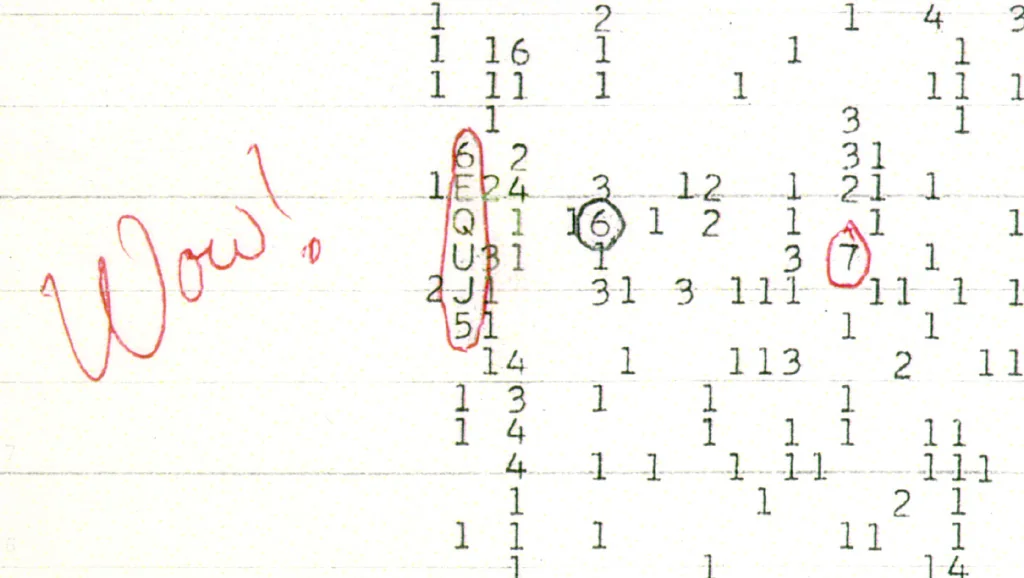


Six printed characters rose and fell on a sheet of computer output: 6EQUJ5. Beside them, astronomer Jerry Ehman wrote the word that made the record famous.
For the Wow signal explained carefully, begin with what those characters were not. They were not an alien sentence or a decoded greeting. They represented a measured change in signal strength.
The observation came from the Big Ear telescope on August 15, 1977. It stood out, and efforts to find a convincing repeat did not turn it into a confirmed message. That combination, a real unusual detection and a missing second chance, keeps the case alive.
What the telescope recorded
Big Ear recorded an unusually strong narrowband radio signal in 1977. The famous characters encoded its intensity over consecutive sampling intervals. The detection lasted through the telescope's roughly seventy-two-second observing window for that sky position. That window describes the instrument's view, not a proven start and finish for the emitting source.
A radio telescope does not hear the sky as a human listener hears a voice. It measures radiation and turns those measurements into records that can be analyzed.
The printed sequence became memorable because it showed a signal changing in strength. The characters used an encoding system, with stronger values represented differently from weaker ones.
That is why reading the sequence as a secret language misses the point. The information lies in the shape and intensity of the detection, not in a supposed meaning attached to the letters.
The observing window is equally important. Big Ear's design meant a particular direction moved through the telescope's response as Earth turned.
A source could remain present longer than that interval while the telescope's sensitivity to it rose and fell. The data cannot directly establish an exact lifetime beyond the available view.
The unusual observation is therefore specific. It was not every telescope hearing a message at once. It was one recorded event in one system, whose properties invited further investigation.
Why the hydrogen line attracted attention
The signal was near the radio frequency associated with neutral hydrogen, an important reference in astronomy. A narrowband feature in that region interested SETI researchers because an artificial transmission was one possible explanation. The frequency alone does not identify the source, and a protected band does not make interference physically impossible.
Hydrogen is widespread in the universe. Its radio emission provides a useful tool for studying astronomical material and a familiar frequency for researchers looking for unusual signals.
An engineered transmission could, in principle, use a recognizable part of the spectrum. That makes the region interesting without proving what any individual detection means.
Natural and artificial sources must both be considered. So must the instrument and the environment around it.
A rule protecting an observing band reduces some sources of interference; it does not create a physical barrier around the frequency. Equipment can malfunction, transmissions can stray, and unexpected effects can occur.
The scientific question is therefore more demanding than asking whether the frequency looks meaningful. Researchers compare bandwidth, timing, sky position, and possible competing explanations.
The hydrogen line is a clue about why the detection drew attention. It is not a signature that an extraterrestrial civilization signed beneath the data.
The shape of a signal can reveal a direction
The recorded rise and fall resembled the response expected as a source passed through the telescope's observing pattern. That supported attention to a sky-associated source. However, the instrument had more than one possible beam location, and a single observation left important ambiguity. Directional clues did not yield a confirmed astronomical identification.
A telescope's response is not equally strong across its field. A source near the center can appear stronger than one near an edge.
As Earth turns, that response can create a characteristic rise and fall. The shape helps researchers ask whether a detection fits the expected geometry.
The match can be informative even when it does not establish the nature of the source. A signal can look consistent with a position on the sky while other questions remain.
The Big Ear record also left uncertainty about which of its possible observing positions corresponded to the event. That matters when later telescopes search for a repeat.
A broad public story often turns the location into a precise address. The data support a more cautious description.
The useful lesson is that instruments shape evidence. To understand the Wow event, the telescope's design is not background trivia. It is part of the explanation of what the record can tell us and what it cannot.
Why repeat observations are so important
A repeat could let researchers confirm a position, compare properties, and test whether the signal persists or changes predictably. Follow-up efforts have not established the event as an extraterrestrial transmission. A lack of repetition does not prove nothing happened. It limits the kinds of conclusions that can be drawn from the original detection.
Astronomy often depends on returning to a source. A second observation can distinguish a stable object from a temporary effect and make a hypothesis much easier to test.
The Wow record did not provide that convenient next step. Researchers could examine the old data, but a missing repeat restricted opportunities for new measurement.
Several possibilities remain compatible with a one-time event. The source may have been transient, aimed elsewhere later, too weak to detect, or unrelated to the favored explanation.
Listing those possibilities is not the same as showing that they are equally likely. Evidence must still guide their assessment.
A useful follow-up states what area was observed, at which frequencies, with what sensitivity, and for how long. Saying scientists listened again hides those important differences.
The continued absence of a confirmed repeat gives the case its distinctive shape. It is neither a demonstrated communication nor a record that can be dismissed simply because a later search did not reproduce it.
What competing explanations must accomplish
Explanations have included interference and natural astronomical possibilities as well as deliberate transmission. Each must account for the measured properties and observing circumstances. A proposal is not confirmed merely because it can produce a signal in principle. The challenge is connecting a real source and mechanism with the specific 1977 record.
A hypothesis needs more than a category. Saying comet, satellite, or aliens does not explain the timing, bandwidth, and apparent direction.
The same standard should apply across candidates. An exciting explanation should not receive easier treatment because it makes a better headline.
Researchers can test whether a proposed source occupied a relevant position or could produce the needed radiation. They can also study known behavior of the equipment.
Some later proposals have attracted publicity without earning broad agreement. That is normal in an unresolved case, but the disagreement should remain visible in an article.
An unresolved natural explanation does not automatically establish an artificial one. Nor does uncertainty about interference make extraterrestrial intelligence the default answer.
The record deserves attention precisely because it contains constraints. A successful explanation should fit them rather than turn the missing information into room for an unrestricted story.
A valuable question without a confirmed alien message
The Wow signal remains a notable one-time radio observation. It demonstrates why searches for technosignatures need careful recording, follow-up, and evaluation of alternatives. Its public fame exceeds what the evidence can prove. The honest fascination lies in a signal worth investigating, not in a message whose sender has been identified.
The mark Ehman wrote is a human response to a surprising record. It captures a moment of recognition, not the final result of an investigation.
That distinction makes the story more relatable. Scientists can be excited by evidence before they know how to explain it.
The task afterward is slower. They preserve the data, assess the instrument, compare alternatives, and look for another chance to observe.
Modern SETI searches benefit from improved equipment and methods, but the central discipline remains the same. A candidate becomes persuasive through testing rather than through the intensity of public hope.
The printout still invites a pause. A narrowband signal appeared in a useful observing window and did not become a secure identification.
The universe has not supplied a confirmed greeting in those six characters. It has supplied a lesson in how a small amount of evidence can open a large question, provided we resist pretending that the question is already answered.
Frequently Asked Questions
Does 6EQUJ5 encode an alien message?
No. It represents signal intensity values recorded by the observing system. It is not a translated sentence.
Did the source transmit for exactly seventy-two seconds?
The detection spans the telescope observing window for the relevant direction. That does not establish the full duration of the source beyond the window.
Was an extraterrestrial origin confirmed?
No. The signal has not been established as a transmission from another civilization. Follow-up and competing explanations remain central to assessing it.