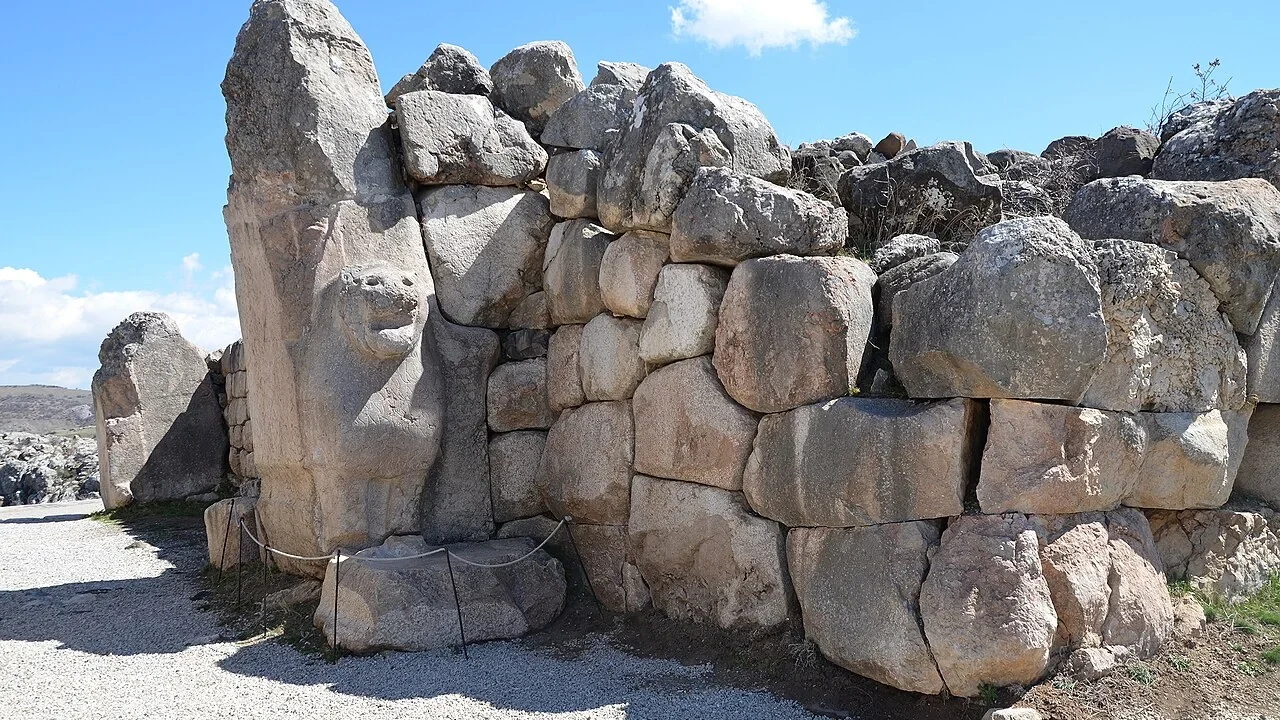
Stone lions guard a doorway in the Anatolian landscape. Beyond them lies the outline of a capital whose rulers exchanged letters, managed temples, and argued with other great powers of the Bronze Age.
The Hattusa lost capital is not a place without a voice. Clay tablets preserve parts of that voice, offering a rare connection between ruined walls and written concerns.
Its story becomes richer when you move past a simple rise-and-fall tale. This was a working city, sustained by administration, food, labor, and belief. Its impressive gates were only the visible edge of a much larger system.
A capital built into a demanding landscape
Hattusa was the capital of the Hittite Empire in central Anatolia. Its ruins include fortifications, temples, royal areas, and gateways fitted to a rocky landscape. The setting shaped the city's organization. Surviving buildings and texts together reveal an imperial center, rather than merely a spectacular collection of ancient walls.
An uneven landscape gives a city both opportunities and problems. High points can support defenses, but moving water, goods, and people through the settlement requires planning.
The builders used terrain rather than treating it as an obstacle to erase. Walls followed and emphasized the shape of the place, creating a capital whose geography became part of its architecture.
A modern visitor can still read some of that relationship. A gate is not simply a carved object; it occupies a route that directed entry and movement.
Inside, the city needed areas for different activities. Religious buildings, storage, administration, and royal power could intersect while keeping distinct practical demands.
The ruins are incomplete, so today's open spaces should not be mistaken for empty ground in antiquity. Lost roofs, walls, and ordinary materials once changed the experience of moving through the city.
The archaeological task is to rebuild that working landscape from what survives, without filling every gap with a confident but unsupported scene.
What the gates did beyond defense
The Lions Gate and other major entrances combined controlled access with strong visual statements. Their carved figures helped shape the experience of approaching the city. Protection, authority, and symbolism could work together at a gateway. The surviving forms reveal design choices, while their full ancient meanings require wider historical context.
Imagine arriving with goods rather than a camera. The entrance would mark a change from the outside landscape into an organized place with rules, guards, and destinations.
Its size and imagery could communicate power before anyone spoke. Monumental architecture often works through that physical experience.
The carved lions also invite questions about protection. Modern visitors may recognize their force without knowing every idea associated with them in Hittite culture.
The right approach combines close looking with comparison. Where similar figures occur, how they are arranged, and what texts say about related practices can guide interpretation.
A gate can also be repaired, altered, or used differently over time. Its surviving appearance may represent more than one phase of activity.
That complexity makes the stone more interesting. It was not a symbol floating outside daily life. It belonged to a route through which real people entered an imperial capital, carrying both routine business and the wider pressures of their world.
Clay tablets and the machinery of rule
Cuneiform tablets recovered at Hattusa preserve texts on administration, religion, diplomacy, and other subjects. They let historians connect the city's material remains with written practices. Archives do not represent every resident equally, however. They reflect the institutions that produced, stored, and used the records most likely to survive.
Clay is an unlikely-looking carrier of a state's memory. Pressed marks can record obligations, rituals, correspondence, and the words of people exercising authority.
When a building burns or collapses, some tablets may become more durable while their original order is disrupted. Preservation can therefore save the words and scramble part of the setting.
Researchers study the script, language, content, and location together. A fragment may fit another fragment, and a formula may help identify a document's type.
The archive is not a complete portrait of street life. People whose work passed through official systems are often more visible than those who left few records.
That bias matters when describing the city. The tablets help us hear the institutions, but we should not assume their concerns occupied every moment of every resident's day.
Written evidence is most powerful when joined with archaeology. A storeroom, a seal, and a text can illuminate one another in ways that no single item could manage alone.
Diplomacy in a world of rival powers
The Hittite state took part in Bronze Age diplomacy with other major powers. Written agreements and correspondence show negotiation alongside conflict. The famous relationship with Egypt illustrates that imperial history includes bargaining, marriage alliances, and formal obligations, not only armies moving across a map in a sequence of battles.
A great power must manage neighbors it cannot simply ignore. Trade, security, resources, and reputation can all enter the same negotiation.
Letters may reveal how rulers presented their status and expectations. Formal language can be part of the message, making rank and recognition visible in the way people address one another.
An agreement also creates work. Terms must be understood, remembered, and connected with future action. Archives help institutions keep that memory.
The human scene is therefore larger than a treaty being announced. Messengers, scribes, officials, and others support the relationship across time and distance.
War and diplomacy are not separate worlds. A military conflict may change bargaining power, while an agreement may reshape later choices about force.
The tablets make that complexity tangible. They show a capital participating in a network, with problems that reached far beyond its walls. The city mattered not only because it was fortified, but because decisions made there affected people in other places.
Yazilikaya and the city’s sacred world
The nearby rock sanctuary of Yazilikaya preserves carved groups of deities and other imagery associated with the Hittite world. It adds a sacred landscape to the story of the capital. The carvings are important evidence, but their arrangement and purposes remain subjects of interpretation informed by texts and comparative study.
Rock reliefs create a different experience from a written tablet. Figures occupy a place, and their relationships unfold as a visitor moves and looks.
The arrangement can matter as much as any single figure. Groups, direction, scale, and clothing may communicate distinctions that a quick photograph misses.
Texts can help identify religious traditions and names, but the connection between a particular passage and a particular carving needs argument. It should not be assumed because both are Hittite.
The sanctuary also reminds us that a capital's life extends beyond its central streets. Important routes and gathering places can belong to a wider landscape.
A visitor can appreciate the art while preserving that uncertainty. Recognizing a procession is different from knowing every ritual performed before it.
The strongest account explains what is visible, which identifications scholars support, and where competing readings remain. Sacred architecture is no less powerful when we admit that part of its original experience has been lost.
Why the end is not one simple mystery
Hattusa's later history belongs to the upheavals around the end of the Bronze Age, but a single dramatic explanation can hide a complicated sequence. Archaeologists examine abandonment, destruction, changing regional power, and later use separately. The empire's decline and the fate of each part of its capital need not share one cause.
A burned layer seems to offer an obvious ending. Yet fire can occur after people have removed valuable objects, during an attack, or in another stage of a site's history.
An empty room may reflect departure rather than sudden death. A missing archive may have been moved, destroyed, or never present in the surviving area.
These possibilities are why context matters. Researchers ask what remained, what was taken away, and how different parts of the city changed.
The wider region also mattered. A capital cannot operate independently of the people, supplies, and institutions that sustain it.
The surviving ruins do not demand an invented final conversation between a king and his guards. They provide a more disciplined route into the end: layers, objects, texts, and changing patterns across the landscape.
The lions still face the outside world. Their silence is not the absence of history. It is a reminder that history survives unevenly, and that a lost capital can return to view through many small pieces of evidence.
Frequently Asked Questions
Where is Hattusa?
The archaeological site is near modern Bogazkale in central Türkiye. It was the Hittite imperial capital, not an Egyptian or Roman city.
Why are its tablets so important?
They preserve written evidence from institutions operating in the Hittite world. Combined with buildings and artifacts, they help historians study rule, religion, and diplomacy.
Was the city destroyed in one known event?
Its ending should not be reduced to a single unquestioned story. Researchers distinguish changes in occupation, destruction evidence, and wider imperial decline.