

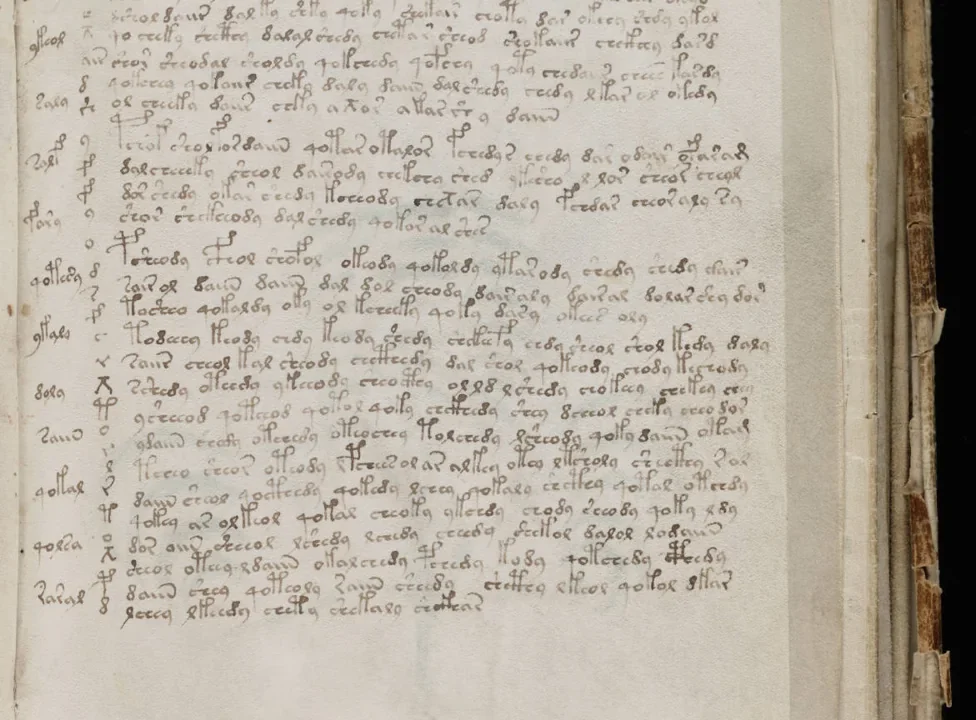
The book looks as though it wants to be read. Lines flow across the pages, labels gather beside drawings, and large plants spread roots and leaves into the margins.
Then the reader reaches the text, and the door closes. The Voynich manuscript mystery begins with a physical object whose writing still lacks a widely accepted decipherment.
That is not the same as a book with no evidence. Its parchment, pigments, drawings, page layout, and ownership history offer real clues. The difficult task is keeping those clues separate from the confident translations that appear, attract attention, and fail to convince other researchers.
What is securely known about the book?
The manuscript is held at Yale's Beinecke Library and is known as MS 408. Its parchment has been radiocarbon dated to the early fifteenth century. It contains an unknown script and varied illustrations. Dating the writing material is important evidence, but it does not directly identify the author or read the text.
A manuscript is more than its words. The material can reveal how pages were prepared, how a book was assembled, and what happened as it moved between owners.
Parchment comes from animal skin. Preparing it required labor, so a substantial book represents an investment even when its purpose remains unclear.
The early date of the parchment constrains some theories. It makes certain modern origin stories harder to sustain unless they explain how old material was used.
Yet a date range is not a name. It cannot prove who held the pen or what language the writer intended to record.
The library's digital images make the pages available to a much wider audience. That access improves opportunities for study while also making speculative pattern matching easier.
The result is a case in which solid physical evidence and uncertain interpretation coexist. A good explanation should begin with that balance, rather than imply the book is either completely understood or beyond all rational investigation.
Plants, bathing figures, and folded worlds
The illustrations include plant-like forms, circular diagrams, bathing figures, and other complex designs. Researchers use these visual groups to discuss possible sections of the book. The drawings suggest themes, but they are not readable captions. Familiar-looking imagery cannot establish a precise medical, botanical, or astronomical meaning without a reliable interpretation of the text.
A plant drawing seems to offer an easy starting point. Identify the species, and perhaps its name will unlock the label beside it.
The difficulty is that some drawings do not fit straightforward modern identifications. They may be stylized, composite, damaged, or based on conventions we do not fully understand.
The same problem applies to human figures and circular designs. A scene may resemble a bath or a chart without telling us exactly how its creator understood it.
Foldout pages add another practical clue. They show that the maker needed more space for certain arrangements than an ordinary page supplied.
Those design choices can help define the problem even when they do not solve it. A book organized around different visual forms may have served a structured purpose.
The careful step is to say what a page contains before saying what it teaches. That leaves the pictures available as evidence rather than turning them into proof of whichever theory first made them seem familiar.
Why patterns do not automatically mean language
The script shows repeated forms and statistical patterns that researchers have studied in several ways. Such patterns can be relevant to language, encoding, or a constructed system. They are not enough by themselves to establish a translation. A theory must explain how the patterns map to consistent words and meanings across the manuscript.
Human readers are good at noticing repetition. A cluster of marks appears twice, and it is tempting to imagine a repeated name or instruction.
The temptation grows when the page contains a drawing that seems to support a particular subject. The text and picture can appear to confirm one another even when both interpretations began as guesses.
A genuine method needs to handle material beyond its starting example. It should not change its rules whenever a difficult passage appears.
Researchers can compare frequencies, neighboring signs, and the structure of lines. These methods may narrow the field without yielding ordinary words.
A structured nonsense system could also display patterns. Conversely, an unfamiliar writing system might make a real language look unusual to modern analysis.
The central question is therefore not whether patterns exist. It is which explanation best accounts for them and survives repeated testing. Pattern recognition starts the investigation, but translation requires a much larger and more demanding chain of evidence.
The ownership trail and its limits
The book takes its modern name from dealer Wilfrid Voynich, who acquired it in 1912. Earlier ownership evidence and correspondence connect it with people studying or collecting unusual manuscripts. These records illuminate its later history. Claims about much earlier owners or authors should be distinguished from direct signatures and securely supported documentation.
An ownership trail can tell you where an object traveled without telling you why it was first created. Those are different histories.
A letter describing a puzzling book may establish that people were already trying to understand it. It may also repeat a belief about its author rather than provide proof of authorship.
Collectors can add stories to objects. A famous name makes a manuscript more appealing, and an attribution can persist long after its evidential basis becomes doubtful.
This is why researchers separate direct marks, dated records, later recollection, and speculation. Each can be informative without carrying the same weight.
Voynich's role belongs to the modern recovery and promotion of the manuscript. It does not imply he wrote it.
The ownership history also explains part of the fascination. People in different centuries have faced a similar experience: a book with the appearance of meaning, and no easy route into it. The repeated attempts are part of the story, even when they did not produce a solution.
How a claimed solution should be tested
A proposed decipherment should state clear rules and apply them consistently to substantial unseen material. It should explain the script, the language, and the relationship between text and layout. Independent researchers must be able to assess it. A few plausible words, chosen after looking at the pictures, do not meet that standard.
A theory can appear convincing when it selects the examples that fit. This is especially easy in a manuscript with many repeated shapes and unusual drawings.
A stronger test holds back pages. The method is developed on one group and then asked to interpret another without changing its basic rules.
The output should make sense as language, not merely as a list of words loosely related to the illustration. Grammar and repeated meanings matter.
The claimed solution must also explain inconvenient patterns. If a sign changes function whenever the reading becomes awkward, the system may be too flexible to test.
Computer tools can assist with comparison and statistics. Their speed does not make the underlying assumptions correct.
A dramatic announcement therefore needs a quiet follow-up: can other researchers reproduce the result? Until that step succeeds, a proposed reading remains a proposal. The standard is demanding because the book offers so many ways to discover a persuasive pattern that may not be real.
An open question, not a blank check
The absence of an accepted translation leaves genuine questions about the manuscript's purpose and system. It does not support every imaginable origin equally. Physical study and documented history still constrain the possibilities. The most useful research adds a testable clue while preserving the distinction between a suggestive idea and a demonstrated reading.
Unknown does not mean unconstrained. A physical book has materials, techniques, and a history that a theory must explain.
An alien origin or a supernatural message adds extraordinary claims without removing the ordinary questions. Who prepared the pages, how were the marks made, and why does the layout have its particular form?
A mundane explanation can also be too confident. Declaring the text meaningless requires evidence, not simply frustration with failed translations.
The better position is patient. Study the writing, study the object, and ask what a new result rules out as well as what it suggests.
The manuscript remains visually rich even without a final answer. Its roots, circles, figures, and lines show that someone organized a demanding work.
We do not need to pretend to hear that person's voice. The honest fascination is that a voice may be present in the record, and the key needed to understand it has not yet earned broad acceptance.
Frequently Asked Questions
Has the Voynich manuscript been definitively translated?
There is no widely accepted complete decipherment. Many proposed solutions have failed to establish consistent readings that independent researchers accept.
Does radiocarbon dating identify its author?
No. It dates sampled parchment within a range. Authorship and the timing of the writing require other forms of evidence.
Can the drawings identify the language?
They may suggest themes and comparisons, but they do not establish a language by themselves. A proposed reading still needs consistent rules and independent testing.
.jpg)