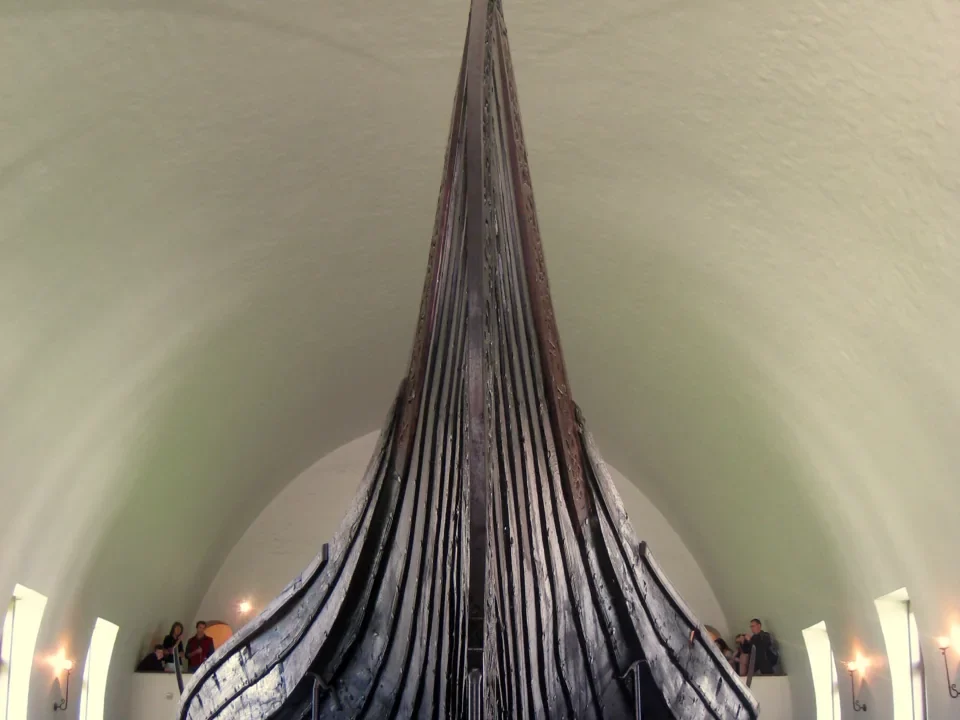

A ship beneath a grave mound carried two women, not a crew preparing to sail. Around them lay objects that included fine woodwork and textiles. The vessel had become part of a rite, and its survival gave later teams a rare view of Viking Age wealth and skill.
The Oseberg ship burial women remain hard to name with trust. The rich setting suggests value, but value is not a name or a title. A queen, a religious figure, or one more high-status woman may fit parts of the evidence without being proven.
The strongest story begins with what was found. The ship, the grave, and the objects can tell us much, even when the people at its center remain partly hidden.
A Working Ship Became a Burial Setting
The Oseberg ship was used in a funeral dated to AD 834 in what is now Norway. The grave contained two women and a rich group of objects. The vessel's form and timber preserve evidence of shipbuilding, while its placement within a mound reflects a distinct, funerary purpose.
A ship is made for movement. A grave mound holds it in place. That change in purpose is the first striking part of Oseberg.
A crafted vessel became a setting for the dead and for the choices made by those who buried them.
The ship was built before the funeral. That matters because the date of a grave is not always the date of each object within it. A vessel can have a life before it enters the ground, carrying signs of use and repair that belong to one more stage.
Timber gives a route to dating. Tree-ring patterns can be compared to longer sequences, helping teams place wood in time. Dendrochronology is therefore central to grasp a site where much of the evidence is wooden.
The ship has a clinker-built hull, with planks overlapping along their edges. The method creates a structure from many joined parts rather than one enormous carved block. Its success depends on how timber, fastenings, and shape work together.
Fine carving adds one more layer. Design on a vessel demands skill. But it also communicates value and display.
The ship shows both building and choices about look. Neither needs to be reduced to a simple label like useful or ceremonial.
The Oseberg find is often used to illustrate the Viking Age as a whole. It should also be kept specific. A rich grave is a rare setting, selected by supplies and choices about the funeral.
It does not show that each household owned a similar ship or group.
Beginning with those distinctions lets the vessel keep its full interest. It was a built object with a history, then a grave setting, then an ancient find. Each stage left a distinct kind of evidence.
Two Women, With Names Still Beyond Reach
The grave contained the remains of two women, but their identities are not securely known. The rich goods indicate a high-status grave context. Planned royal or religious roles remain readings; the link between the women cannot be settled simply by assuming one was a ruler and the other a servant.
Human remains can reveal age estimates and aspects of health. But they do not carry a written biography. Names need a distinct kind of link.
Without a sound inscription or one more secure link, a famous past name remains a plan.
That is why claims that one woman was a specific queen need a clear label. A name from later tradition may fit an interesting story. It does not become shown because the grave is rich or because a reader would prefer a named heroine.
Related Reading

The second woman deserves the same care. It is common to call her a servant or a companion sacrificed for the grave. Such claims concern social link and the circumstances of death.
They need evidence beyond the fact that two women shared the grave.
We can say something useful without deciding their rank. The people who arranged the grave invested heavily in the setting. The ship and goods show that the event mattered to a community with access to skilled work and supplies.
That investment does not tell us whose status each object stood for. Some goods may reflect the dead, some the people arranging the grave, and some wider ideas about a fitting rite. A funeral is a social act, not a sealed inventory of personal ownership.
The doubt also opens a useful question about Viking women. Their roles should be studied from mixed evidence, rather than small by a modern assumption that a ship must mean a male warrior. Oseberg itself makes that assumption hard to sustain.
The women remain central even without names. The unknown parts are not empty space to fill with a dramatic pair of titles. They are limits that keep the account faithful to the people whose lives we are trying to recover.
Wood and Textiles Preserve More Than Treasure
Oseberg's finds include finely worked wooden objects and fragile textiles. They reveal technical skill, artistic choices, and supplies beyond the ship itself. Some images invite reading of belief and ceremony; their precise meanings remain debated, most of all where the remaining matter is fragmentary or lacks a period account.
Gold is not the only matter that can show wealth. A complex wooden object may need good timber, skilled tools, time, and careful labor. Fine textile work also carries cost, even when the finished piece seems light and quiet.
The grave's wooden objects include forms linked with transport and display. Their design draws attention to makers who seen both structure and surface. A carved edge can be beautiful while remaining part of an object with a useful shape.
Textile fragments present a distinct challenge. A pattern may survive in pieces, and the original whole may have to be modeled carefully. What looks clear in a modern drawing may include choices made to connect incomplete evidence.
The Oseberg tapestries have prompted discussion of processions, belief, and ritual imagery. Those discussions are valuable when they mark where record ends and reading begins. A easy to recognize figure does not automatically explain the entire event depicted.
Later written traditions can help frame questions. But they were not made at the same moment as each remaining object. Matching a textile scene to a saga needs attention to the gap in time and to the distinct purpose of each source.
The objects also preserve labor. A grave summary can list goods so quickly that the work disappears. Weaving, carving, joining, and finishing each need knowledge.
The people who supplied that knowledge may be less famous than the grave, but their skill is present throughout it.
This is one reason the group matters beyond a search for the women’s names. It shows how a community could gather materials and work into a rite setting. The ship was the largest object.
But it was not the only one carrying past value.
Keeping Ancient Wood Alive for Modern Study
Dig changed the conditions around Oseberg's wooden finds. Conserving waterlogged ancient wood presents long-term challenges, and earlier treatments can affect later survival. Teams therefore study the objects' modern condition as well as their ancient history; a restored ship is not an untouched view of the original grave.
Wood can survive in the ground under conditions very distinct from a museum room. Once excavated, it may lose water, shrink, crack, or change as the surrounding setting changes. Recovering a find is the start of one more hard task, not the end of its survival story.
Care methods reflect the knowledge and materials available at the time. A treatment that seemed useful decades ago may later reveal weaknesses. That does not mean the original workers were careless.
It means a fragile object can outlast one generation's best solution.
The Oseberg group has helped drive research into ancient wood conservation. Its value creates a strong reason to grasp deterioration and improve care. The work links historians, dig teams, conservators, and matter experts around the same objects.
A modern display may therefore show both ancient structure and later support. Captions and museum records help viewers grasp that combination. Calling the whole thing perfectly preserved can hide the labor needed to keep it stable.
The same principle applies to an image of the ship. It can show the restored vessel's form. But it cannot display each stage of dig or repair.
A past dig image answers a distinct question from a museum image.
Oseberg's mystery is strongest when it remains specific. The women’s identities are uncertain. The grave date, the ship, and much of the physical evidence are clearer.
A good account does not make each part mysterious simply because one part lacks a name.
The vessel that once moved through water now carries questions through time. Its wood and textiles still reward careful study, while the two women at the center remind us that even a rich grave can preserve a world more plainly than it preserves the story of one life.
Frequently Asked Questions
These questions distinguish rich status from a confirmed identity and an ancient vessel from its later use in a grave and its museum life. The answers keep the unknown women at the center without inventing titles. They also show why care records are key evidence for understanding what survives today.
Were the Oseberg Women Definitely Queens?
No identity or royal title is securely shown for them. The grave was rich, but a high-status setting alone cannot name the people within it.
Was the Ship Built in the Same Year as the Burial?
The ship had an earlier history before it was used for the funeral dated to AD 834. Dating the grave and dating the vessel are linked but separate tasks.
Is the Displayed Ship Completely Unchanged?
No. Dig, care, and restoration form part of its modern history. Museum images show a preserved and supported artifact, rather than an untouched grave scene.