


A fragment of thigh bone can carry a question seven million years old: did this animal walk upright? The bone cannot answer in words, and much of the skeleton is missing. Teams must read shape, structure, and comparison instead.
Sahelanthropus walking evidence has been debated for years. A 2026 study revisits the case for bipedalism in Sahelanthropus tchadensis, an early possible member of the human lineage known from fossils in Chad.
The stakes are large. But the clues are small. A result about walking must fit partial body structure, the fossils' link, and the range of movement seen in living animals.
Imagine turning a cast under a desk light. A ridge or curve becomes clearer. But it does not turn into a footprint.
The task is to infer movement from body structure while keeping the missing parts of the story clear.
What Bipedalism Means Here
Bipedalism means movement on two legs. But it can explain distinct degrees of reliance on upright walking. The Sahelanthropus debate concerns whether the fossils support such movement in an early possible hominin.
It does not imply a modern human stride or rule out large climbing and other forms of movement.
The well-known image of human evolution often shows a row of figures becoming steadily more upright. That picture is simple. But it hides how traits can change at distinct rates.
An animal can climb well and also use two-legged movement. Walking and climbing are not always mutually exclusive traits in an early long-term setting.
Human evolution therefore needs more exact questions. Was upright walking regular? What other movements stayed key?
Which body features support those accounts?
Bipedalism is also not unique to humans in the broadest sense. Other animals can move on two legs. The hominin question concerns a given body and long-term setting.
The term hominin refers to the human branch after its separation from the lineage leading to living chimpanzees. Placing a very early fossil on that branch can be hard.
Sahelanthropus is often discussed as an early possible hominin. The word possible reflects the test of reading a small set of ancient remains.
Its age makes the question key. If the walking account is backed, it can inform ideas about very early movement in the lineage.
It would not tell us everything about the animal's life. Diet, behavior, social setting, and habitat each need clues of their own.
A useful account begins with that narrow question about movement. The broader story of human origins becomes more reliable when each trait is assessed instead of assumed from one dramatic label.
Why a Femur Can Preserve Movement Clues
A femur is a thigh bone shaped by growth and movement. Its form can offer clues to how forces passed through the leg. Teams compare it with other bones.
A fragment is useful, but missing joints limit the gait that can be rebuilt from it.
Bone is living tissue during an animal's life. Its form reflects growth, inheritance, and mechanical use. That makes fossil anatomy useful.
Related Reading
But not a simple recording of each step.
The femur connects the hip and knee. A full bone offers several regions for comparison. A shaft fragment keeps only some of those features.
The missing parts matter because distinct traits can carry distinct facts. A shaft's shape cannot supply each detail that a hip or knee joint would show.
Teams compare fossils with living apes, humans, and other useful fossils. The comparison asks where the ancient bone fits and which accounts are plausible.
Locomotion evidence often comes from a mix of traits. One feature may overlap between groups, while a pattern across several features is more useful.
The 2026 study reexamines support for upright movement. Earlier work and critiques reached distinct views. So the debate should not be presented as though no doubt ever existed.
Statistical methods can help quantify shape differences. Their usefulness depends on the shared sample and on how well the fossil keeps the measured regions.
A model can also be sensitive to rebuilt model. If a missing or damaged feature must be estimated, that assumption belongs in the proposed account.
The femur is therefore a clue-rich object with clear limits. It can support an argument about how forces passed through a limb. But it cannot alone deliver a full scene of the animal walking across its landscape.
Try to picture the missing joint at each end of the shaft. Those gaps are not blank parts that a drawing can fill with certainty. They are limits on what the bone can show, even when its surviving surface is clear.
The Skull and Arm Bones Add Different Questions
The skull and limb remains offer separate clues about posture and movement. Teams assess them together, while also considering whether partial bones belong to the same species. Clues for climbing does not always refute some upright walking, and a skull's tilt cannot replace a full study of the legs.
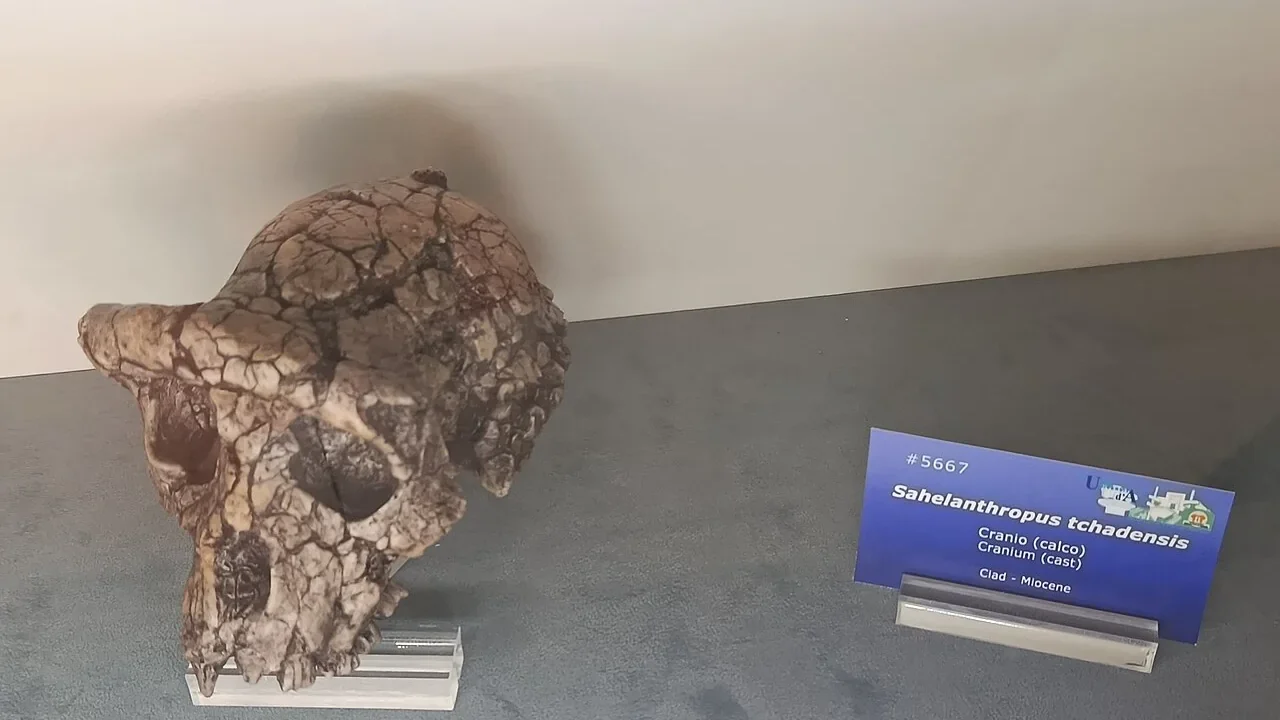
The famous Sahelanthropus cranium helped begin the debate. Its rebuilt model and the position of the opening for the spinal cord have been used in arguments about head posture.
Head posture is related to the body. But it is not a full gait measure. A skull cannot supply the mechanics of each limb joint.
Arm bones raise other questions. Their form may support climbing or other upper-limb use. Those actions could coexist with some two-legged movement on the ground.
The proposed account must also address link. Fossils from the same locality are not always parts of one personal. Teams need to assess the case for assigning remains to a species.
Chad fossils are notably valuable because they broaden the geographic picture of early possible hominins. They also remind us that the known fossil record is a sample, shaped by where remains survived and were found.
A gap in the record is not proof that an animal was absent from a region. Nor does one locality show the full range of a species.
The bones therefore give several partial views. The skull may inform posture, the arms may inform climbing, and the femur may inform lower-limb loading.
A strong account makes those views fit without demanding that each trait look modern. Evolution can make a mosaic of features instead of a neatly staged transition.
That is a more striking picture than a single march toward humanity. It leaves room for early animals that joined movements in ways no living species exactly repeats.
Why Scientific Disagreement Is Part of the Story
Disagreement over Sahelanthropus reflects the difficulty of inferring behavior from partial ancient remains. New analyses can strengthen or test accounts by testing features and comparisons. The debate should be reported as an clues-based question, not as proof that all results are as likely or that one study ends each doubt.
A critique can be useful when it identifies a given weakness: a comparison, an assumption, or a feature that may have more than one meaning. That gives later work something to test.
Simply saying teams disagree is less helpful. It leaves readers unable to judge what the disagreement concerns or which clues each side uses.
The 2026 paper adds a new study to a longer debate. It should be read alongside the earlier accounts it addresses, not only through a headline about the first walker.
No fossil establishes a direct ancestor just by being old. An animal may be close to the useful branch without being the ancestor of each later species.
The same caution applies to the phrase missing link. Evolution is a branching history, and one fossil often informs links instead of closing a single empty slot.
The cast shown with this article is also a model of a skull, not the femur being studied. Its caption needs to make that role clear.
Future clues might include more full remains or better shared study. Such work could narrow the doubt without changing the importance of the current fossils.
For now, the honest story is both remarkable and careful. Very old bones may support upright movement near the roots of the human lineage. But the route from body structure to behavior remains an argument to examine.
A small fragment can change a large question. Its power comes not from the story we want it to tell. But from the features it keeps and the tests those features can withstand.
Frequently Asked Questions
These questions distinguish early bipedalism from a modern gait and show why climbing and walking can coexist. They also clarify the image's role. The answers keep the discussion focused on body clues while avoiding claims that one fragment reconstructs each movement or identifies a direct ancestor with full certainty.
Does Sahelanthropus Have a Confirmed Modern Human Gait?
No. The debate concerns clues for early two-legged movement. It does not show an identical gait to that of living humans.
Does Evidence of Climbing Rule Out Upright Walking?
Not always. An animal can join climbing with some two-legged movement. The degree and mechanics of each behavior need body clues.
Is the Skull Cast a Photo of the Studied Femur?
No. It is a labeled cast of the cranium used for species setting. The thigh-bone clues are discussed on their own.
_-_Chieti_Museum_of_Biomedical_Sciences.jpg)