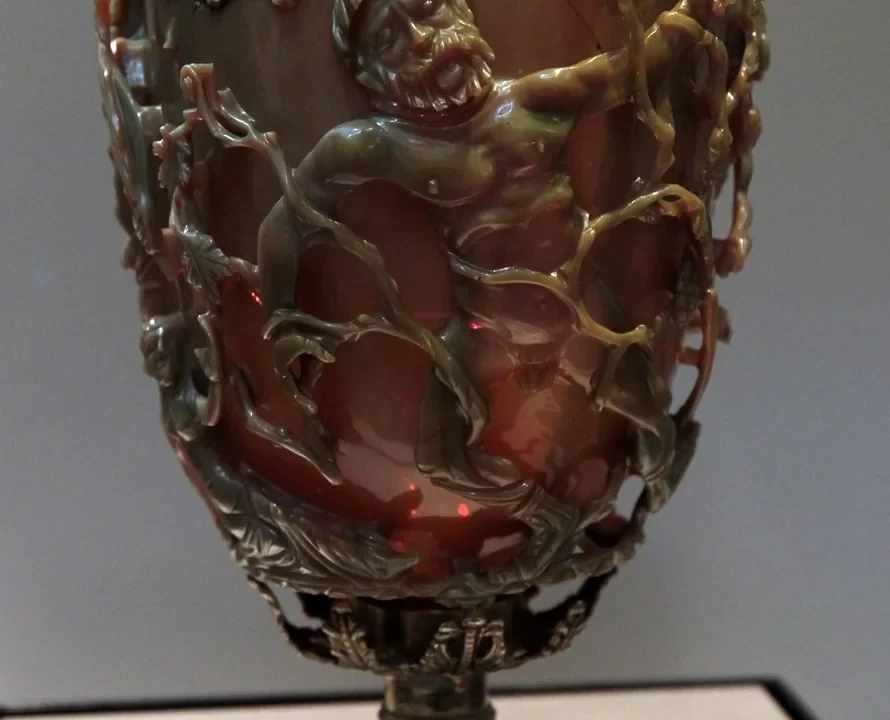

Move the light, and an ancient cup seems to change its mind. Seen with light reflected from its surface, the Lycurgus Cup looks green. With light passing through it, the glass can glow red.
The object stays the same while the view changes.
The Lycurgus cup color change is sometimes called Roman nanotechnology. That label sounds modern, but the effect is real. Tiny bits within the glass help make its rare behavior.
The cup also carries a carved story about a king caught in vines. Science and myth share the same vessel. To grasp it, we need to separate what the glass does, what the image depicts, and what we can know about the people who made it.
One Cup, Two Ways of Seeing Light
The Lycurgus Cup is a fourth-century Roman glass vessel. It seems green in reflected light and red in transmitted light. This behavior is called dichroism; the color depends on the path light takes through the matter, rather than a chemical transformation happening each time someone moves a lamp.
Reflected light reaches the eye after interacting with the surface and matter. Transmitted light passes through the glass before it reaches the eye. Those are distinct views of the same object.
So they need not make the same seen color.
The effect is easy to mistake for a coating or a trick. Yet the rare behavior belongs to the glass. The cup is not painted green on one side and red on the other to create a simple illusion.
Glass is often imagined as a neutral clear matter. In practice, its ingredients and small structures affect how it handles light. A window, a colored bottle, and an optical filter may all be glass while making very distinct views.
The British Museum identifies the cup as late Roman and dates it to the fourth century. It is a small vessel, not a vast piece of machinery. Its science interest comes from how finely the matter's properties operate within that small form.
The word dichroic means that the matter presents distinct colors under distinct viewing conditions. It does not mean the cup senses a viewer or changes in response to a mood. The light and the matter are enough to explain the shift.
This is a useful first lesson in reading a science image. An image needs a lighting caption. Without one, two accurate pictures of the same cup can appear to contradict each other.
The missing detail is how each image was made.
Once that detail is restored, the apparent mystery becomes a clear question about light. What in the glass changes which wavelengths reach the eye from each direction? That question leads from the whole vessel to structures far too small to see unaided.
Tiny Metal Particles Make a Large Difference
Research links the cup's optical behavior to very small bits containing gold and silver within the glass. Their scale matters because small metal bits interact with light differently from a solid piece of metal. Modern analysis can explain the effect without proving that Roman makers seen it in modern terms.
A gold ring and a tiny gold-containing particle in glass do not handle light in the same way. Size changes the interaction. At very small scales, a matter can have useful optical properties that are not obvious from the bulk metal.
Nanoparticles are bits measured on a scale far smaller tha normal grains of sand. The term describes size. It does not imply a computer chip, an electronic circuit, or a modern factory.
Natural processes and older crafts can create small structures too.
Related Reading
That is why the phrase Roman nanotechnology needs a careful account. It can draw attention to the striking scale of the bits. It can also mislead if readers assume the makers had modern instruments or the same theory of how it works.
Science analysis studies what is present now. It can identify elements, examine structure, and link those findings with optical behavior. It cannot automatically tell us each step the first glassmaker took or each idea that person held.
The bits are not simply loose glitter trapped in clear glass. Their small scale and distribution help create the effect across the matter. A seen fleck added for design would be a distinct kind of feature.
Making such glass may have needed useful skill with ingredients and heat. A craft worker can learn that a process works without knowing the later science account. The skill to repeat a result and the skill to explain it mathematically are linked but separate achievements.
The cup therefore lets us admire Roman glassmaking without inventing a lost lab. Its matter shows a striking effect. Modern research gives us tools to study that effect.
The past question of exactly how the makers reached it remains more hard.
The Carved Cage Tells a Myth
The cup's outer design depicts the myth of King Lycurgus, shown caught within vines. Its openwork design is a demanding form of glass carving often called a cage cup. The imagery adds a cultural story to the optical effect, though the exact intended use of this vessel remains debated.
The glass is not only rare in color. Parts of the outer design stand away from the vessel's body, creating a delicate openwork structure. The result looks like a cage around the cup.
But it is a worked part of the object rather than an unrelated basket.
Carving a thin design from glass poses risks. Remove too much and a figure can break. Leave too much and the forms lose clarity.
The object preserves skill in shaping, not just skill in mixing the matter.
The figures belong to a myth involving Lycurgus and Dionysus. Vines bind the king within the scene. The design gives the viewer something to read while the glass gives the eye a changing color.
It is tempting to assign one exact ritual use to such a striking vessel. A link with wine or Dionysian imagery seems meaningful, but imagery alone does not settle who used the cup or on which occasion. An object can carry a myth without serving only one ceremony.
The British Museum describes it as a drinking cup. Scholars have also discussed how its special lighting effect might have been displayed. That range of discussion should not be hidden behind a firm invented banquet scene.
Later metal fittings are one more reminder that an old object has more than one stage of life. The glass and each part seen around it need not have been made together. Museums record substances, condition, and alterations because those details help separate the stages.
The carved king gives the vessel its name. But he is not the answer to the color. Myth explains the design's story.
Optical science explains the changing view. Holding both accounts side by side makes the cup richer than either one alone.
What the Cup Proves, and What It Leaves Open
The Lycurgus Cup proves that Roman glass workers made a vessel with striking optical and carved features. It does not show a modern theory of nanoparticles in antiquity. The object invites study of substances, craft, and later collecting, while some details of manufacture and first use remain uncertain.
A remaining masterpiece can make an entire era seem more advanced than the evidence supports. One extraordinary cup is not a census of Roman glass. It tells us that this result existed, not how often it was achieved or how widely its recipe was known.
The same limit applies to skill. We can see the success in the object. Failed attempts are much less likely to be collected and admired.
Useful knowledge may have involved trial, selection, and loss that the finished cup cannot show.
The museum's record also places the vessel within a later history of ownership, exhibition, study, and conservation. Its ancient life is only one part of the story. Collectors and teams changed how the object was framed and what questions people asked of it.
For modern readers, the safest excitement lies in the evidence itself. A tiny metal structure changes seen light. A carved glass cage survives.
A myth wraps around a vessel whose look depends on illumination. None of those facts needs an invented secret civilization to feel striking.
An image can help explain the effect if the caption states the lighting. A green view alone does not display both colors. A red view alone does not show the whole behavior.
Two views make the contrast clearer than a vague claim that the cup changes color.
The lesson travels beyond antiquity. Substances can carry properties that remain hidden until the right test is applied. A well-known-looking object may ask an unfamiliar science question, and a careful measure can reveal more than a dramatic guess.
Imagine the lamp moving once more. The king stays trapped in the carved vines. The glass stays in the same place.
Only the path of light changes, and a small Roman cup gives the eye a distinct world.
Frequently Asked Questions
These answers separate the cup's seen behavior from claims about ancient science theory and from its mythological scene. They also show why lighting details belong in captions. The vessel is striking as evidence of matter skill, even where its first making and use remain partly uncertain.
Does the Lycurgus Cup Physically Turn From Green to Red?
The viewing effect changes with the lighting arrangement. Reflected and transmitted light reveal distinct colors, rather than the cup changing its composition.
Did Romans Know the Modern Science of Nanoparticles?
The cup does not prove that. It shows a successful result in glass, while the makers' theory of how it works and exact process remain separate past questions.
What Does the Carved Scene Show?
It depicts the myth of King Lycurgus caught in vines. The myth explains the subject of the design, not the chemical cause of the color effect.