

A broken stone turned a wall of ancient signs into a language people could study again. Its message was not a lost spell or a secret history. It was a royal decree.
That ordinary purpose made Rosetta Stone decipherment extraordinary. The same decree appeared in three scripts, including Greek, which scholars could read.
The stone did not solve the problem overnight. It provided a bridge, and researchers still had to work out how to cross it. Their progress changed the way Egyptian objects could speak to modern readers, from the names of kings to the words of people whose lives left far quieter traces.
Why three scripts mattered
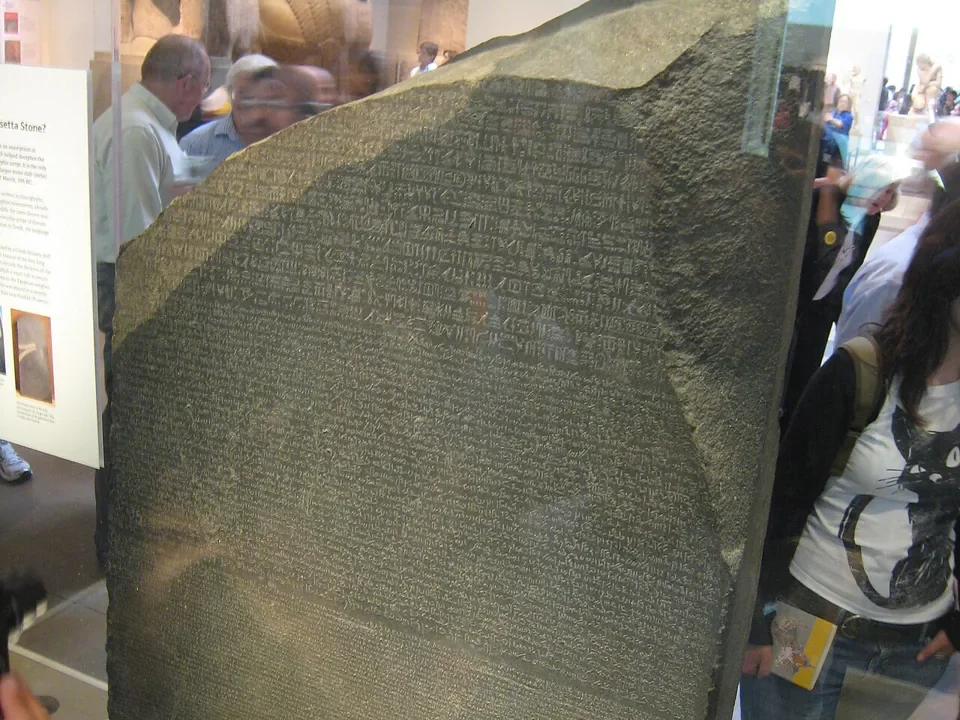
The Rosetta Stone presents a decree in Egyptian hieroglyphs, Demotic, and ancient Greek. Greek offered a readable comparison for the Egyptian passages. The scripts are not three separate languages: hieroglyphs and Demotic record Egyptian. The comparison helped scholars test how signs conveyed names, sounds, and meaning.
A text in an unknown script poses several problems at once. You may not know where words begin, which language they represent, or whether a sign stands for a sound or an idea.
A readable parallel reduces some of that uncertainty. If the known text mentions a royal name repeatedly, the unknown passage may contain repeated groups corresponding to it.
Yet parallel texts are not always perfectly identical. Differences in wording, damage, and layout can complicate the comparison. A patient reader must follow the actual evidence rather than assume one sign equals one Greek word.
Demotic added another route into the problem. It was a different Egyptian script, used for purposes distinct from monumental hieroglyphs.
The stone's value lay in these relationships. It gave researchers something to compare, not a printed key explaining the entire writing system.
That is why the discovery mattered so much and still required years of work. A bridge is useful only when you understand where its supports stand.
A decree made for an ancient audience
The inscription concerns Ptolemy V and dates to 196 BCE. It reflects a political and religious arrangement in Ptolemaic Egypt, where Greek administration and Egyptian traditions coexisted. Its different scripts addressed different reading communities. The stone's modern fame should not hide the practical purpose it served in its own time.
The text belonged to a world in which rulers needed recognition, institutions needed privileges, and public messages could reinforce a relationship between them.
The decree praises the king and sets out honors. Its language tells us that written monuments were tools of authority, not simply containers for timeless wisdom.
A multilingual setting made multiple scripts useful. A priest working within Egyptian traditions and an official trained in Greek did not necessarily read the same form of writing.
Putting a message into several scripts helped it move across those boundaries. The decision later created an unexpected opportunity for people separated from that society by many centuries.
The surviving piece is only a fragment. Its broken outline matters because missing portions limit what can be read directly from it.
Even a fragment can carry a powerful relationship between texts. The stone's usefulness came from what survived together, while its losses remind us that archaeology rarely hands over a complete object with every question answered.
How the stone entered a modern race
French soldiers found the stone near Rashid, also known as Rosetta, in 1799 during Napoleon's Egyptian campaign. After the French defeat, it passed into British custody and reached the British Museum. Copies helped researchers study the text beyond one location, making decipherment a wider scholarly effort.
Its recovery belonged to a military campaign, not a peaceful laboratory search. The setting is important because the object's movement cannot be separated from the power relations around it.
The text attracted attention because the readable Greek suggested a way to understand the other passages. Scholars could work from reproductions rather than all standing before the original.
Copies expanded access, but they also introduced practical concerns. A damaged sign or an imperfect reproduction can lead a reader toward the wrong pattern.
Researchers therefore needed to compare observations and return to details. An exciting guess had to fit more than a single group of marks.
The object also gained a life outside scholarship. Its public display made it an emblem of ancient Egypt and of the institutions that held Egyptian material.
That later fame can blur the earlier story. The stone was an ancient decree, a reused fragment, a wartime discovery, and a modern museum object in succession. Each stage left questions that deciphering the text alone could not settle.
Names opened a door, but sounds opened the language
Thomas Young made important progress identifying phonetic signs in royal names. Jean-Francois Champollion went further by recognizing the broader role of sound in Egyptian hieroglyphs, aided by his knowledge of Coptic. The breakthrough involved a mixed writing system, rather than replacing every picture with one simple alphabetic letter.
A royal name is a useful test case because it may recur in a recognizable setting. Researchers could compare repeated sign groups with names in the known text.
But finding a name does not automatically unlock the grammar around it. The bigger challenge was deciding whether sound-based writing extended beyond foreign royal names.
Champollion's work helped establish that it did. Coptic, a later stage of the Egyptian language written largely with Greek letters, offered valuable linguistic connections.
The result was not a tidy alphabet with one function for every sign. Egyptian writing could combine sound signs, signs representing words, and signs clarifying categories of meaning.
A modern reader who expects a simple substitution code can therefore misunderstand the achievement. Decipherment required learning how the system worked, not merely discovering which letter matched which bird.
The scientific strength of the method came from testing readings against more texts. A proposal that could read only its favorite example was far weaker than one that opened new inscriptions.
Why the breakthrough changed more than royal history
Once researchers understood Egyptian writing better, they could study a much wider range of texts. Monumental inscriptions, religious works, administrative records, and personal material became more accessible. Decipherment did not eliminate interpretation, but it allowed archaeology to connect objects and places with words from the society that produced them.
Before a script is readable, an object may offer shape, material, and imagery while keeping its written meaning closed. Reading can add a name, a function, a date, or a particular concern.
Those additions can transform a display case. A vessel may become linked with a person, and a carved scene may reveal a message rather than only a visual style.
The language also opens quieter forms of history. Records of work, property, family, and administration help historians move beyond the lives of rulers.
This does not mean every surviving text tells an unfiltered truth. Official praise can exaggerate, and personal documents still require context.
Reading creates new evidence; it does not remove the need to assess evidence. Historians must ask who wrote a text, whom it addressed, and what it tried to achieve.
That is the real payoff of the stone. It did not give modern readers one final story about Egypt. It gave them the tools to ask better questions of many different Egyptian voices.
How to recognize a genuine decipherment
A convincing decipherment should explain patterns consistently and work on material beyond the original example. It should account for language, grammar, and signs without constant special exceptions. The Rosetta Stone illustrates why a readable parallel is valuable, while reminding us that a striking resemblance is not enough to translate an unknown text.
Imagine a claimed solution that finds three familiar names in a strange manuscript. It may sound impressive, especially if the names suit a popular theory.
Now ask what the method does with the rest of the page. If every difficult sign needs a new rule, the apparent success may be a coincidence.
The same caution applies to drawings. A plant illustration may suggest a topic, but it does not establish the sound or meaning of the text beside it.
The Rosetta Stone offered a special advantage because a known text constrained the investigation. Even then, the strongest progress came from expanding the test beyond one object.
Its story is useful when considering other undeciphered writing, including the Voynich manuscript mystery. Similarity can begin a question, but a reliable method must do the harder work.
The broken decree remains compelling because the breakthrough was earned. Signs became readable through comparison, language knowledge, and repeated testing. The stone supplied the opportunity; disciplined work supplied the explanation.
Frequently Asked Questions
Are there three languages on the Rosetta Stone?
There are three scripts but two languages. Hieroglyphs and Demotic record Egyptian, while the third text is Greek.
Did Champollion work without earlier help?
No. Earlier scholars, including Thomas Young, made important advances. Champollion’s achievement belongs to a longer history of attempts, comparisons, and language study.
Did the stone make every Egyptian text easy to read?
No. Decipherment opened the writing system, but damage, unfamiliar wording, and historical context can still make individual texts difficult. Translation and interpretation remain scholarly tasks.