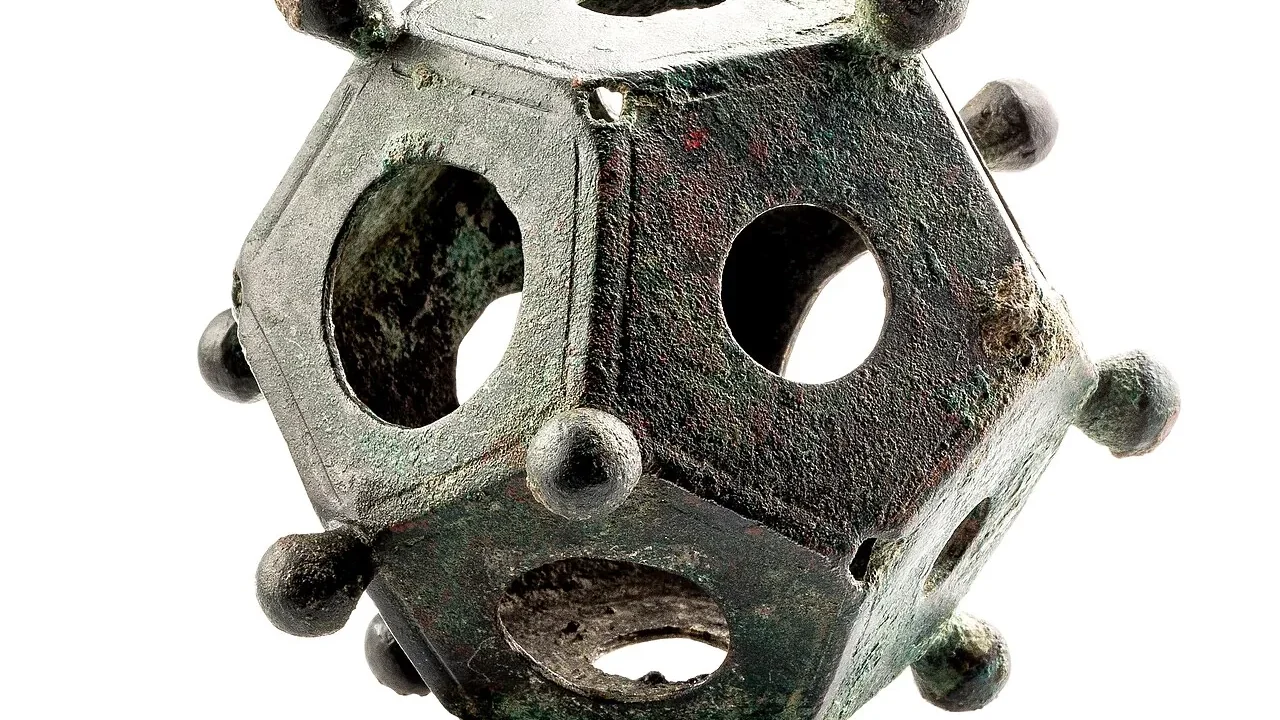
A small bronze object has twelve faces, round holes, and knobs at its corners. It looks deliberate, skilled, and useful. The problem is that usefulness has become a guessing game.
The Roman dodecahedron purpose remains uncertain despite a growing collection of finds and a long list of proposed functions. Some explanations sound practical. Others depend on ritual, status, or measurement.
The object rewards a different kind of curiosity from a hidden-code story. There is no need to invent a secret message. The mystery lies in an everyday fact: people once understood what to do with something, and their explanation did not survive with it.
What makes these objects distinctive?
Roman dodecahedra are generally hollow, twelve-sided metal objects with circular openings and projecting corner knobs. Many are bronze, and examples differ in size and hole arrangement. They are associated chiefly with parts of the northwestern Roman world. Their deliberate construction is clear, while the intended function remains unresolved.
The geometry invites handling. A face offers a hole to look through, and the corner knobs seem to provide contact points. Those features encourage people to invent tasks the object might perform.
Variation makes the problem harder. If a device were a standard measuring tool, researchers would want to understand how its different dimensions related to a consistent system.
The material also matters. Bronze work required skill and resources, so the objects were not casual scraps shaped without thought.
But expense does not prove a religious function, just as a geometric form does not prove a scientific one. Both claims need additional evidence.
The distribution of finds is useful because it places the object within a particular part of the Roman world. It may point toward a regional practice rather than an empire-wide standard.
The first step is to describe the surviving family of objects accurately. A theory that fits one attractive example may fail when confronted with the differences among the others.
Why archaeological context matters more than a clever use
The location and surroundings of a find can help establish how an object was used or valued. Dodecahedra recovered with different material may support different possibilities, but old discoveries often lack detailed context. Missing excavation records limit interpretation. A visually clever demonstration cannot replace evidence of ancient use.
Suppose an object is found in a workshop beside tools and unfinished products. That setting makes a craft-related use worth investigating.
Now suppose a similar object appears in a deposit with valuables. The context raises a different question about storage, status, or the reason it was placed there.
Neither setting produces an automatic answer. Objects can move, be reused, or enter deposits long after their original function has ended.
Careful excavation helps distinguish those possibilities. Soil layers and neighboring finds preserve relationships that disappear when an object is pulled out of the ground without records.
This is one reason new finds can be valuable even when they look familiar. A well-documented example may answer more than an impressive object discovered decades ago.
The mystery therefore belongs partly to how evidence survives. The bronze remains easy to admire, while the information needed to explain it may have been lost in the moment it first returned to modern view.
The attraction of measurement theories
Some proposed functions treat the openings as part of a measuring or sighting device. Such ideas must explain hole sizes, object dimensions, operating conditions, and variation between examples. A device that can produce a measurement today is not automatically a device intended for that measurement in Roman times.
Looking through paired holes suggests a way to compare angles or distances. It is a natural idea because the object offers several possible lines of sight.
The next question is whether the results are reliable. A practical instrument must work across ordinary conditions and users, not only in a demonstration arranged to favor it.
Researchers would also want to know how someone interpreted the result. Markings, a known unit system, or related equipment could strengthen the case.
The lack of a clear scale does not make measurement impossible. It does mean the theory must explain how the user obtained useful information without one.
Variation is another test. A proposed method should account for different examples rather than quietly choose the one that works best.
A measurement hypothesis is worth examining precisely because it can be tested. The strongest version states how it should operate and what archaeological evidence we would expect if that were its historical function.
Knitting, craft, and the replica problem
Modern replicas can be used for demonstrations, including craft activities such as making finger-like forms. These experiments show possible functions, not proven original functions. A persuasive craft theory needs evidence that the relevant technique, materials, and use existed in the right historical setting, and that the object improves the task.
A clever replica video can feel like a solution because it turns an unfamiliar artifact into something that works. The viewer sees hands perform a task and understands the result.
The missing step is historical. Many objects can be repurposed in ways their makers never intended.
A bottle can hold a candle. That does not mean every ancient bottle was manufactured as a candle holder.
The same logic applies to a dodecahedron. A technique must be evaluated against evidence of the practice, the distribution of the artifacts, and the details of the surviving forms.
Experiments are still useful. They can reveal wear patterns to look for, show whether a task is practical, and identify design features that help or hinder it.
The experiment becomes misleading only when possibility is announced as proof. Keeping the distinction clear allows modern creativity to contribute to the investigation without replacing the people and practices we are trying to understand.
Could symbolism explain the shape?
Ritual or symbolic functions have also been proposed. The unusual form, material, and regional distribution can make such ideas worth considering, but unusual does not mean sacred. A symbolic explanation should connect the object with relevant imagery, practices, deposits, or texts, rather than use ritual as a label for anything without an obvious practical purpose.
Archaeologists sometimes face a false choice: an object must be either a tool or a religious symbol. Human life rarely divides so neatly.
A practical item can also carry status or meaning. A symbolic object can be handled, displayed, exchanged, and used within a routine.
The knobs and openings may therefore matter in more than one way. But a theory should specify the relationship rather than treat every feature as a mysterious symbol.
Comparisons can help if they belong to the same period and region. A resemblance to a much later object may be intriguing without carrying much evidential weight.
Written silence is frustrating, but it does not license an invented ceremony. The safest account identifies the missing evidence.
This leaves room for future discovery. A new context, representation, or associated object might strengthen one interpretation. Until then, the object's unusual appearance should keep the question open, not force it into the category that sounds most dramatic.
What would move the mystery forward?
Progress would come from well-recorded finds, systematic comparison, meaningful wear analysis, and theories that predict evidence. No single modern demonstration settles the Roman dodecahedron purpose. The goal is not to choose the most entertaining explanation, but to identify the one that best fits the complete family of objects and their historical contexts.
Start by comparing examples carefully. Hole sizes, weight, materials, casting methods, and surface wear may reveal patterns hidden by photographs.
Then connect those patterns with place and time. A regional use should make sense within the communities where the objects occur.
A proposed task can generate specific expectations. Repeated contact with thread, metal, or another material might leave traces, although preservation and later handling complicate the test.
Negative results matter too. If a theory requires markings or a standard size that the objects lack, it must explain that mismatch.
The best answer may not arrive as a spectacular revelation. It may emerge from many modest findings that gradually make one explanation more likely than the rest.
For now, the bronze object remains a lesson in lost familiarity. Its makers may have seen nothing mysterious at all. The wonder belongs to the gap between their ordinary knowledge and the carefully documented questions that survive for us.
Frequently Asked Questions
Has the purpose been conclusively identified?
No single function is widely established for the full group of objects. Several practical and symbolic explanations remain under discussion.
Does a successful knitting demonstration prove ancient use?
No. It establishes that a replica can perform that task today. Historical use requires supporting evidence about the technique and its context.
Why are new finds important if the objects look similar?
A well-recorded discovery preserves context. That information may reveal patterns of use that older, poorly documented finds cannot provide.