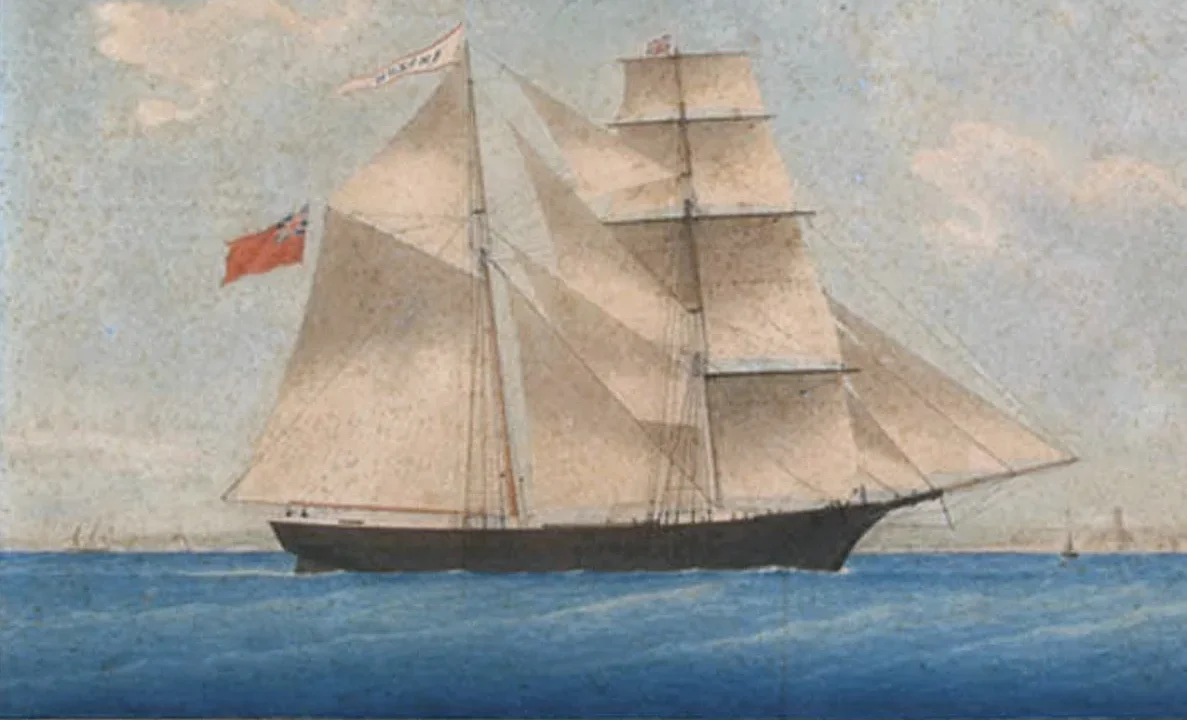


The vessel was still afloat. Its people were not aboard.
That simple contrast gave the Mary Celeste disappearance its lasting power. When the Dei Gratia encountered the brigantine in the Atlantic in December 1872, the boarding party found a ship that could still be sailed, but no captain, family, or crew to explain why it had been left.
A later reader sees the surviving ship and asks why anyone would abandon it. The people aboard had faced the opposite problem: they had to decide whether staying seemed safe. Understanding that difference does not solve the mystery, but it changes the question in a useful way.
What happened on the Atlantic voyage?
Mary Celeste sailed from New York toward Genoa with an alcohol cargo under Captain Benjamin Briggs. His wife and young daughter traveled with the crew. The ship was found deserted in December 1872, and its boat was missing. The absent people were not recovered, leaving the reason for departure uncertain.
The voyage crossed a wide stretch of water where an emergency could isolate a ship from immediate help. Routine decisions about navigation, pumps, sails, and cargo therefore carried serious weight.
The last surviving log entry places the vessel near the Azores in late November. The discovery occurred later and elsewhere, leaving an interval that must be reconstructed rather than directly observed.
The gap matters. A ship can continue drifting or sailing after people leave it, so its final position does not reveal the exact place of abandonment.
It also leaves room for changing weather and conditions. A reassuring description at one point cannot prove that nothing alarming happened afterward.
The alcohol cargo became important in later explanations, but cargo alone is not a confession. Its condition must be assessed alongside the vessel and the missing equipment.
The strongest starting point is modest: a real voyage, a real deserted ship, a missing boat, and people whose final movements remain unknown. Those facts are compelling without adding a supernatural passenger.
What the boarding party could and could not know
The people who boarded could observe the ship's condition and what remained aboard. They could not witness the missing crew's final decision. Later summaries sometimes turn those observations into a complete scene. Food, cargo, damage, water, and missing equipment are clues, but each needs a reliable source and careful interpretation.
A discovery scene contains evidence after an event. It is not a recording of the event itself.
An item might be missing because it was taken into the boat, lost earlier, or moved under another circumstance. Its absence has to be connected with other clues.
The same caution applies to water in the vessel. A measured amount at discovery may differ from what the captain believed was entering the ship at the moment of departure.
A salvage crew also has its own perspective. It needs to assess whether the ship can be managed and brought to a port. That task does not reproduce every pressure on the original crew.
Records and later retellings can blur together. A memorable detail should be checked against the earliest dependable account, especially when it makes the scene seem eerily theatrical.
The mystery becomes clearer when the evidence stays in time. What was found, what was reported, and what was later imagined are three different parts of the story.
How cargo fears could influence a decision
One group of explanations concerns the alcohol cargo and a possible fear of fumes or explosion. A perceived threat could prompt temporary evacuation even without a fire leaving obvious damage. Such scenarios are hypotheses. They must explain the surviving vessel, the decision to leave, and why the people did not return.
A captain does not need to see flames before worrying about an explosive atmosphere. If the situation appears dangerous, waiting for proof may seem like the worst choice.
That makes a fear-based explanation plausible in principle. It also makes the crew's information central to the question.
A modern demonstration can explore whether a cargo-related event might leave limited visible damage. It cannot prove that the same sequence happened on this voyage.
The difficult part is the return. If people intended to wait nearby, what separated them from the ship? Weather, equipment failure, or a lost connection must become part of the scenario.
Every extra step adds another claim to evaluate. A theory that explains the first decision but not the final absence is incomplete.
This is why the cargo hypothesis should be presented as an attempt to connect clues, not as a solved case. Its strength depends on the entire chain, rather than the appeal of one dramatic possibility.
Water, navigation, and the pressure of uncertainty
Other explanations focus on concern about flooding, faulty readings, weather, or position. A crew could misjudge a ship's condition under pressure. The surviving vessel's later seaworthiness does not prove that the original decision was irrational. It shows only that abandoning the ship did not become necessary in the way the people may have feared.
At sea, a wrong estimate can be deadly in either direction. Leaving a usable ship can expose people to greater danger, while staying in a vessel believed to be sinking may also feel intolerable.
The captain's task is to judge incomplete information. Pumps, sounds, movement, and readings contribute to that judgment, and none arrives as a neat historian's summary.
Navigation adds another layer. Believing land is near can make entering a boat seem more manageable than it would in the open ocean.
But a theory must not give the captain knowledge we cannot establish. It should explain what the evidence permits without inventing a private calculation.
The distinction between actual danger and perceived danger is essential. It offers a humane way to examine the decision while keeping the outcome in view.
We may never know exactly what Briggs believed in the final moments aboard. The surviving clues still allow researchers to compare realistic maritime scenarios instead of treating an unexplained departure as proof of an impossible event.
How a real ship became a ghost story
The case attracted fiction, rumor, and increasingly vivid retellings. Claims about untouched meals, sudden supernatural disappearance, or a perfectly staged cabin can become more memorable than the documented record. The ship's later history is also separate from the missing crew's fate. Narrative additions should not be mistaken for evidence.
A deserted ship is an unusually strong image. It gives a storyteller a setting that seems to ask for an unseen presence.
The temptation is to make the absence more dramatic. A routine missing detail becomes a sudden interruption, and an uncertain report becomes a vivid scene.
Fiction can then feed back into popular memory. Readers encounter a detail often enough that they stop asking whether it began in testimony or in a story.
This does not make the case uninteresting. The documented disappearance already involves real people, uncertainty, and a difficult decision at sea.
The ship continued its own history after the salvage. Those later events do not establish what happened to the people who left it in 1872.
Keeping the timelines apart prevents a second layer of confusion. A wreck associated with the vessel's later end cannot serve as the missing boat or explain an earlier disappearance merely because it carries the same famous name.
A mystery shaped by the limits of the record
No single explanation is established by the surviving record. Plausible scenarios generally involve a decision to leave, followed by separation from the ship and failure to reach safety. The unresolved part is the exact sequence. The case is strongest when discussed as a historical maritime investigation rather than a collection of unsupported eerie details.
A good theory must respect all the important clues at once. The boat was absent, the ship remained usable, and the people did not return to the known record.
That combination favors questions about judgment, movement, and survival. It does not remove the possibility of error in the accounts, and it does not identify one cause beyond doubt.
The human cost should remain visible. Benjamin Briggs, his family, and the crew were not characters placed aboard to create a puzzle for future readers.
Their experience belonged to the realities of nineteenth-century shipping, where a decision made with limited information could become final far from help.
The abandoned ship still invites imagination. The more responsible imagination begins with the pressures of that world rather than with invented monsters.
The wind could keep moving a vessel after its people had gone. That ordinary fact is haunting enough, and it explains why the surviving ship can tell us so much about a voyage while leaving its last human chapter closed.
Frequently Asked Questions
Was Mary Celeste found with everyone suddenly vanished?
It was found deserted, but the exact circumstances of departure are unknown. The missing boat suggests that leaving the vessel was part of the sequence.
Does an undamaged ship rule out a cargo-related scare?
Not necessarily. People could react to a perceived threat before obvious damage occurred. That possibility remains a hypothesis, not proof of what happened.
Are all the famous cabin details reliable?
No. Popular retellings have added or distorted details. Claims should be checked against dependable records rather than repeated because they sound eerie.