The pillars look solid enough to climb, but there is no rocky cliff in the image. These towering forms are gas and dust. Within and around them, young stars are taking shape, and light from other stars is changing the scene.
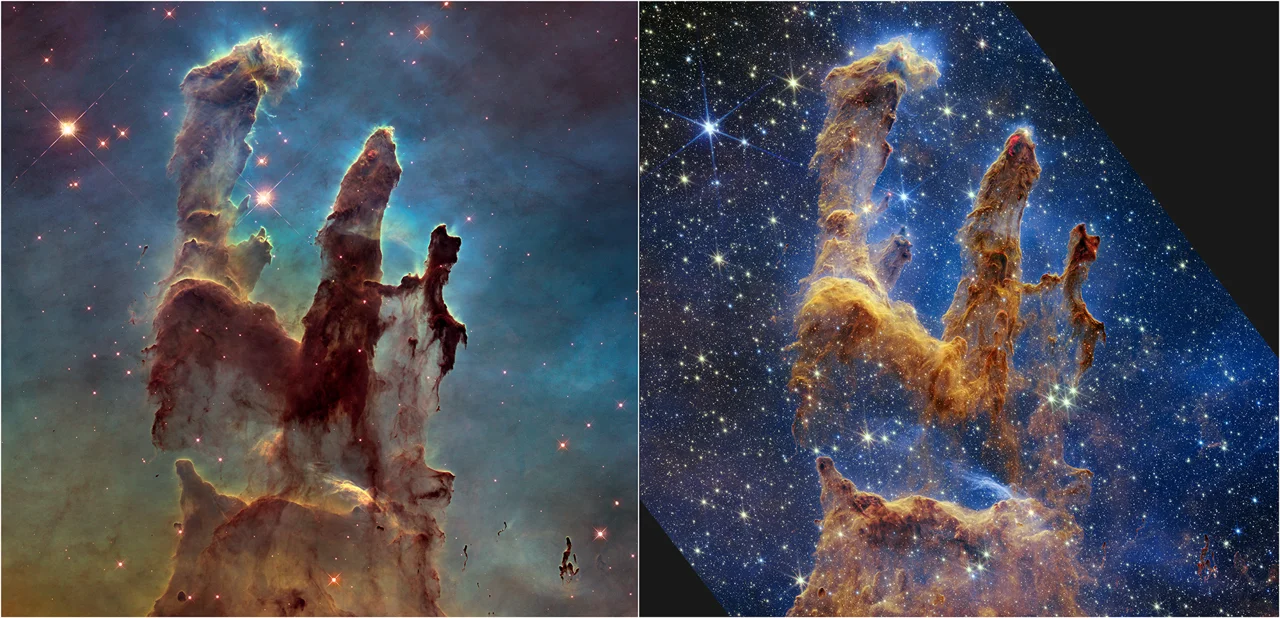
Webb Pillars of Creation images reveal this well-known area through infrared light. The result looks warmer and more crowded than some earlier seen-light views. That change does not mean the nebula suddenly filled with stars between images.
Distinct tools show distinct parts of the same place. To read Webb's view well, we need to separate the colors assigned to data, the light the telescope measured, and the physical process that gave the pillars their shape.
The Pillars Are Clouds, Not Stone Towers
The Pillars of Creation are columns of gas and dust in the Eagle Nebula, about 6,500 light-years from Earth. Their cliff-like look is a visual resemblance. The matter is far more diffuse than rock; Nearby stars and the process of star formation shape the area over long periods.
An image needs scale to be read well. Without it, the pillars can resemble a desert canyon. With it, the scene becomes a vast area of interstellar matter, measured in light-years rather than the height of a well-known cliff.
The Eagle Nebula is also known as M16. Names help link records made by distinct telescopes. But they do not mean the entire nebula is shown in each image.
The famous pillars occupy one part of a larger star-forming setting.
Dust does not mean household dust blown into space. It refers to small solid grains mixed with gas between stars. Those grains affect which light can pass through and how the area seems at distinct wavelengths.
The columns are three-dimensional. A flat image projects their structure into one view. Some matter lies in front of other matter, and the picture cannot directly give each depth link the eye may assume.
Light from nearby young stars acts on the clouds. It can heat and ionize gas and help remove matter from exposed areas. The shapes are therefore part of an active setting, rather than objects that will keep the same edges forever.
The word creation refers to star formation, not to a literal factory with a fixed output. Some dense parts of a cloud can collapse toward new stars, while other matter is dispersed. Building and clearing can occur within the same area.
The first useful correction is simply to let the rock-like image become a cloud again. The pillars are striking because diffuse matter can take on such a large and easy to recognize form, not because space contains a hidden stone landscape.
Infrared Light Changes What We Can See
Webb's cameras observe infrared wavelengths that differ from the seen light used in many well-known images. Near-infrared data can reveal stars through some dusty regions, while mid-infrared views emphasize distinct features of the dust. Neither view shows everything; the contrast adds data by making the wavelength contrasts clear.
A cloud can block one kind of light more strongly than one more. That is why changing wavelength can change the view without changing the object. The matter was already there; the instrument is sensitive to a distinct part of its light.
Related Reading
Webb's NIRCam records near-infrared light. Its 2022 view of the pillars shows many point-like sources and gives some dusty forms a more open look. The image does not mean the telescope removed dust.
It means the measured light can pass through some regions more readily.
MIRI records longer, mid-infrared wavelengths. Its view can emphasize dust in a distinct way and show fewer of the stars that stand out in NIRCam. A combined image draws on both, but the caption should explain what has been combined.
Hubble's well-known pillar images remain useful. They show one more wavelength range and a longer history of record. Webb adds to that record rather than making each earlier view wrong or worthless.
Assigned colors make infrared measures seen to human eyes. Distinct filters are mapped to seen colors. The resulting red, blue, or orange is a display choice linked to data, not always the literal view an astronaut's eyes would have.
That is why the phrase true color can mislead when used casually. The key question is what was measured and how it was displayed. A color key can answer that question far better than a promise that no processing occurred.
The distinct views are strongest when seen as layers of evidence. Near-infrared, mid-infrared, and seen light each reveal something. Together they make the cloud's structure and young stellar population easier to study.
What the Young Stars and Red Features Suggest
Webb's pillar records help teams identify young stars and study gas and dust around them. Some red features are linked with energetic outflows from forming stars. The images guide models of star formation, but not each bright point or red patch has the same origin or stage of growth.
A star begins when part of a cloud becomes dense enough for gravity to drive collapse. The process does not happen evenly across the whole nebula. Local conditions matter, so a dramatic cloud can contain both active sites and regions with no new star forming.
Growing stars can send matter outward. Those outflows may interact with surrounding gas and create seen features. A jet is part of a physical process, not a crack in a solid pillar.
The red structures discussed in NASA's Webb release include signals linked with young stellar activity. Their shape and location help guide reading. Color alone is not enough to identify each object in a complex image.
Bright point-like sources need their own context. Some are linked with the area, while other seen points may be foreground stars. NASA clarified details of what seems in the NIRCam view, a useful reminder that even a famous release can need refinement.
Teams use more than the look of a source. Filters, brightness, position, and other records help distinguish types and stages. An attractive picture is a starting display of data, not the full analysis.
Better counts of young stars can help test star-formation models. So can estimates of the matter available in the cloud. A model must explain both the places where stars form and the wider setting in which they form.
The beauty and the science use therefore come from the same measures but answer distinct questions. A viewer can enjoy the large forms. A team can ask how those forms relate to young stars, dust, and the changing supply of matter.
A Familiar Image Can Still Ask New Questions
The Pillars of Creation became famous through Hubble and gained new detail through Webb. Repeated study links distinct instruments and methods rather than simply replacing one picture with one more. The area remains active, and its images are time-delayed views carried by light from thousands of years away.
Light takes time to travel. At a distance of about 6,500 light-years, the image shows light that left the area long before modern telescopes existed. The telescope records its arrival now, not an instantaneous view of the distant cloud.
That does not make the data less real. It places the record within space science's normal limits. Almost each distant scene is a view into the past, with the delay growing as distance grows.
Claims that the pillars are certainly gone now need their own evidence. A light-travel delay does not by itself prove destruction. We should not turn doubt about the present state into a firm dramatic ending.
The image also changes through processing and contrast. Teams select filters, combine data, and prepare a display. Those steps are necessary to make measures usable, and the best captions explain them openly.
Credit belongs to the observatories and to the people who processed the data. NASA, ESA, CSA, and the Space Telescope Science Institute appear in Webb credits, alongside named image processors. Keeping that credit preserves the collaborative nature of the work.
An image of Hubble and Webb views together is a useful teaching tool when labeled. It shows that an instrument's wavelength range affects what becomes seen. The two scenes should not be described as a simple before-and-after change in the cloud itself.
The pillars remain a meeting point between notice and find. We know their outline well, yet each new set of data can reveal one more part of their physical life. The well-known towers become more interesting when they are allowed to stay gas, dust, and unanswered science questions.
Frequently Asked Questions
These answers clarify the matter, the color display, and the travel time of the light. They prevent a famous image from becoming a literal rocky scene or an unsupported before-and-after story. Webb's value lies in new measures that help explain an area already rich in science questions.
Are the Pillars Made of Rock?
No. They are columns of interstellar gas and dust. Their cliff-like appearance comes from shape, scale, and the way the image presents the view.
Why Do Webb and Hubble Show Different Colors?
They observe distinct wavelengths and use distinct filter combinations and display mappings. The gap does not mean the nebula physically changed into new colors between images.
Are We Seeing the Pillars as They Are Right Now?
We see light that took about 6,500 years to reach us. That delay does not by itself show whether any specific structure still exists in exactly the same form today.