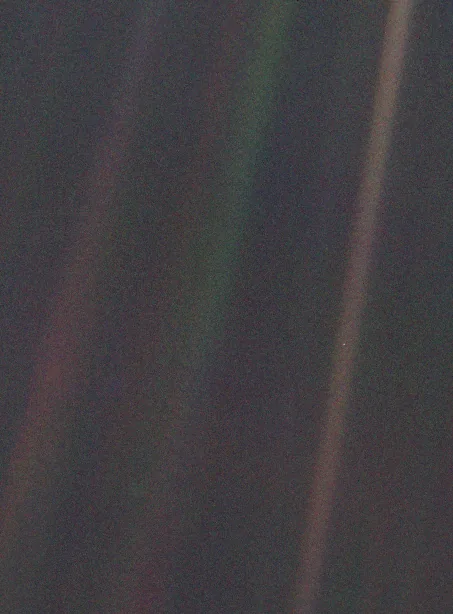

Earth occupies less than a pixel in one of the most famous space images. A faint point sits within a streak of light, easy to overlook until the caption says what it is. The point contains each place any human had lived when the image was taken.
The Pale Blue Dot photo story begins with Voyager 1 looking back in February 1990. It had traveled far beyond the planets it first explored. Turning the camera inward made a view that had little surface detail and enormous meaning.
The picture does not show borders, cities, or faces. Its force comes from distance. To grasp it well, we need to know how the camera made the image and what that tiny point does, and does not, reveal.
Voyager Looked Back at a Small Inner World
Voyager 1 took the Pale Blue Dot image on February 14, 1990, as part of a solar system portrait. It was about six billion kilometers from the Sun. Earth appeared smaller than one pixel, making the view a distant signal rather than a detailed globe.
Voyager 1 had already given experts close views of Jupiter and Saturn. Those encounters made the spacecraft famous for revealing detail. The later Earth image did almost the opposite.
It made our planet so small that detail disappeared.
The camera was part of a mission designed to study worlds far from Earth. A look back needed pointing it toward the inner solar system. The Sun's nearby glare created a challenge that a normal family image would never face.
The wider sequence is often called the solar system family portrait. It included a few planets in separate frames. It was not a single wide-angle picture in which all the worlds sat neatly beside one another at equal size.
Distance matters in the caption. Six billion kilometers gives the scale of the spacecraft's position. It should not be confused with a measure of the seen streak in the image or with the exact distance between Earth and Voyager at each moment.
Light carried the data to the camera, and the spacecraft later sent its data back. Those are two stages of the image's journey. The picture was made far away, then became something people could see on Earth.
The image belongs to a specific date in 1990. A newly processed version can look clearer while still using that first record. Processing later does not turn it into a new image of Earth taken on a later day.
The setting is simple to state and hard to imagine. A machine built by people looked back from beyond its first targets, and one of its smallest seen points was the planet where those people had built it.
The Bright Beam Is a Camera Effect
Earth seems within a streak caused by sunlight scattered inside the camera. The beam is not a physical column illuminating the planet in space. The image combines records through color filters; its faint point stands for Earth's light, while the surrounding streak reflects the challenges of imaging near the Sun.
The sunbeam is one reason the picture feels so striking. It seems to place Earth on a thin stage of light. That look invites a poetic reading, but the optical account is distinct.
The streak belongs to the camera's handling of bright sunlight.
Lens flare and scattered light are well-known in images made toward a bright source. A spacecraft camera has its own optical behavior. In this case, the effect helps explain why the dark scene contains broad streaks even though space is not filled with seen beams like a dusty room.
Related Reading

The point called Earth is also not a resolved blue marble. It is too small for the camera to show continents or cloud patterns. Color is built from filtered records, and the small signal has to be read at the scale of the instrument.
A crop can make the point easier to find. It cannot create surface data that was never logged. Enlarging a tiny signal changes how it is displayed, not the amount of real detail captured from the planet.
NASA released a reprocessed version for the image's thirtieth anniversary in 2020. That version used updated techniques to improve presentation while respecting the first data. Its history is therefore one record and more than one display.
The first view and a later crop can both be useful. One gives the broad frame and the scattered light. The other directs attention to the tiny point.
Captions should name which view is shown so readers know why the same image may look distinct.
The camera effect does not weaken the meaning. It explains the setting in which the signal seemed. The planet was truly small in the view, even though the bright streak around it came from the instrument.
What the Picture Cannot Show
The Pale Blue Dot image does not reveal Earth's surface, climate, borders, or individual life. Its science detail about Earth is small by distance and resolution. Its cultural value comes from perspective; Noting that distinction lets the image remain powerful without treating it as evidence for questions it cannot answer.
A detailed Earth image can show clouds, ice, coastlines, and changes over time. The Pale Blue Dot cannot do that work. It belongs to one more scale, where the planet is a point within a much larger view.
That is why the image should not be used as a measure of Earth’s health. The small point does not reveal current pollution, warming, or habitat loss. Those questions need other data made with suitable tools and repeated records.
The absence of seen borders is meaningful in one sense and small in one more. The camera cannot resolve human boundaries at that distance. It does not prove that political divisions have vanished.
It changes our view of their scale.
The same applies to people. Each human on Earth in 1990 was within the planet's signal, but no individual was seen. The statement connects the image with shared life rather than claiming a tiny hidden portrait of each person.
Carl Sagan helped bring the image into public reflection and gave Pale Blue Dot to a book title. His writing belongs to the image's cultural history. A story can discuss that influence without reproducing a long copyrighted passage.
The picture leaves room for a few responses. A viewer may feel humility, closeness, distance, or responsibility. Those feelings are not instrument readings.
And they need not be presented as one emotion each person must share.
The strongest account holds both kinds of value plainly. The camera logged light from a distant world. People noted that world as home and gave the small signal a human meaning far larger than its size in the frame.
Why a Faint Point Became So Memorable
The image joins a real spacecraft observation with a simple idea: Earth is small within the solar system. Its lack of detail invites a shared perspective rather than a local scene. Its force comes from the contrast between a tiny signal and the lives it represents.
Most images ask us to look well at what is present. This one asks us to consider what has become too small to see. Well-known landmarks disappear, yet the knowledge that they are all there changes how we read the point.
The picture also reverses a common space image. A launch image looks outward from Earth. A planetary flyby looks toward an unfamiliar destination.
Voyager's backward glance connects the journey with the place it left behind.
There is no need to add a dramatic sound or a moving blue globe to make the story clear. Those additions can help a video. But they are not part of the first record.
The still frame's limitations are central to its meaning.
A correct image caption preserves the date, spacecraft, and processing history. It also identifies the sunbeam as scattered light. Those details give viewers enough context to grasp the real scene instead of an ornamental version of it.
The image remains widely shared because its basic contrast is easy to grasp. Home is vast in experience and small in the camera's frame. A person can grasp that contrast without learning each technical detail of Voyager's instruments.
Yet the technical detail adds depth when it answers the right question. Knowing how the filters and flare worked helps us see what the spacecraft actually measured. Knowing the mission history helps us see why the camera was so far away.
At the end, the point is still faint. It has not become a detailed map or a proof of one philosophy. It is a real distant view of Earth, offering a scale that normal life rarely allows us to hold in mind.
Frequently Asked Questions
These questions explain the date, the bright streak, and the limits of the tiny Earth signal. They keep the record separate from later image processing and from poetic reading. The image's power does not depend on hidden detail; it depends on knowing what that faint point stands for.
When Was the Pale Blue Dot Photograph Taken?
Voyager 1 took it on February 14, 1990. Later reprocessing and crops use that first record rather than new images from the same distance.
Is the Sunbeam a Real Beam Around Earth?
The seen streak is caused by sunlight scattered inside the camera. It should not be read as a physical shaft of light surrounding the planet in space.
Can We See Continents in the Blue Point?
No. Earth was smaller than a pixel in this view, so the image does not show surface details. Enlarging the point cannot recover information the camera never recorded.