

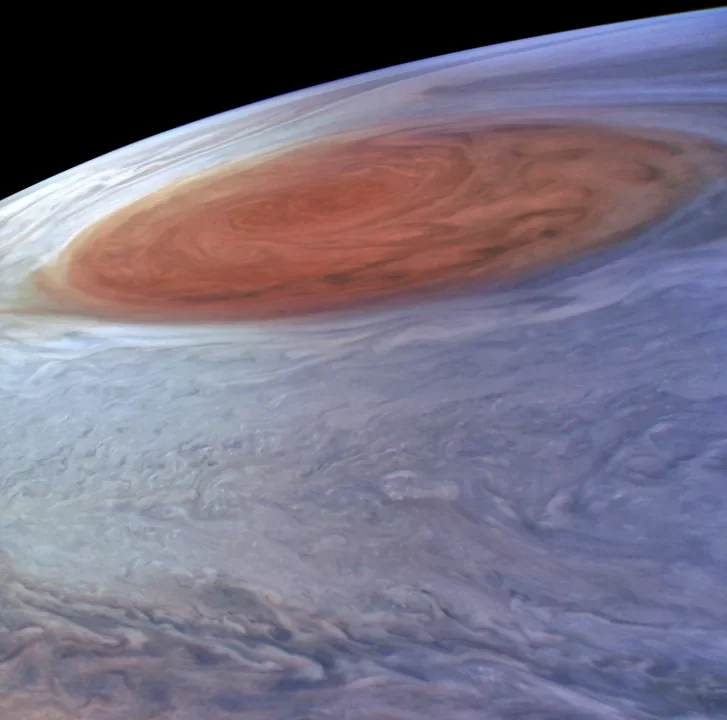
A storm larger than Earth turns in Jupiter's cloud bands. Its oval shape looks well-known in planet images, yet the Great Red Spot is not a fixed mark painted on the globe. It is moving air, changing shape and size within a restless atmosphere.
The Jupiter Great Red Spot storm has lasted far longer than an Earth hurricane. That invites a simple question with a hard answer: what keeps it going?
The planet's fast rotation, deep atmosphere, and surrounding flows all belong to the problem. So does a limit in the evidence. We have long records of a red spot, but matching each old record to the exact same storm is not as easy as the famous image suggests.
A Vast Storm in a World Without Solid Ground
The Great Red Spot is a large anticyclonic storm in Jupiter's southern hemisphere. It rotates within the planet's atmosphere and sits among powerful cloud bands. Unlike an Earth hurricane, it does not cross continents or meet a solid surface beneath the clouds in the same way.
Jupiter is a gas giant. Its seen face is made of clouds, not a rocky landscape with oceans and land. That gap changes how we think about a storm.
There is no well-known coastline waiting to weaken it.
An anticyclone rotates around a region of high pressure. The word helps distinguish the Great Red Spot from the low-pressure storm pattern many readers know on Earth. Similar-looking spirals can belong to distinct kinds of atmospheric flow.
Jupiter's rotation is fast, with a day lasting about ten hours. Rotation helps organize moving air into broad bands. The Great Red Spot lives within that larger system, rather than sitting apart from the rest of the planet's weather.
The cloud bands are seen clues to flows that can move in distinct directions. An image freezes them, but the atmosphere keeps changing. Time series show more than one frame can about how the spot interacts with its surroundings.
Size contrasts should carry a date. The spot has shrunk over the modern watching record. A number from an old Voyager or Hubble image is not a current measure simply because the picture is still shared online.
NASA's Hubble records show that the oval changed in both width and shape across decades. That makes the Great Red Spot a continuing record project, not a solved feature with one permanent diameter.
The first useful view is therefore a moving one. The red oval is part of a broad atmosphere with its own flows, pressures, and energy. To explain the storm, we have to explain some of that larger setting too.
Why a Long-Lived Storm Can Still Change
The Great Red Spot persists while its size, shape, and internal flow change. Surrounding winds and interactions with smaller vortices may affect it. Teams use repeated records and models to study those links; Long life does not mean the storm is stable in each detail or will continue forever.
A whirlpool can keep its general form while the water within it changes. That simple image helps with a long-lived atmospheric vortex. The feature can remain easy to recognize without holding the same parcel of air in place for centuries.
The spot receives and loses energy through its setting. Nearby flows and smaller eddies matter. Teams ask which interactions support the vortex and which help reshape or weaken it.
The answer involves a balance, rather than one fuel source that never runs out.
Related Reading
The lack of a well-known solid surface helps explain why contrasts with Earth hurricanes have limits. On Earth, land and ocean conditions play major roles in storm life. Jupiter's atmosphere presents a distinct set of boundaries and depths.
The seen cloud layer is also not the whole storm. A striking surface view tells us where clouds are, but not exactly how deep each part of the flow extends. Other instruments are needed to probe below the image.
Juno has helped add data about Jupiter's atmosphere from close flybys. Distinct instruments study distinct aspects of the planet. Their results need to be combined carefully, rather than treating a vivid cameran image as a complete weather map.
The shrinking trend raises an obvious question: is the spot about to vanish? A trend alone cannot give a sound end date. The rate may change, and the processes supporting the storm are still being studied.
The strongest claim is that the storm changes while it persists. That is already a striking result. Its long life gives experts a way to watch a large vortex respond to its surroundings across a span far beyond normal weather on Earth.
The Red Color Is a Separate Puzzle
The Great Red Spot's color is linked with chemistry in Jupiter's clouds, but its exact cause remains an active question. Sunlight and compounds in the atmosphere are among the factors studied. A red image shows the result; it does not identify the responsible matter without further evidence.
Color feels like an easy clue because the eye sees it at once. Chemistry is harder. A few substances or reactions can make similar colors, and a planet's light has passed through a complex atmosphere before reaching a camera.
Sunlight can change molecules. Products of those reactions may help color the clouds. Teams test possible materials and contrast their behavior with what instruments observe.
A plausible lab result still has to fit the planet's actual conditions.
The spot's color can vary with time and viewing conditions. That is one more reason not to assign one simple paint-like ingredient from a single image. An image records light through filters and processing choices, as well as the planet itself.
Enhanced-color images are useful when labeled. They can make structures easier to see. But they do not always match the view a human eye would have from the same position.
A science image is often a display of data, not a claim of unaltered natural color.
JunoCam has made dramatic close views of the region. Some images are processed by members of the public from mission data. Credits should include that processing role when it belongs to the image, rather than naming only NASA.
The winds and the color need not have one shared account. A storm's motion can be modeled through fluid behavior while its hue needs chemical evidence. Solving one part would not automatically settle the other.
That separation helps keep the wonder precise. The spot is a long-lived vortex whose seen clouds also carry a chemical mystery. Its red look is a clue to study, not a label that makes the physics beneath it self-explanatory.
Reading the Old Record Without Stretching It
Astronomers have described spots on Jupiter for centuries, but continuity between all early reports and today's Great Red Spot is uncertain. Modern images give a clearer record of its recent changes. Past drawings remain valuable when their dates, viewing limits, and possible contrasts are kept in view.
A seventeenth-century observer saw Jupiter through tools very distinct from those used today. The planet was a small bright disk, and a feature could be hard to follow. A gap in the record may reflect the observer's limits as well as a change on the planet.
That is why the phrase the same storm for hundreds of years needs care. Early reports show interest in a persistent spot, but the exact link to the modern feature is not settled simply by the long span of time.
Modern imaging supplies more regular measures. Spacecraft add close views, while telescopes on and near Earth give repeated monitoring. These approaches complement one another: a flyby offers detail, and a long series offers change.
The Great Red Spot also makes a fine example of how a famous object can keep generating new science. Knowing the outline is not the same as knowing how it works. Millions of people can identify the oval while teams still test its depth, energy balance, and color.
Useful captions preserve that distinction. They name the mission, date, processing, and scale when available. A 2017 flyby image remains key.
But it should not be described as an image taken today.
There is no need to promise that the storm is eternal. A moving atmosphere can make a long-lived feature without granting it permanence. The unknown future is part of what makes continued monitoring worthwhile.
The oval turns on in the cloud bands, well-known but never fully fixed. Each new record adds one more frame to a long record, helping experts ask a better question about how this enormous storm keeps its form while the world around it flows.
Frequently Asked Questions
These answers separate the well-known Earth contrast from Jupiter's own weather, and a measured shrinking trend from a prediction of disappearance. They also keep the color question distinct from the storm's motion. The Great Red Spot is well seen; But it still leaves key questions open.
Is the Great Red Spot an Earth-Like Hurricane?
It is a storm. But it is an anticyclone in a gas giant's atmosphere. Its pressure pattern, setting, and life span differ from those of a normal Earth hurricane.
Will the Great Red Spot Disappear Soon?
Its shrinking trend is real. But it does not give a sound disappearance date. Teams still study the processes that reshape and sustain it.
Do We Know Exactly Why It Is Red?
The chemistry behind the color is not fully settled. Sunlight and atmospheric compounds are studied, and a color image alone cannot identify the cause.
.png)