

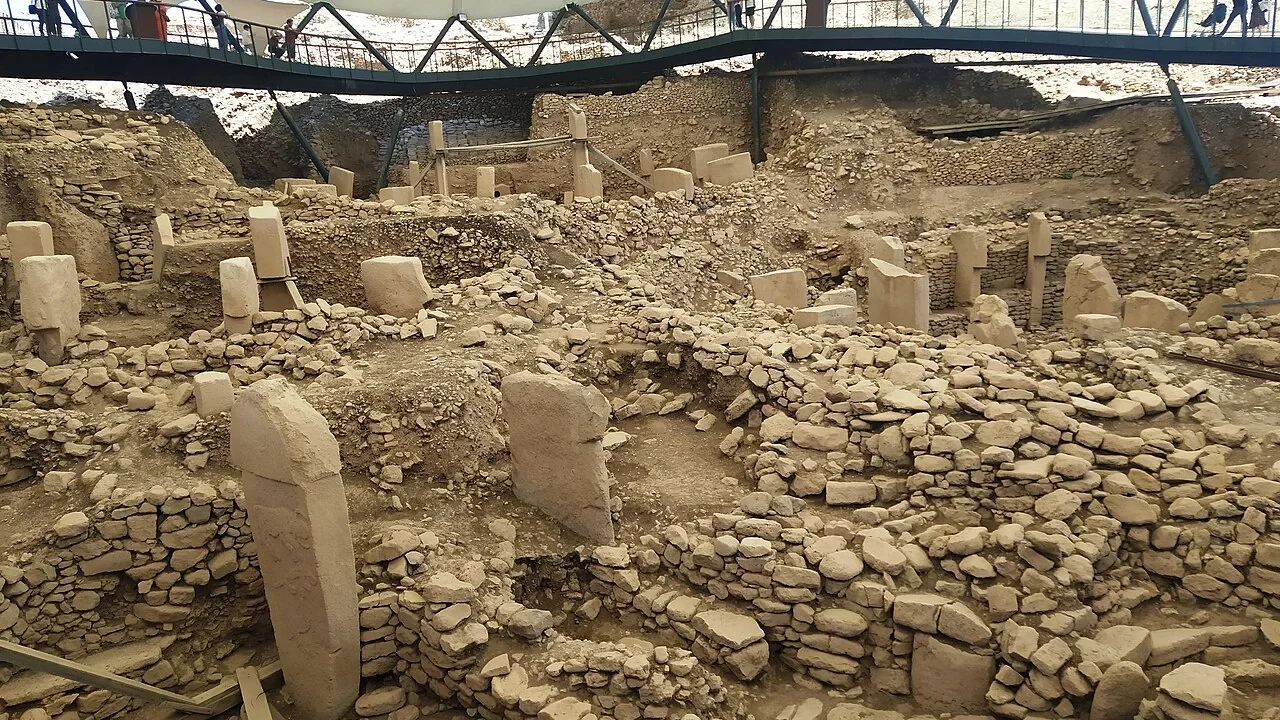

Stone figures stood on this hill thousands of years before the pyramids rose in Egypt. Some have carved arms, hands, and animal forms, as though the rock holds the outline of a gathering that has not quite ended.
The Gobekli Tepe builders left no written explanation for visitors. Their work survives as architecture, tools, bones, and layers of earth.
The site is extraordinary, but its importance does not depend on claiming it was the world's first town or that nothing comparable existed nearby. Its deeper value is the way it reveals people creating demanding shared spaces during a period when ways of living were changing.
Who built the stone enclosures?
Gobekli Tepe belongs to early Neolithic communities in southeastern Anatolia. The site includes monumental structures made during the transition toward farming life. Its builders were capable of organizing labor and shaping limestone. Their identities and beliefs must be reconstructed from material evidence, not from an surviving written account.
The older story of human progress often sounds neat: people farmed, settled down, produced surplus food, and then built monuments. Archaeology has made that sequence more complicated.
Shared construction could matter while communities were still changing how they obtained food and organized daily life. A building project may also strengthen the relationships needed to support it.
At Gobekli Tepe, the scale and design show coordinated effort. That does not require a modern state, but it does require people to act together.
Calling the builders primitive hides the practical knowledge visible in their work. They understood stone, tools, placement, and the organization of a demanding task.
Calling them members of a lost supercivilization hides them in a different way. It replaces the evidence of local people with an imagined outside source.
The more interesting view gives the builders their own achievement. Their communities made choices that changed the hill, and the surviving remains help us study those choices even without knowing their names.
What the T-shaped pillars tell us
T-shaped pillars are a defining feature of the site's monumental structures. Some show carved arms and hands, supporting interpretations of human-like figures. Animal reliefs add another layer of imagery. These details make the pillars more than structural supports, although their exact meanings remain open to archaeological interpretation.
A pillar can carry a roof, mark a boundary, or represent something. The same object can perform more than one of those roles.
Human-like details matter because they turn an abstract shape into a possible figure. The placement of larger pillars within a structure may add to their importance.
Animal carvings invite questions about the world the builders knew. Creatures that mattered in their environment could also carry meanings tied to danger, identity, memory, or ritual.
The carvings do not come with captions. A modern observer may recognize a snake or a bird without knowing what that creature meant in the setting.
This is where comparisons help and where they can mislead. Similar imagery at nearby sites may reveal a shared visual tradition, but a later myth cannot automatically explain a much earlier carving.
Look at the stone closely, then keep the distance between observation and interpretation. The figure is there. The story a modern visitor attaches to it may still need evidence.
How labor could bring a community together
Building large stone structures required quarrying, shaping, transport, placement, and maintenance. Those activities imply cooperation and practical planning. They do not reveal one proven system of leadership. Archaeologists investigate whether gathering, food sharing, social ties, and ritual helped people organize work at the site.
A finished enclosure can make construction look inevitable. The workers faced a different view: stone had to become a useful form and arrive in the right place.
Even modest tools can accomplish demanding work when skill and time are available. The question is not simply whether ancient people had a crane. It is how they used the techniques they did possess.
Food and scheduling matter as much as force. People involved in building needed support, and the community had to manage other tasks alongside the project.
A gathering may strengthen ties among groups. Sharing work and food can create obligations, memories, and a reason to return to a place.
These are plausible social mechanisms, not a recovered transcript of a planning meeting. Archaeologists test such ideas against remains, spatial patterns, and comparisons.
The monument therefore opens a social question. How can people build something larger than one household's needs? The answer may lie as much in relationships as in the weight of the stones.
Why the word temple needs care
Gobekli Tepe is often described as a temple site because of its monumental buildings and imagery. The word is a useful shorthand, but it can imply beliefs and institutions that the evidence does not establish. Research considers the site's wider setting, including everyday activities and links with nearby communities.
A modern temple belongs to a known religious tradition. It may have named gods, formal leaders, and written rules. None of those features can simply be carried backward to this site.
The buildings may have supported gatherings with ritual importance. Yet social, ceremonial, and practical functions need not fall into separate categories as they do in a modern guidebook.
The same space can host a meal, reinforce relationships, and carry symbolic meaning. A label that permits only one function may narrow the question too early.
Researchers also revise their views as more of the site is studied. New evidence about activity and occupation can challenge an older image of an isolated ceremonial hill.
That is a sign of research working, not of archaeology failing. A model should change when the evidence grows.
The best visit leaves room for that process. The site can inspire awe without a promise that every building had the same function or that one modern word captures the entire society behind it.
How archaeologists place the site in time
Researchers use several forms of evidence to build the site's chronology, including excavation layers, associated material, radiocarbon dates, and comparisons with regional sites. A date applies to a particular sample or context. It should not automatically be treated as the exact construction date of every pillar or building.
Stone itself does not carry a simple birth certificate for the moment a worker set it upright. Dating a monument often means connecting it with other material.
A sample of organic matter may provide a useful range, but its relationship to a structure must be established. Material could be older than its final deposit or enter a layer later.
Excavation context helps manage those problems. The position of walls, fills, floors, and objects can reveal a sequence of activity.
Comparisons across the region also matter. The site belongs to a landscape of communities and traditions rather than an unexplained dot on a blank map.
Headlines tend to compress ranges into a single impressive age. That can be convenient, but it hides how researchers build and revise their chronology.
A careful description keeps both the broad result and the limits. The buildings are very early, and some details of their sequence remain subjects of ongoing study. Precision is strongest when it acknowledges what a date actually measures.
A monument that changes our questions
Gobekli Tepe expands what we know about early community life, skilled construction, and the relationship between gathering and economic change. It does not erase the rest of prehistory or prove a single origin for civilization. Its importance lies in adding complexity to a human story that was once presented too simply.
The most revealing question may not be which monument is oldest. A competition for first place can turn every site into a contender and reduce its unique evidence to a number.
Instead, ask what people were doing here that earlier models did not expect. The answer includes shared architecture and a strong visual language during a period of changing food production.
Then ask how the site connects with its neighbors. Related evidence makes the builders more understandable rather than less impressive.
The people involved lived with practical needs as well as ideas. They needed food, tools, and social support while making spaces whose meanings are only partly visible to us.
Conservation protects that incomplete record. An undisturbed layer may answer a future question that today's researchers have not yet learned to ask.
The pillars remain powerful because they hold both knowledge and silence. We can see what hands shaped. We cannot yet hear every reason those hands went to work, and that measured uncertainty gives the hill its lasting fascination.
Frequently Asked Questions
Is Gobekli Tepe the world’s oldest settlement?
That is not a reliable description. It is famous for early monumental structures, while older settlements and other important Neolithic sites are known.
Did the builders have writing?
No written explanation from the builders has been recovered for the site’s purpose. Researchers rely on archaeology and regional comparisons.
Do the animal carvings prove a particular religion?
They show a rich visual tradition and invite symbolic interpretations. They do not identify a complete religious system or a named pantheon on their own.

.jpg)