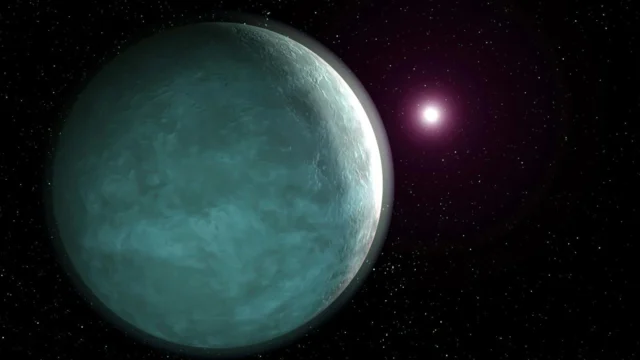
A planet can have moons we have not yet noticed. Even after spacecraft visits and decades of scope work, a small faint companion can stay hidden near a much brighter world.
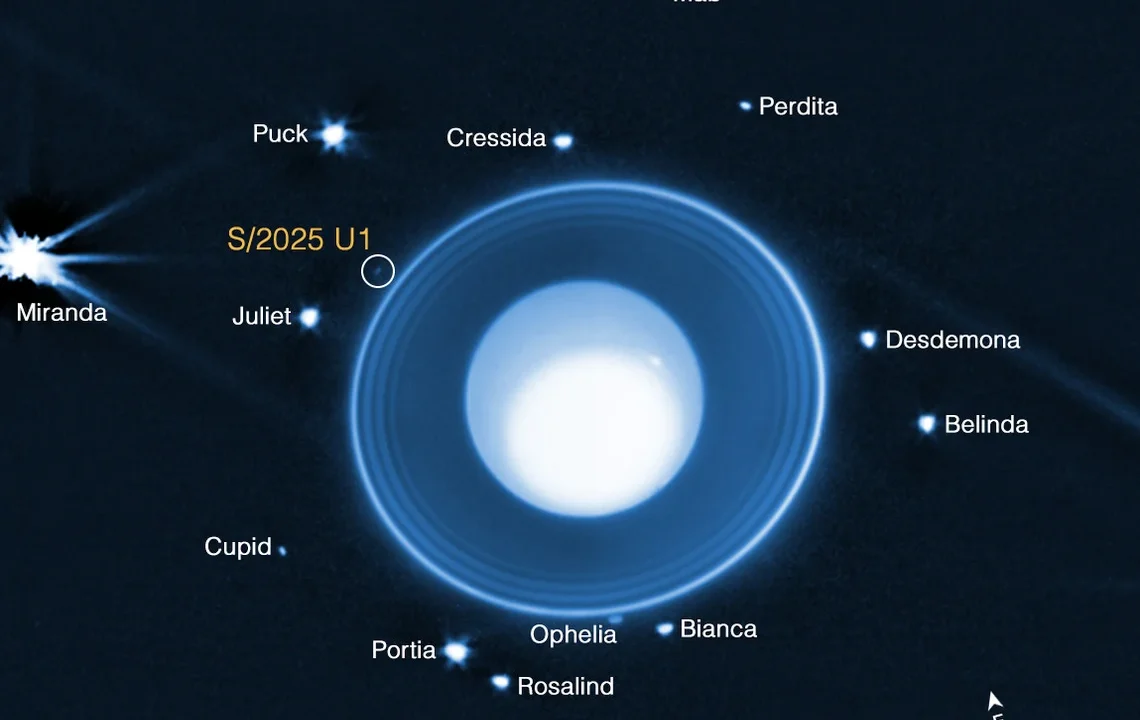
Webb data from February 2025 revealed a new Uranus moon, for now designated S/2025 U1. NASA announced the finding in August 2025 and noted that the find had not yet been peer reviewed at that announcement stage.
The object is not new in the sense of having just formed. It is newly found. That difference matters whenever astronomy turns an old part of nature into a new part of our catalog.
Imagine searching for a dim spark beside a floodlight. The spark can be real while the glare makes it hard to measure. For Uranus, infrared data and a sequence of exposures helped bring a small companion into view without making each question about it disappear at once.
What Webb Saw Near Uranus
Webb found a faint point near Uranus in February 2025 data. Teams identified it as a new moon with a working label, S/2025 U1. NASA noted the finding was not yet peer reviewed at announcement.
More work can refine its orbit and other physical traits.
The data were taken on February 2, 2025. The finding came from a sequence of infrared exposures instead of a single glance through a normal scope.
James Webb observations can reveal faint objects in settings where glare and contrast make the task hard. The instrument's sensitivity is valuable. But teams still need to study the data with care.
The reported object lies within the system of known Uranus satellites. Its apparent motion and location support the proposed lunar identity.
A working designation is a working label. It identifies the find in a systematic way without requiring an early lasting mythological name.
The label does not give the moon a birth date. A body found in 2025 may have existed for a very long time. Finding and formation are separate events.
NASA set out the known moon count as 29 at the time of the announcement. That number should stay tied to the date instead of be treated as a lasting total for all future catalogs.
The find also shows why a visited planet can still hold surprises. A spacecraft's view and a later scope's data differ in layout, sensitivity, and aim.
No survey sees each object as well. Small moons can fall below earlier finding limits or be hard to distinguish from nearby bright structure.
The result is therefore a new entry in knowledge, not a sudden addition to the planet's gravity. A small world was already there, and a better view made it clear to us.
Why Tiny Moons Are Difficult to Measure
Small moons reflect little light and can hide in glare. Rings and image artifacts make the search harder. Brightness also depends on the surface, not only size.
A diameter estimate needs assumptions, while repeat views help test whether a faint point is a real moving body.
Brightness is not the same as size. A small reflective object can appear brighter than a larger dark one under some settings. Teams must consider that link when estimating a moon's diameter.
Planetary rings add one more test. They contain structure and reflect light close to the planet. A faint moon must be separated from that setting, not simply noticed as a dot.
Related Reading
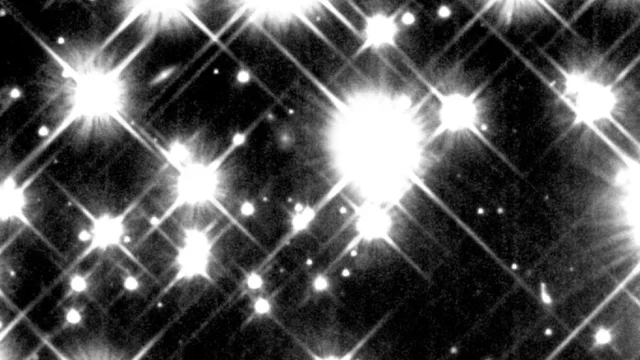
An instrument can also create patterns around a bright source. Grasp those patterns helps prevent an artifact from being mistaken for a body.
Repeat exposures give a useful check. A real object should behave in ways consistent with its motion and the viewing layout. Noise and many artifacts do not follow the same pattern.
The viewing sequence can be joined to improve sensitivity. That processing needs to keep the signal while accounting for movement between frames.
Small moons are therefore found through both hardware and method. A sensitive camera helps. But the study decides whether the faint feature supports a real claim.
A reported diameter should stay an estimate. Unless the body is direct resolved in enough detail, its brightness and assumed reflectivity play a role.
That doubt is normal in remote astronomy. It does not make the finding meaningless. It defines which traits are known more plainly and which need more work.
The tiny point in the image carries distinct levels of facts. Its presence may be well backed while its exact size, shape, and surface stay much less constrained.
An Orbit Gives the Point a Place in the System
A moon needs a physical link to the planet, not just a nearby place in one image. Data and orbit models test that link. More views can refine the path.
A new detection still does not reveal the body’s whole history from formation to the present.
A background star can appear close to Uranus by chance. A moon must instead have motion consistent with belonging to the planetary system.
Orbital confirmation uses data across time and a real model. More data can improve the path estimate and reduce ambiguity.
The system's inner region contains many bodies and rings. A new small companion can add a question about how those parts share space and influence one one more.
That does not mean a single image reveals a collision waiting to happen. Stability questions need calculations and a enough constrained orbit.
The same caution applies to origin stories. A moon may have formed with the system or through later processes. But its current location alone does not prove one route.
Small moons can help teams study ring-moon links. Their gravity and orbital setting may be useful, though given effects must be shown instead of assumed.
Uranus also has an unusual tilted tilt. The system's layout affects how it appears from our viewpoint and why distinct viewing seasons can be useful.
The new object gives that layout one more measured participant. It can be placed more well as data accumulate.
A point becomes a moon through a tested link. That is the real step beyond just noticing something faint: the object gains a path, a setting, and a role in a planetary system that is still being mapped.
What the Discovery Says About Unfinished Catalogs
A new moon around a familiar planet shows that catalogs have limits. Better tools can find bodies missed in earlier views. That builds on past work rather than making it worthless.
Different observations reveal different parts of a system, so even our Solar System can surprise us.
A catalog can feel final because it presents clean names and numbers. The sky does not change its contents to fit that list. The list changes as our data improve.
For small moons, the difference can be large. Earlier images may have been excellent for large bodies while lacking the sensitivity needed for a tiny dark companion.
The aim of an view matters too. A mission studying a planet's atmosphere may not search each area in the same way as a later moon survey.
That is why the find is best seen as an extension of knowledge. It builds on earlier work instead of making that work worthless.
The image should keep the same clarity. An annotated Webb view can show where the candidate appears. A Voyager view of Uranus can give setting.
But it does not depict this 2025 finding.
Captions help readers separate those roles. A small arrow on a real find image may tell more than a vivid artist's scene of an invented close-up surface.
Future data can refine the moon's orbit and real traits. The report status can also change. So the original announcement's review note should not be silently converted into a lasting judgment.
The story is quiet but powerful. A well-known planet held a faint companion beyond earlier reach, and a new viewing method widened the view.
There may be more such small bodies to find. The useful result is not an invented count. But a habit of curiosity: even the well-known Solar System is still a place where careful light data can reveal something we have not seen before.
Frequently Asked Questions
These questions separate find from formation, working labels from lasting names, and size estimates from direct data. The answers show how a faint finding becomes part of a catalog without resolving each real detail. More data can strengthen the orbit and improve what teams know about the small companion.
Did the Moon Form in 2025?
The date refers to its finding, not its formation. The find does not show that a new body suddenly appeared that year.
Is S/2025 U1 a Permanent Name?
It is a working designation. A working find label and a lasting moon name are distinct stages.
Does the Announcement Prove an Exact Diameter?
The size is estimated from data and assumptions about reflectivity. A faint point does not always give an exact resolved shape or diameter.