A galaxy can contain hundreds of millions of stars' worth of mass and still be hard to see. The trick is not that all its stars have vanished. Their light is spread across a large area.
So each patch looks faint.
That is the puzzle behind the Nube invisible galaxy nickname. Teams explain Nube as an unusually diffuse system, not a truly lightless object. The name, Spanish for cloud, fits its faint, extended look.
A 2024 study and the IAC's account place the galaxy within a debate about how galaxies form and how dark matter models explain their structure. One unusual system can test an idea without proving that an entire framework is wrong.
Imagine a spoonful of paint spread across a wall instead of left in a small patch. The amount may be the same. But the color becomes harder to notice.
Surface brightness gives teams a similar way to think about a galaxy that hides in plain sight.
Why Nube Is Faint Without Being Empty
Nube’s stars spread their light across a broad area. That gives the galaxy low surface brightness and makes it hard to see. It is not empty or truly invisible.
Total light and light per area differ, which helps explain why a large system can look faint.
An image records light against a background. A compact source can stand out because much of its light falls within a small region. A spread-out source has a harder task.
Surface brightness measures light per apparent area. It is distinct from the total light added across the whole object.
The teams estimate a stellar mass of roughly 400 million solar masses for Nube. The exact number of stars is not the same as that mass estimate, because stars have distinct masses and brightnesses.
The system's large extent makes it unusual for its stellar mass. This is the link that matters, instead of a claim that size alone makes a galaxy invisible.
An ultra diffuse galaxy can therefore be a real system with normal emitting stars and an extraordinary spread. The faintness comes from the arrangement as well as the contents.
A deep image gathers more useful facts about weak signals. Careful processing is also needed to separate an extended feature from background changes and instrument effects.
The faint object should not be confused with a dark-matter-only structure. Nube has seen starlight. Its nickname is a description of how hard that light is to find.
Keeping that gap clear helps the research question emerge. Why are the stars spread so broadly, and what history made the system?
The galaxy does not break the rule that stars emit light. It shows how the same light can become hard to notice when the scene is large and the contrast is low.
How a Faint Galaxy Can Be Found
Finding an extended faint galaxy needs sensitivity to weak contrast, careful background treatment, and checks against artifacts. Follow-up data help show that the feature is a real system and constrain its traits. The find process is therefore more than finding a smudge.
It is testing what that smudge stands for.
Related Reading

A faint patch can arise from several sources. It might be a real object, scattered light, a processing effect, or a variation in the image background.
Galaxy detection needs to separate those possibilities. Teams compare data, examine structure, and use follow-up data suited to the proposed object.
A longer exposure can help. But it does not solve every problem. If the background is modeled poorly, a real diffuse feature can be weakened or an artificial one can be created.
This makes low-brightness astronomy notably demanding. The study must keep broad signals without mistaking every broad signal for a galaxy.
Stellar distribution is one clue. A coherent extended system should show traits that fit a space source instead of a random patch of image noise.
Distance is another key part of the proposed account. A nearby small object and a distant large object can have similar apparent sizes. Real size needs distance facts.
The study reports a large half-mass radius, a measure of how far the stellar material extends. Such a value depends on the model and data used to infer the system's structure.
A published study gives other teams the basis for checking those steps. A dramatic image alone cannot show all the real traits quoted in a story.
The find is therefore an act of careful separation. A weak feature becomes a galaxy when several data and tests support that identity, not when the nickname becomes popular.
Why Dark Matter Models Enter the Debate
Nube's unusual size and stellar distribution give a test for galaxy-formation models, including models involving dark matter. A hard match can motivate new accounts or more data. It does not, by itself, prove that dark matter is absent or that every known model has been disproved by one galaxy.
Dark matter is used to explain gravitational behavior that visible matter alone does not account for in many systems. It does not emit normal light in the way stars do.
A galaxy's stars therefore offer only part of its real story. Teams use models to connect the visible spread with the gravitational setting and the system's history.
Dark matter models differ in their assumptions and predictions. A news phrase such as tests the model should be followed by the given link that is hard to explain.
For Nube, the unusual diffuse structure motivates that comparison. The question is whether a proposed formation path can make the seen mix of size and stellar content.
A mismatch can have several accounts. The model may need refinement, an unusual history may be useful, or a measure may need better constraints.
One object can be valuable exactly because it is unusual. It tests the edge of a model's range. It does not always explain the behavior of all galaxies.
The next step is to look for predictions. Does the proposed account fit other systems? Does it imply a feature that new data could confirm or reject?
That is more useful than declaring a whole framework dead. Research progress often comes from making a hard case more exact.
Nube is a test worth studying because its light spread is so surprising. Its faint look draws attention. But the deeper test lies in the quantitative traits behind that look.
What Almost Invisible Teaches Us About Surveys
Surveys can miss galaxies whose light is spread thinly. Finding Nube shows why detection limits matter to a galaxy list. Tools favor some kinds of objects over others.
Teams must account for that before treating the observed sample as a full map of what exists.
A catalog is not a full inventory of the universe. It is a set of objects found and classified under given settings.
Those settings favor some objects over others. Bright, compact sources may be easier to find than faint, extended ones, even when the latter contain large material.
This is a selection effect. It does not mean the survey was careless. It means the sample needs to be read in light of how it was gathered.
IAC research on Nube draws attention to that hidden range. Better sensitivity to diffuse systems may reveal objects that earlier methods did not spot.
The new objects can then change a comparison. A model tested only against easy-to-see galaxies may face a distinct test when the sample includes very faint extended systems.
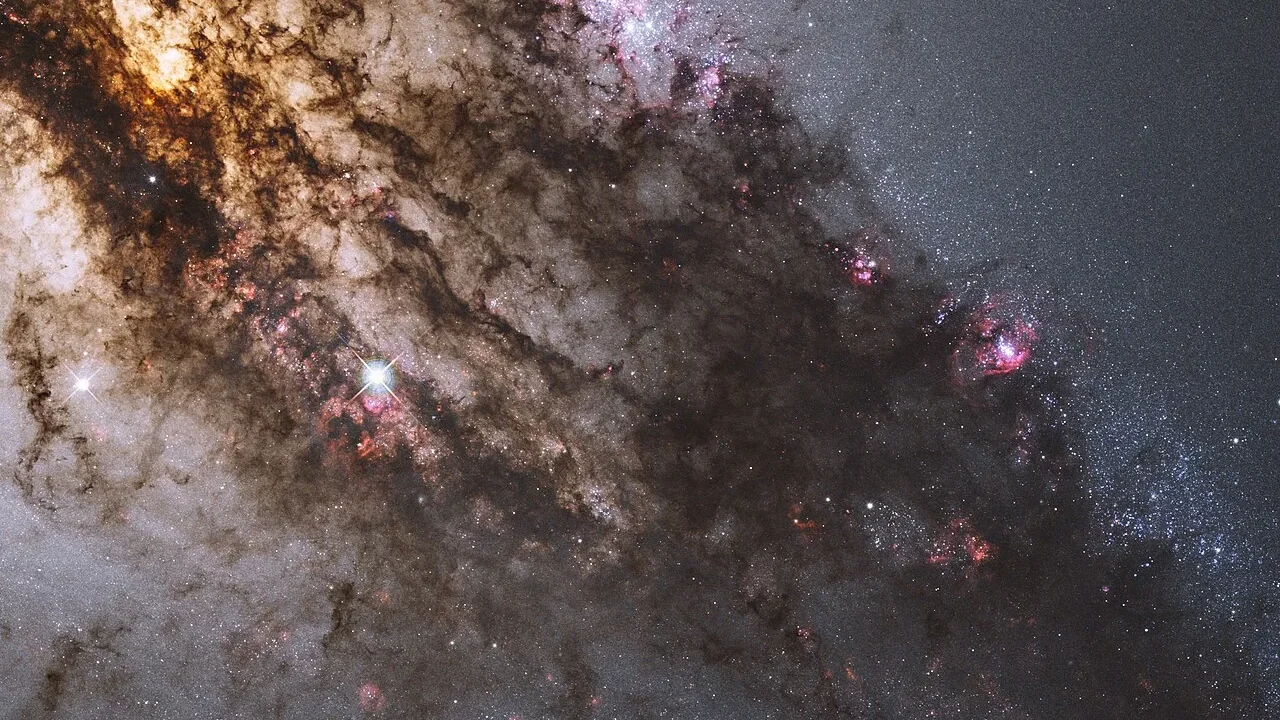
Images should also support the correct identity. A striking photo of Centaurus A is not a photo of Nube, even though both are galaxies. The featured image must be labeled for what it actually shows.
A faint original image may seem less dramatic than a colorful substitute. It is often more informative because the difficulty of seeing the object is part of the find itself.
Nube asks us to notice what contrast can hide. A galaxy need not be empty to be elusive, and a catalog need not be full to be useful.
The lesson reaches beyond one cloudy name. The universe may contain more kinds of systems than our first images reveal. Learning to see the faint ones can change not only the list of galaxies, but the questions we ask about how they formed.
Frequently Asked Questions
These questions distinguish faintness from emptiness and a model test from a full disproof. They also clarify why stellar mass is not an exact count of stars. The answers keep Nube's unusual look linked to the measured spread of light and to the limits of how galaxies are found.
Is Nube Literally Invisible?
No. It has found starlight. The nickname refers to its very low surface brightness and the difficulty of seeing its diffuse structure.
Does Nube Prove Dark Matter Is Wrong?
No. It gives a hard case for models of galaxy structure and formation. One unusual system does not settle every question about dark matter.
Is Stellar Mass the Same as an Exact Star Count?
No. Stars have distinct masses. A total stellar-mass estimate cannot be read direct as a count of individual stars.