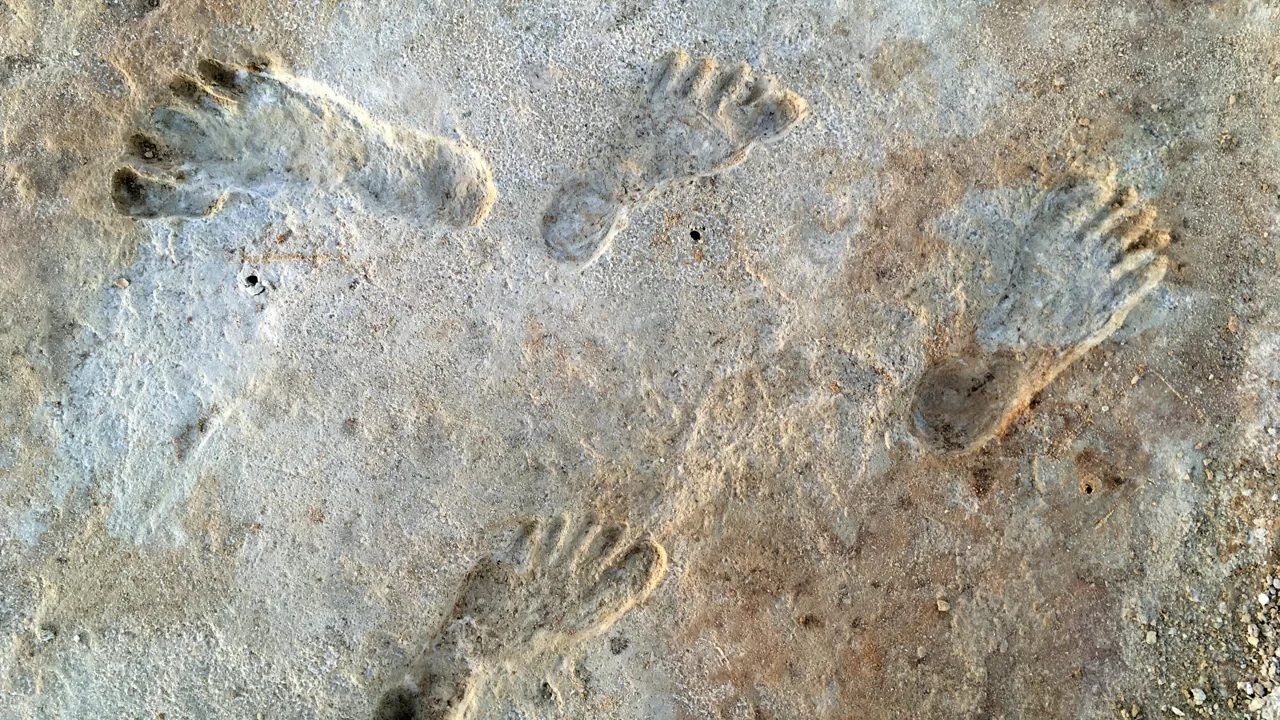
A foot pressed into wet ground. The person moved on, and the mark stayed behind for more than twenty thousand years.
At White Sands National Park in New Mexico, tracks from people and huge Ice Age animals survive in the same landscape. No written record names the walkers. No face looks back from the mud.
Yet these small dents have changed a major debate about when people lived in North America.
Today, the White Sands footprints ask us to look below the bright dunes and picture a place with water, grass, and life. They also show why a bold claim needs more than one way to test it.
A lake shore beneath the desert
The White Sands footprints formed in a landscape very different from the park today. Lake Otero once lay within the Tularosa Basin, with wet ground and richer plant life nearby. Tracks preserve a glimpse of that setting before the famous white dunes became its dominant feature.
The modern dunes can make the past hard to picture. White sand curls into ridges, and a dry wind moves loose grains across the ground. It feels like a world shaped mainly by heat and open space.
The old lake bed tells another story. Water drew animals toward a place where food and drinking sites could be found. Soft ground near the lake could record a step, then bury it under later layers.
A track needed the right balance. If the mud was too hard, a foot left little mark. If it was too wet, the edges could slump.
If later weather stripped the surface away, the print could vanish.
Those limits help explain why the record is precious. Many people may have crossed a region without leaving a trace that survives. A patch of preserved mud is a small window, not a complete map of every journey.
It also changes how we read the present. A dry basin was not always dry. The shape of a landscape can outlast the water, plants, and animals that once made it feel familiar.
What the age of a seed can tell us
Researchers first used aquatic seeds found above and below track layers to estimate their age. Radiocarbon dating gave a range of roughly 23,000 to 21,000 years. The result raised a fair question: did those seeds carry older carbon that could make the tracks seem too old?
A foot does not come with a date stamp. To learn its age, a team must study the layer that holds the print and the material around it. Position matters as much as the sample itself.
Think of a stack of sheets. A mark between two sheets belongs within that stack, but only if the sheets have stayed in place. Geologists test the ground for signs that layers were mixed or moved.
At White Sands, seeds from a water plant gave researchers a useful clock. Living plants take in carbon. After death, one form of that carbon decays at a known rate, which allows a sample's age to be estimated.
Related Reading

The concern was not a claim that every date must be wrong. Water plants can use carbon with a different history from the carbon in the air. If that older carbon enters a seed, a date may look older than the moment the plant grew.
That is why a careful study treats a striking number as a result to check. The right question is how the sample formed and what its date actually measures.
A criticism can make an argument stronger when it points toward a useful test. In this case, the challenge helped guide the search for other clocks in the same ground.
Two more clocks helped test the tracks
The age claim grew stronger when researchers tested land plant pollen and quartz grains from the track sequence. Pollen offered another carbon record. Quartz gave a separate estimate based on its last exposure to light. Comparing these methods reduced reliance on the original aquatic seeds alone.
Land plant pollen helped address the concern about water plants. Tiny grains could be collected from the same parts of the layered ground, giving the team another kind of material to date.
Quartz added a different test. Under the right conditions, grains build up a stored signal while buried. Exposure to light resets that signal.
A lab can use it to estimate how long the grains have been hidden from sunlight.
The name for this test is optically stimulated luminescence. The name is long, but its purpose is simple: it asks when a grain last saw the light, rather than when a plant stopped living.
These clocks do not measure exactly the same event. A plant's death, a grain's burial, and a person's step must be connected through the layers. That link needs careful field work, not just a neat list of lab results.
When different methods point toward a similar age, the case becomes harder to dismiss as one sample's unusual history. It does not mean every question about the site has been answered.
Tracks bring people into an Ice Age world
Human tracks at White Sands place people within an Ice Age landscape shared with large animals. Footprints can reveal direction, spacing, and size, but they cannot give every walker's name or purpose. A trackway is evidence of activity, with some details clearer than others to modern researchers.
A footprint can feel more personal than a stone tool. We know the motion of taking a step. A line of prints brings that motion back into view, even when the person is long gone.
Researchers can compare the length of prints and the gaps between them. That helps them study movement and body size. It does not allow a stranger's full life to be read from the ground.
Small tracks may be linked with younger walkers, but age estimates require care. A print's shape can change with soft mud, load, or a sliding foot. Size alone is not a birth record.
The Ice Age setting adds another layer of wonder. Large animals also moved through the basin. Their tracks show that this was a living place, with paths made by many kinds of feet.
It is tempting to turn every meeting of trackways into a dramatic chase. Yet crossing lines do not always show that two creatures arrived at the same moment. The layers and sequence must support that reading.
The power of the site does not depend on a made-up scene. It lies in traces left by real movement. People were present, animals were present, and the ground sometimes kept the marks of their passing.
A changed timeline still leaves open questions
The tracks support human presence in North America well before many older arrival timelines allowed. They do not identify the first person to reach the continent or prove a single migration route. New research can refine the ages while leaving those wider questions open for further evidence and debate.
Evidence of people in one place sets a boundary for the story. People must have reached that place by the time the tracks formed. The prints do not show the first crossing into the continent.
That distinction matters. A headline about the first Americans can sound as though one site has solved every stage of a long journey. A lake bed cannot reveal all the routes, stops, or earlier homes of its walkers.
The site has also kept producing new work. A USGS data release in October 2026 described an expanded set of track layers and refined the age of the sequence to about 23,500 to 21,700 years ago.
Such changes are part of research, not a reason to abandon the evidence. Better samples and more ground can sharpen an age range. They can also show how the environment changed while people used the area.
Protecting the tracks is essential to that work. A fragile surface can lose both a footprint and the clues around it. Photographs, maps, and casts help share the discovery while the original remains a resource for study.
The quiet step at the start of this story still has force. It reminds us that a human past can hide beneath a familiar view. Sometimes the smallest mark changes the largest question.
Frequently Asked Questions
The most useful questions concern the age of the tracks, what they prove, and how the public can learn about them. Those are separate issues. Dating establishes when people were present, while research and park exhibits help explain the evidence without turning guesses into settled facts.
Do the tracks prove who the first Americans were?
No. They show that people lived in the region by the time the tracks formed. They do not name those people or establish one complete route into North America.
Why did researchers test more than aquatic seeds?
Critics asked whether older carbon in lake water could affect seed ages. Tests of land plant pollen and buried quartz offered other ways to check the age of the same sequence.
Can visitors walk over the fossil tracks?
The park says the fossil track areas are currently inaccessible. Its visitor center exhibits and published photographs let people explore the evidence while the fragile originals remain protected.