

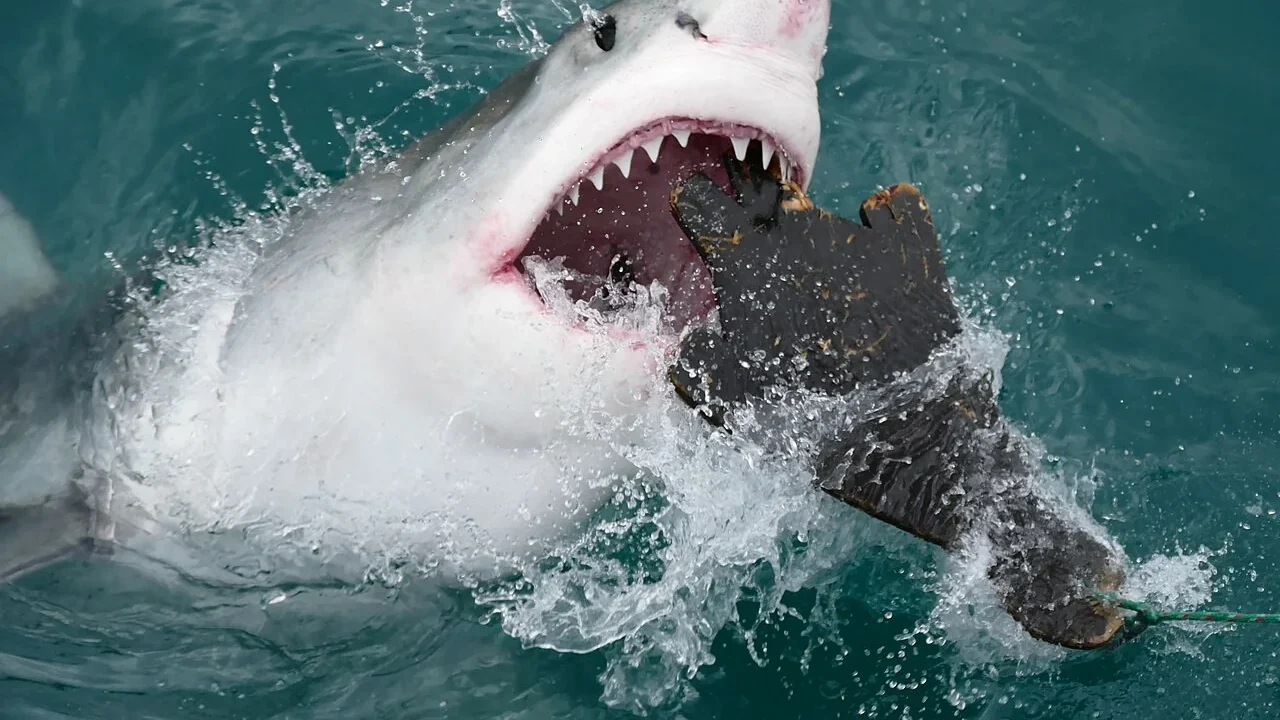

A dark shape passes beneath clear water, and everyone on the boat tries to give it a length. It looks enormous. The camera records the moment.
But the image does not record a ruler beside the animal.
Reports of a huge shark near a busy beach can make a normal question feel urgent: how big can a great white shark become? The answer requires a distinction between a species that genuinely grows large and a given sighting that may be hard to measure.
Great white shark size is impressive without an invented record. NOAA describes animals that can reach around twenty feet, with some summary figures slightly above that. Yet a claim that one shark is the biggest ever needs evidence beyond a striking view.
The real story begins with how a living animal is seen, measured, and understood.
Large adults belong to a slow-growing species
A great white shark can grow to several meters in length, but it takes years to do so. Age, sex, and growth differ from one shark to the next. One large animal does not prove a new species exists.
Nor can one sighting by itself prove a world record.
The great white's shape is built for swimming through a wide range of ocean states. A strong tail moves a body that can look both heavy and remarkably smooth in the water.
Its upper surface is darker than its pale underside. That color pattern can make part of the outline blend with the sea, especially when someone is looking from above or through changing light.
Size also changes through life. A young shark does not use the ocean in exactly the same way as a large adult. Food, habitat, and the movements of prey help shape where different animals are found.
Slow growth matters for more than the size question. A species that takes many years to mature cannot replace losses as quickly as one with a short life cycle and many young.
This is why the same traits that attract public fascination can create vulnerability. The animal's impressive scale does not make its population immune to fishing impacts or habitat changes.
A photograph can stretch the story
A photo can make a shark look larger when it is close to the camera. A boat behind it may look small by contrast. Lens choice, water, and the angle add more doubt.
A real photo is not always a sound scale from which to measure an animal.
Place a small object close to a camera and a large object farther away. The small object can fill more of the image. That familiar effect becomes harder to judge when the distances are hidden by water.
A shark may pass closer to a camera than a diver or boat used for contrast. Treating them as though they share one plane can produce an inflated length estimate.
The body's angle adds another problem. A shark viewed head-on, at a tilt, or through a bent surface does not present its full length in the same way as a straight side view.
Water and waves can further distort the visible outline. The animal may be partly hidden, and a moving shadow may be mistaken for the end of the body.
None of these effects requires a dishonest photographer. A real encounter can create an image that looks more dramatic than a measured contrast would show.
A record needs a method that another person can check
A strong claim about great white shark size states how length was measured and what uncertainty remains. Direct measurements, calibrated imaging, and documented observation can support different levels of confidence. A record claim should compare like measurements and remain open to review, rather than relying on a witness's impression alone.
A number gains meaning through its method. Was the full body measured? Was the animal straight?
Did the observer know the scale and distance? These questions explain why two reports can disagree without either person inventing a sighting.
Even the word length may refer to different measurements. A contrast needs the same definition on both sides. Otherwise, a longer-looking figure may come from a different way of measuring rather than a larger animal.
A useful record also preserves its evidence. Clear images, written records, and the setting of the measurement allow someone else to judge the result. A number repeated without those details becomes hard to test.
There are methods that estimate size from closely arranged cameras or known scales. Their strength lies in calibration, not simply in using more advanced gear.
Uncertainty should travel with the result. If an estimate could be off by a meaningful amount, giving a precise figure without that range can mislead readers.
The most convincing record is not the one with the boldest headline. It is the one whose method survives close questions. The animal does not become less impressive when the claim is narrowed to what the evidence really shows.
A shark near shore is not automatically behaving unusually
White sharks use both coastal and open-ocean habitats, with their choices changing through life. Food, temperature, and seasonal movement can bring them near shore. A sighting close to a beach does not by itself reveal an animal's intent or prove that its movements fall outside the species' usual range.
A beach can feel like a human place with the ocean attached. For a marine animal, it is part of a larger coastal system. Fish move through it, temperatures change, and food can be available at different times.
White sharks do not all occupy one narrow strip of water. Young animals and large adults can favor different settings. A sighting needs to be read alongside that life stage and local habitat.
A camera usually catches a short interval. It may not show where the shark came from, how long it stayed, or where it went next. That limited view cannot support a full story about its behavior.
Research tags can help answer movement questions over longer periods. They give a series of records rather than a single dramatic frame, although each kind of tag has its own limits.
For people at the coast, local safety guidance remains more useful than guessing at an animal's motive from a clip. A wildlife sighting should be handled through the suitable local data and response.
The distinction matters because fear can make every close encounter seem like a new pattern. Sometimes the new event is not the shark's presence. It is the fact that more cameras and observers noticed it.
The important unknowns extend beyond a giant individual
Teams still study white shark abundance, movement, and life history, even in well-studied regions. Large sightings can raise interest. But population health cannot be read from a few famous animals.
Protecting the species requires grasp many individuals and the pressures they face across a changing ocean.
One huge animal can become a public symbol for an entire species. That symbol is memorable. But it can hide how unevenly data is gathered.
A place with many observers may generate many reports without supporting more sharks overall.
A population trend needs more than a count of viral clips. Teams must consider where and when animals were seen, how effort changed, and whether the same individuals were seen again.
The great white is well studied in some settings. Yet basic questions remain. A lack of certainty is not a reason to invent a hidden abundance or a sudden collapse.
It is a reason to keep measuring closely.
The same care applies to a giant-size claim. An individual can be extraordinary while the population story remains hard. Those two facts do not compete with each other.
The best wildlife story keeps the wonder and the method together. It lets the animal be large, powerful, and difficult to study without turning every uncertainty into a monster.
The next time a shadow passes beneath a boat, the feeling may come first. That is natural. The number should come later, after someone asks whether the view really tells us how long the shark is.
Frequently Asked Questions
The most common questions mix a real species trait with a claim about one animal. These answers separate maximum scale, image measurement, and population trends. A shark can be genuinely large while a given photograph still leaves its exact length uncertain, and that distinction protects the value of the observation.
Can a great white shark really reach about twenty feet?
NOAA describes adults that can grow to around that scale. Individual size varies, and an exceptional sighting still needs a documented measurement.
Does a nearby boat make a photograph easy to measure?
Only if the relative distances and viewing angle are known. A boat farther from the camera can make a closer shark look disproportionately large.
Does one huge sighting show that white shark numbers are rising?
No. Population trends require systematic data across time and places. A single animal or viral photograph cannot show the size of a head count.

_attacking_a_seal_shaped_decoy_..._(29724038004).jpg)