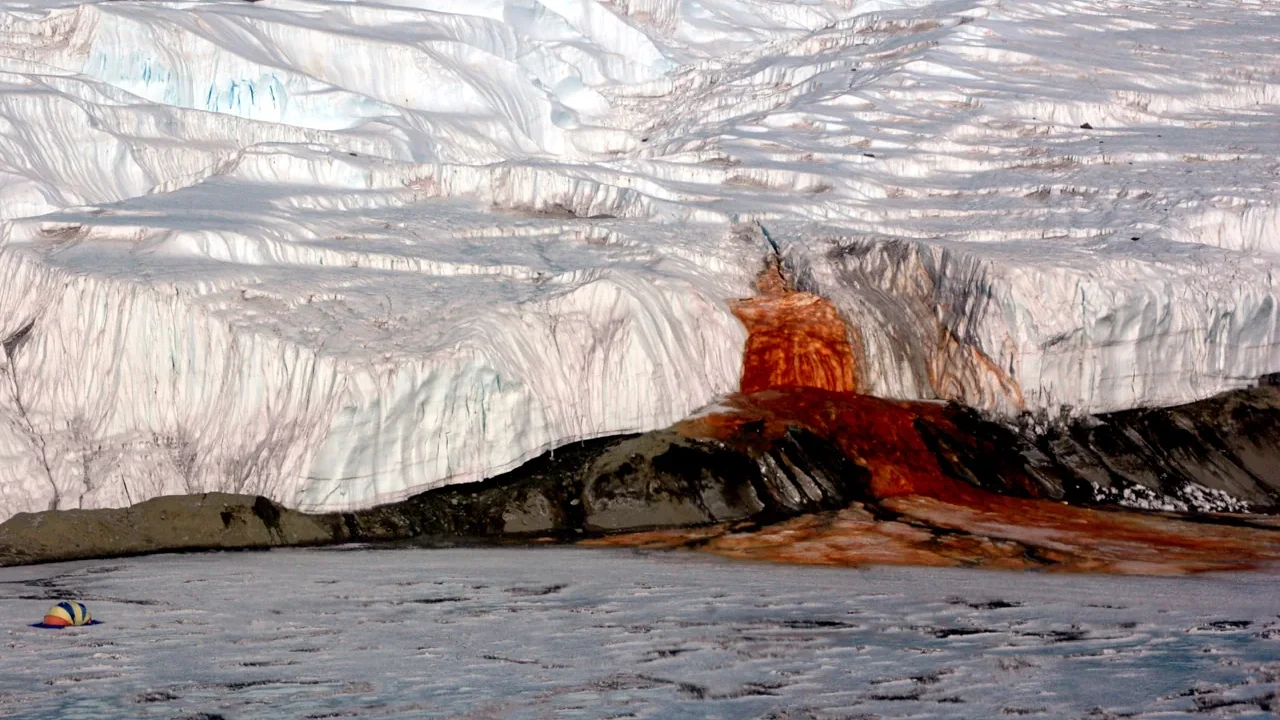

Red water marks the front of a glacier in Antarctica. Against white ice, the stain can look like a wound. The name Blood Falls captures that first impression, but no blood is flowing from the glacier.
Blood Falls Antarctica red water comes from iron-rich brine that reaches the surface from beneath the ice. Contact with air changes the matter and gives it the striking color. The water's salt content helps make the hidden liquid possible in a place that seems entirely frozen.
The color has an account, while the whole system still offers questions. Beneath the well-known image lie fluid routes, tiny bits, and microbial life adapted to a cold, dark setting.
The Red Color Begins With Iron-Rich Brine
Blood Falls is an outflow at Taylor Glacier in Antarctica's McMurdo Dry Valleys. Its salty water contains iron. When it reaches air, iron-rich material oxidizes and turns red; the name describes that appearance, not blood or a red animal hidden within the glacier and its buried water system.
Brine is water with a high concentration of dissolved salts. Its chemistry differs from fresh water, including the temperature at which it freezes. That gap is one reason liquid can exist within a setting that looks too cold at first glance.
Iron adds the seen clue. Matter carried in the water changes when exposed to oxygen. The red staining then marks the ice and the surface around the outflow.
The image shows the result of a change in the iron, not the original color of each drop underground.
Early explorers considered other accounts, including algae. Later work shown the value of iron-rich salty water. The story shows how an appealing visual guess can be replaced as samples and methods improve.
Thomas Griffith Taylor logged the feature during the Terra Nova expedition in 1911. That date belongs to the history of human record, not the date when the entire hidden system began.
The fall is also not always a large open cascade. The outflow can create deposits and staining, with look changing through conditions and time. A single bright image should not imply a constant volume flowing each day.
The location matters. Taylor Glacier, Taylor Valley, and Lake Bonney are linked names within the setting. They are not interchangeable labels for each red patch or each Antarctic glacier.
The first account is therefore chemical and local. One salty fluid reaches air at one glacier, and its iron-rich matter changes. That is enough to make the red scene real without keeping the word blood as a literal cause.
Tiny Particles Made the Color Story More Precise
A 2023 study examined Blood Falls matter with powerful microscopes and identified tiny iron-rich nanospheres. Their oxidation helps explain the color. These bits were not simply usual iron-oxide crystals; the finding refined an older broad iron account by showing why the structure and scale of the matter matter.
Calling the color rust is a useful first image because many people know that iron can turn red-brown when it reacts with oxygen. Yet an image can stop too soon. The exact bits in a natural sample need to be examined.
Johns Hopkins expert Ken Livi studied matter from the water using an electron microscope. The work found tiny round iron-rich structures containing a few elements. Their small size and lack of a usual crystal structure helped explain why earlier approaches could miss their role.
Nanospheres are a shape and scale account. The word does not mean an engineered product was placed beneath the glacier. Natural processes can create very small structures with key optical and chemical effects.
Related Reading
Crystal structure also matters. Some methods are most of all useful for naming orderly crystalline matter. If a sample's useful bits do not have that order, a search aimed only at standard minerals can overlook part of the story.
The broad account and the newer detail do not need to be enemies. Iron oxidation was already central. The later work added a more clear account of the matter carrying that process.
This is a common pattern in science. A useful first answer can be refined rather than discarded. Blood Falls did not become mysterious again because a microscope revealed more detail; the answer became more precise.
The image's red color therefore connects scales. At one scale, it stains a glacier face. At one more, tiny bits react with the air.
Grasping the link needs both field samples and tools that can see far below the scale of the image.
A red stain can be easy to see and hard to explain at the right scale. From far away, it looks like one patch of color. In a sample, it becomes a crowd of tiny bits.
A tool that sees their shape asks a different question from a tool that looks for an ordered crystal.
That is why a new method can add to an old answer. The iron was not a new element added to the story in 2023. The new view helped show the form in which it occurred.
The big scene stayed the same while the small-scale account became clearer.
The Hidden Water Has Its Own Route Through the Ice
Research links the outflow with a subglacial brine system beneath Taylor Glacier. Salt helps lower the freezing point, while pressure and fractures can influence release. Studies use radar, time-lapse images, and other records to investigate the route; the exact triggers of each outflow event are not fully settled.
A glacier is not always a simple solid block with nothing happening inside or below it. Water, sediments, salts, and pressure can create a more mixed system. Blood Falls gives a seen outlet from part of that hidden setting.
Radar can help map structures beneath ice. It does not give a normal image of a hidden lake. The return signals must be read through models of matter properties and geometry, which is why other evidence remains useful.
Time-lapse images add the timing of seen change. A camera can show when staining or an outflow develops, even when no person is watching at that moment. The record helps connect surface events with weather and other conditions.
University of Alaska work has examined outflow history and a winter release. A release without surface melting is most of all informative because it tests accounts that depend on meltwater entering from above.
Pressure-driven fracture is one route considered in that work. The key point is not that each release has one proven trigger. It is that records can narrow which processes fit one event.
The water's age and the history of the salts also need care. A long-isolated system can contain a complex record. Estimates about when a reservoir formed should not be reduced to an exact birthday for each drop emerging at the surface.
The hidden route keeps part of the story open. The red color is no longer an unexplained look, but the timing and mechanics of release still reward study. A mystery can lose one question and gain a more focused one.
A Dark Ecosystem Offers Clues Beyond the Color
The brine system contains microbial life adapted to cold, dark, salty conditions. Microbes use sources of chemical energy rather than local sunlight. Their study helps researchers ask how life persists beneath ice and what similar settings might offer elsewhere; it does not establish a discovery of life on another planet.
Sunlight supports much of the life well-known at Earth's surface. Beneath a glacier, that direct route is unavailable. Microbes can use other chemical supplies, which makes the system valuable for studying the range of conditions life can occupy.
The National Science Foundation describes the outflow as a window into a sub-ice ecosystem. The phrase is useful because teams can sample matter that reaches the surface. They do not have to treat the red stain as a full view of the entire hidden community.
The living things' slow life and small supplies matter. Survival in a harsh setting does not mean rapid growth or easy abundance. A system can remain active at a pace very distinct from a sunlit pond.
Astrobiology uses such places to sharpen questions about other worlds. Cold, salty, dark settings are useful to ideas about Mars and icy bodies. The contrast guides methods and expectations; it does not give evidence of extraterrestrial living things by itself.
The nanosphere finding adds a second lesson for that wider work. Instruments tuned to find certain kinds of minerals may miss other forms of matter. A search for life-linked clues needs to consider the range of structures nature can make.
Blood Falls therefore joins life science, fluid behavior, and matter science. The famous color is the entry point, not the whole subject. Each field asks a distinct question about the same outlet.
The red mark on white ice remains striking. Knowing its cause makes the deeper story seen: a hidden salty system, tiny reactive bits, and life using supplies far from sunlight. The glacier is not bleeding.
But it is offering a real science window into a world beneath its surface.
Frequently Asked Questions
These questions separate the color from the name, salty water from fresh-water expectations, and an Earth analogue from a find elsewhere. They keep the account grounded while showing why the whole system matters. Blood Falls is most interesting when its chemistry and living setting are studied together.
Is the Red Color Actually Blood?
No. It comes from iron-rich matter in salty water that changes when exposed to air. The name is based on look.
How Can Liquid Water Exist Beneath Cold Ice?
High salt concentrations lower the freezing point, and the local system has its own pressure and heat conditions. Fresh-water assumptions do not describe the whole brine setting.
Does Blood Falls Prove There Is Life on Mars?
No. It gives an Earth setting useful for contrast and testing ideas. Evidence of life on one more world would need records from that world.