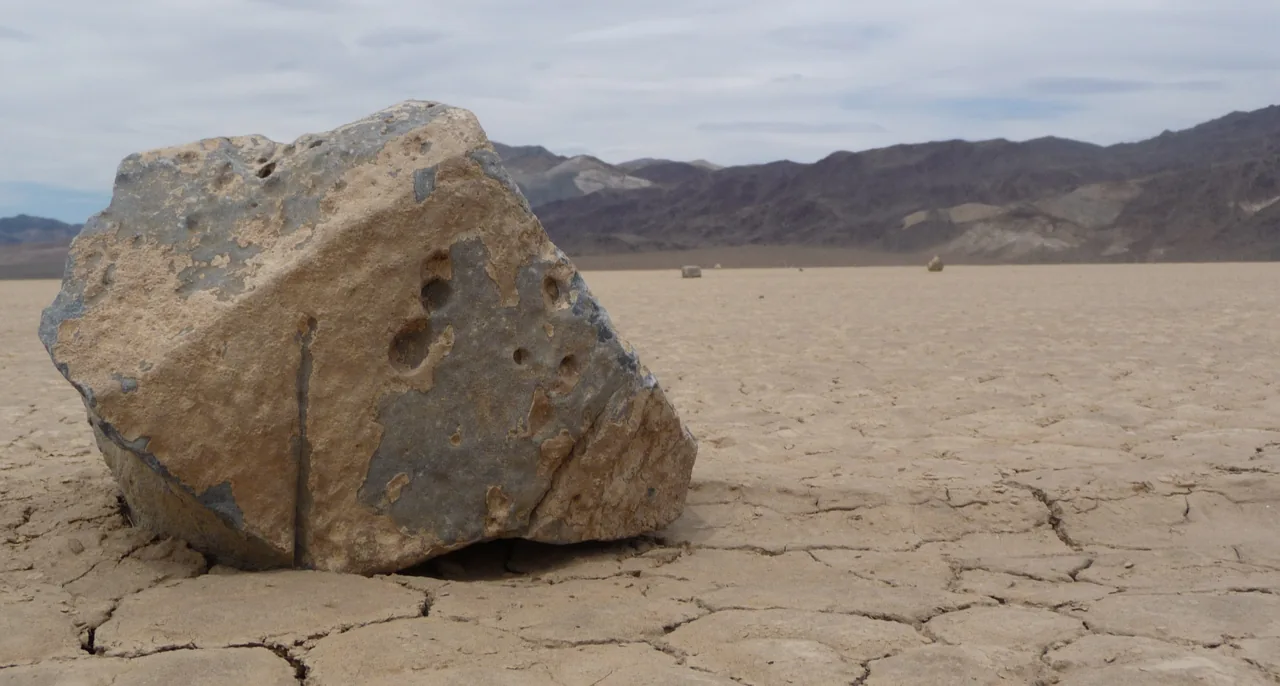
A rock rests at the end of a long trail across a dry lake bed. The track turns, curves, and sometimes runs close to other tracks. No footprints explain the movement.
For decades, the stones looked as if the desert had quietly pulled them across the ground.
Sailing stones Death Valley is now a mystery with an observed mechanism. In 2013, teams watched thin floating ice and light wind move rocks across wet mud at Racetrack Playa. The work was noted in 2014.
The account is striking because it combines conditions that seem out of place in a famous desert: water, freezing nights, sunlight, and ice. The stones did not need a hidden force. They needed a rare moment when those normal ingredients worked together.
A Dry Lake Bed Keeps Long Records of Motion
Racetrack Playa is a dry lake bed in Death Valley National Park. Rocks leave trails when conditions allow them to move across soft mud. The tracks remain after water and ice disappear; this made the scene puzzling because most visitors saw the record without seeing what caused it.
A playa can be dry for much of the time and still hold shallow water after suitable weather. The word dry describes its normal look, not a rule that water never reaches it. That gap is central to the stones' story.
Rocks arrive from the surrounding landscape through normal erosion and gravity. Once on the flat surface, some can move under the right conditions. Their trails then become a record that lasts longer than the moving event.
The tracks are not all straight. Some curve, change direction, or run alongside others. Those shapes gave teams clues to shared forces.
If a few stones moved together, an account had to account for that linked pattern.
The rock at the end is not always seen in each image of a track. A picture can show one part of a longer history. That is one more reason field notes matter when a striking image becomes the basis of a claim.
The National Park Service describes a range of stones and trails at the site. The seen mechanism should not be used to claim that each rock in each period was tracked directly. A supported process can explain many features while leaving individual histories unrecorded.
The seen scene creates a timing problem. Visitors arrive when the surface is dry and the stones are still. The conditions that moved them may have been brief and rare.
Absence of movement during a visit is not evidence that the tracks are impossible.
The first clue is therefore the mismatch between event and record. The desert preserves a line long after the water and ice that helped make it have gone.
A Shallow Pond Freezes Into Thin Ice
The seen process begins with shallow water on the playa and freezing conditions that create thin floating ice. As sunlight warms the surface, the ice can break into panels. Those panels give a large area for wind to push while remaining in contact with rocks in the shallow pond.
The pond must be shallow enough for rocks to interact with ice and mud, yet deep enough for part of the ice to float. That balance is more specific than the simple presence of winter weather. Not each cold night makes a moving-rock event.
Related Reading
Thin ice is the surprising feature. Earlier ideas sometimes involved thick ice carrying rocks or very strong wind acting directly on them. The records showed that light panels could act across a broad area without lifting the stones like cargo.
Sunlight changes the ice after a freezing night. Cracks and breaks divide the surface into pieces that can move. The timing matters because the useful panels exist only during part of the pond's changing state.
Ice has a larger area than the exposed side of a small rock. Wind can push that area and transmit force to a stone at its edge or within its path. The arrangement helps explain why light wind can matter more than a viewer might expect.
The rock still has to move across mud. The wet surface differs from the hard dry ground seen by most visitors. The same stone can be hard to shift under one condition and easier under one more.
This is a coupled process. Water prepares the surface. Cold forms ice.
Warming breaks it. Wind moves the panels. Mud records the stone's path.
Removing any one part can change the result.
The account is not that deserts secretly behave like polar seas. It is that a desert can briefly give the right ingredients for a very local ice-driven event. The rare combination, rather than a rare force, made the tracks hard to witness.
Researchers Finally Watched the Stones Move
Researchers watched rocks move at Racetrack Playa in December 2013 and recorded the conditions. Thin ice panels and light winds pushed stones slowly across mud. Work published in 2014 linked that process with the track puzzle, replacing guesses with direct observations and measurements of real moving events.
A mystery changes when someone sees the event instead of only its aftermath. The teams had prepared to monitor the site, including rocks fitted with GPS devices. That planning allowed movement to become data rather than one more unverified story.
The ice breakup was audible as cracking and popping. Then panels began to move with wind across the shallow pond. The stones advanced slowly enough that an observer could miss the motion without watching carefully.
The National Park Service account describes movement under light winds of roughly three to five meters per second. That was a contrast with ideas needing hurricane-like wind. The ice gave the wind a larger surface to act on.
Movement was measured in meters per minute, not a dramatic racing speed. The name sailing stones can suggest a fast glide, but the seen pace was modest. Long tracks can form through repeated or sustained slow movement.
Some rocks moved together because they met the same moving ice. That helps explain nearby trails with similar turns. Shared patterns no longer needed a hidden hand dragging each stone separately.
The study did not simply declare an idea plausible. It combined direct watching with records of position and conditions. That combination is what made the result decisive for the seen events.
The year also needs clarity. The movement was witnessed in 2013, and the account was published in 2014. Saying the rocks first moved in 2014 would confuse the date of the report with the date of the physical event.
A Solved Mystery Still Needs a Protected Surface
The ice-and-wind observations explain a real process, but the site remains fragile. Footprints and vehicle tracks can damage wet playa surfaces. Rocks and trails should stay in place; Knowing the mechanism gives visitors a reason to protect the evidence, rather than push stones and create false records.
The tracks are not only a spectacle. They are records of conditions and movement. Disturbing a stone or marking the mud changes the scene that teams and other visitors use to grasp the place.
Wet ground is most of all at risk. A footprint can last long after the brief conditions that made it. The same skill to preserve a stone's trail can preserve damage made by a person who walks across soft mud.
The Park Service asks visitors to avoid disturbing the surface and the rocks. That guidance follows the site's physical nature. It is not an arbitrary rule designed to keep a solved mystery out of reach.
The account also changes what curiosity should seek. There is no need to push a rock to see whether it makes a track. That would record human interference, not the natural process.
The interesting evidence is the link among water, ice, wind, and mud.
Not each future event will look exactly like the one seen. The water depth, freezing, panel size, and wind can vary. A mechanism can be shown while its occurrence remains irregular and worth monitoring.
The solved status is part of the appeal. The landscape offered clues for years, and a well-timed study linked them with the event. It shows how patient measure can turn an eerie scene into a clear physical story.
The rock at the end of the trail is still silent. Its silence no longer needs an unknown force. The line behind it records a rare day when a desert pond froze, broke, and moved, leaving the stone a little farther from where it began.
Frequently Asked Questions
These questions distinguish the apparent self-motion from the measured forces and explain why light wind can be enough. They also mark the gap between a solved mechanism and a complete record of each stone. The site remains scientifically useful precisely because its surface preserves events so well.
Do the Rocks Move by Themselves Without Any Force?
No. The seen process involves floating ice panels pushed by wind across a shallow pond. The rocks move over wet mud under those conditions.
Does the Process Require Extremely Strong Wind?
The logged events occurred under light winds, aided by the broad area of thin ice. That differed from earlier ideas needing very strong wind acting directly on rocks.
Is the Mystery Still Completely Unexplained?
No. Direct records and instrument records shown an ice-and-wind mechanism for seen events. Individual track histories and future occurrence can still be studied.