
The emperor listened while men who disagreed about God argued in front of his throne. Rank shaped life at court. A question about faith could thus lead to a harder one.
Who had the right to give the king advice?
Akbar religious debates grew out of that charged setting. They brought new voices to the Mughal court. Yet it did not become a place where all could speak.
Every guest still entered a world ruled by an emperor.
That tension makes the story worth hearing. Akbar could hear new views and fund art, yet also make his own rule stronger. The open question and the throne shared the same room.
Who Entered the House of Discussion?
Akbar's court hosted discussions among Muslim scholars and, later, thinkers from other faiths. These meetings are associated with the Ibadat Khana at Fatehpur Sikri. They reveal a ruler's sustained interest in belief, though the surviving accounts do not let us reconstruct every conversation or treat all participants as equals.
Akbar ruled from 1556 to 1605. His empire held people with many beliefs, languages, and local loyalties. The task of governing them gave questions about religious authority a practical weight as well as a personal one.
The Ibadat Khana, often translated as the House of Worship, became a setting for debate. Early discussions involved Muslim scholars. The circle later widened to include people whose ideas came from other traditions.
Museum accounts describe Hindu, Jain, Christian, Jewish, and Zoroastrian voices among those involved in religious discussion at court. The king heard more than one kind of learned view. That alone changed who could speak in his court.
Imagine the difficulty of the exchange, without inventing its words. A term that seemed clear to one scholar might need careful explanation for another. The ruler had to listen across those differences, while everyone knew his response mattered.
Religious dialogue still had stakes. A guest could defend a faith and seek the king's favor at once. Belief, rank, and power met in the same place.
Nor can we assume that all subjects enjoyed the same access as selected guests. An invitation tells us who reached the ruler. It does not show that an ordinary person could enter the hall and challenge the throne.
The meetings were remarkable within their own setting. We understand them better by keeping that setting visible, rather than turning them into a copy of a modern panel discussion.
A New Capital Built for a Listening King
Fatehpur Sikri gave Akbar's court an architectural setting for government, ceremony, and inquiry. Its buildings drew on several artistic traditions. The city helps us picture the world around the debates, but surviving stone alone cannot identify every conversation or reveal exactly what each guest believed when leaving the court.
The red sandstone buildings of Fatehpur Sikri stand near Agra. Much of the great palace complex took shape while Akbar used the city as his capital in the 1570s and early 1580s.
A court was not just a king sitting in one room. Officials brought business. Visitors presented gifts.
Artists, translators, servants, guards, and builders all helped keep the larger system moving.
Related Reading



The buildings bring styles together. Some forms had roots in Iran and Central Asia. Others drew on skills and tastes from India.
Makers chose and joined these forms. They did not just copy a whole palace from one distant place.
That makes the city a useful companion to the story of the debates. The buildings and the conversations both show a ruler drawing on varied resources. Yet a resemblance between two patterns does not prove that a particular carved bracket represents one religious policy.
Old stone can tell us much, but not all. A court can show who could pass through a space. A carved screen can show skill.
Neither records the words that guests spoke at night.
The distinction protects the human story. The people who spoke here had doubts, ambitions, and disagreements that no surviving wall can fully record. Their world was lived before it became a monument.
When Akbar later made Lahore his principal residence, the court's work moved with him. The life of the empire was larger than a single capital, and the reach of an idea did not depend on one room remaining full.
The Books That Turned Power Into a Story
Akbar supported illustrated manuscripts and brought artists from different backgrounds into royal service. These books record events and express the court's view of its ruler. They are rich historical sources, but their beauty and detail should not make us mistake a commissioned image for an unfiltered window onto the past.
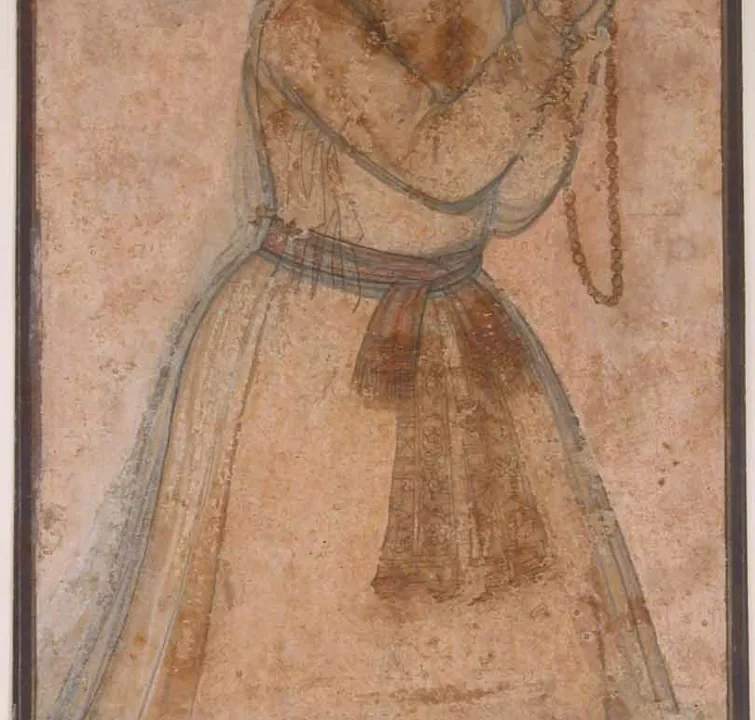
Royal patronage made books into major works of art. Painters supplied faces, landscapes, battles, and scenes of ceremony. Calligraphers and other makers turned text and image into an object worthy of the court.
Court painters did not all come from one background. Persian and Indian artists worked within the Mughal workshop. Their shared labor helped develop a style that changed over time rather than arriving fully formed.
The Akbarnama told the history of the reign. It gave Akbar's acts a place within a larger account of kingship. A richly painted scene could make an event feel close, even when it was made years after that event.
This is where a reader needs two kinds of attention. Look at what the picture shows, and ask why someone wanted the scene shown in that way. Clothing, posture, and placement may tell a story about rank as well as appearance.
A court history can preserve useful detail and still favor the ruler. Favor does not make every statement false. It gives us a reason to compare the account with other evidence and to notice what it leaves out.
That approach also applies to Akbar religious debates. Accounts written near power may present a wise king judging quarrelsome scholars. The picture helps explain an ideal of rule, while the actual exchanges were likely less tidy than any finished royal story.
The books add depth, but do not settle all the questions. They show how a court wished to be seen. They also hold clues to what it did.
We can learn from both, while keeping the two apart.
Curiosity and Authority Shared the Throne
Akbar's interest in different beliefs widened courtly discussion and helped shape an image of inclusive rule. It also existed within an empire that used force and hierarchy. Understanding the debates means holding those facts together, without declaring the ruler either a modern liberal or a man whose curiosity meant nothing.
Imperial power gave Akbar the means to summon scholars, support translations, and pay for books. The same power set the terms on which those activities took place. Curiosity did not float free of the state that funded it.
That is why we need to ask what a ruler meant by peace. A king could hear more voices and still demand that people obey him. He could hear a case yet keep the final right to judge it.
The discussions also belonged to a changing reign. A meeting held early in the experiment need not have had the same guests or purpose as one held later. Treating every debate as a single event flattens years of thought and conflict.
Akbar's religious interests extended beyond conversation to a code of conduct and forms of personal devotion. Historians differ over how best to describe some parts of that project. A neat claim that he simply invented a new mass religion can hide more than it explains.
Smaller questions can be more useful. Who could reach the king? Which books did he fund?
What did a court writer praise? These questions give us clues that we can test.
They also make the story more human. A scholar did not need to agree with every guest for an encounter to matter. A court did not need to become equal for a wider range of voices to alter its habits.
Fatehpur Sikri's empty spaces can make the old discussions seem silent and settled. They were neither while people lived them. Each speaker brought a view of the world, and each spoke within the reach of a throne.
That balance is what holds our gaze. A king asked questions that crossed old lines. Those lines did not all go away.
The talks left books, buildings, and hard questions for us to read.
Frequently Asked Questions
The main questions concern who joined the discussions, how open the setting was, and what the surviving sources can show. The evidence points to a wider courtly exchange, not a modern free forum. Books and buildings help recover that world while leaving some of its voices beyond our reach.
Did Akbar invite only Muslim scholars to debate?
The early discussions involved Muslim scholars, but the circle widened to include thinkers from other faiths. The court became a meeting place for several traditions rather than only one school of belief.
Were the debates the same as modern religious freedom?
No, selected guests spoke within an imperial court governed by hierarchy. Their access does not establish equal rights or open participation for everyone in the empire.
Can Mughal paintings show exactly what happened?
They preserve valuable detail and ideas about royal life. Many were commissioned to tell a courtly story, so they need to be read alongside texts and other evidence.
Sources and Further Reading
Explore History & Civilizations for more archaeology, ancient lives, and the records that bring the past into view.