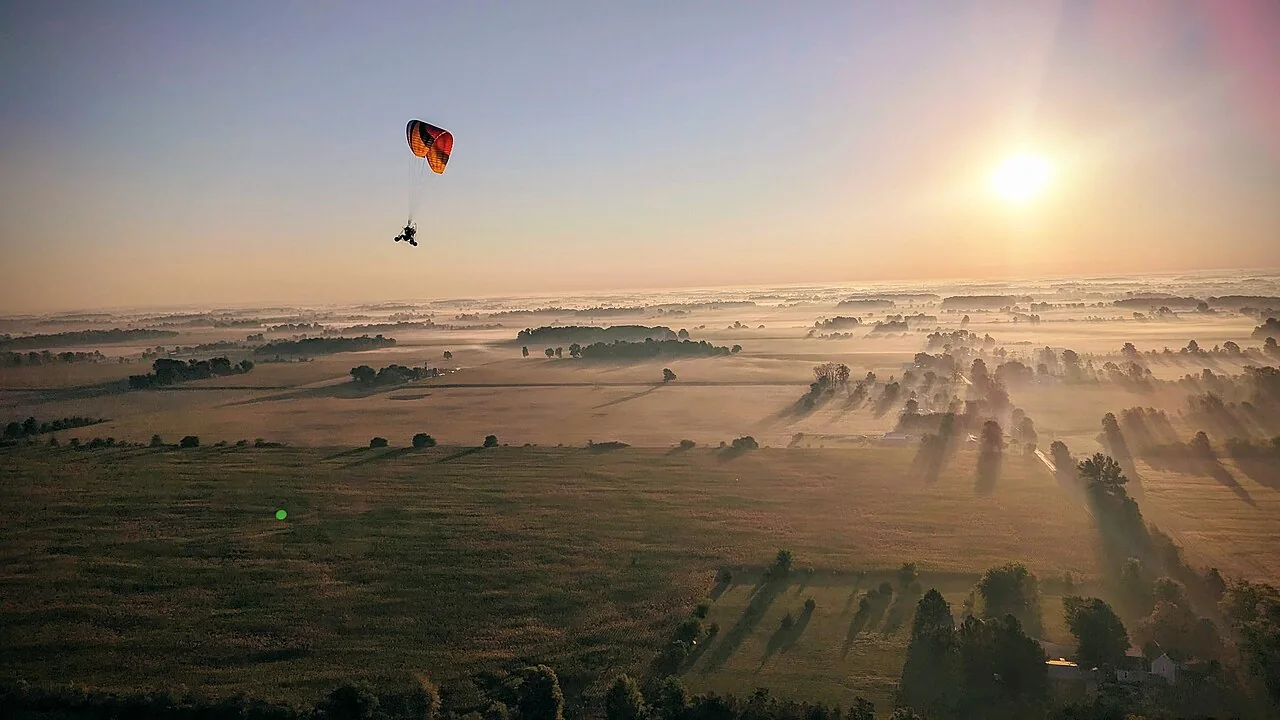

A work commute can begin with a wing spread on the ground instead of a key turned in a car. A report from Colorado described air traffic controller Jake Hutzler traveling to work by powered paraglider, adding an unusual flight to a very familiar destination.
The machine is small compared with the aircraft he helps guide. A fabric wing carries the pilot. An engine and propeller give thrust.
It looks like freedom from roads. But that view leaves out the planning beneath the flight.
Paramotor commuting is a useful case study in how a simple-looking invention meets a hard setting. The wing must work with moving air, the route must fit the space around an airport, and the trip needs somewhere suitable to end. The sky offers room.
Yet it is not an empty road.
A fabric wing does the lifting
A powered paraglider combines a flexible wing with an engine-driven propeller and a suspended pilot. The wing gains its shape and lift from airflow. The engine supplies thrust rather than acting as a helicopter rotor.
That difference explains both the machine's appeal and its reliance on suitable weather and space.
The wing is not a rigid airplane wing with a fixed shape. Air enters its cells and helps it take form. Lines connect that structure to the pilot below, creating a system that must work as a whole.
The propeller moves air to produce thrust. Forward motion then lets air flow across the wing. Lift and thrust perform different jobs, even though both are needed for a powered flight.
This is why the machine can look deceptively simple. Fabric and lines make the wing appear light. But they also require care, correct assembly, and an grasp of how the system behaves.
A photograph often captures only the calm part. The pilot hangs beneath an inflated wing, apparently floating above the landscape. It does not show the preparation that allowed that stable shape to develop.
Nor does the image make a paramotor a small helicopter. The wing needs airflow and does not offer the same style of hovering or vertical operation. Comparing the two based on an engine alone misses the main difference.
The route includes more than the line on a map
Paramotor commuting depends on suitable departure and landing areas as well as the route between them. Obstacles, nearby people, weather, and airspace all affect that route. A straight line can be short on a map while still being a poor choice for a real flight over the same ground.
A road map invites a tempting thought. If traffic follows a long bend while a workplace sits straight ahead, flying seems to remove the problem. That shortcut has to be judged in three dimensions.
The start and end are part of the journey. A clear patch seen from above may contain lines, fences, people, or an uneven surface that is hard to notice until much closer.
The air can also change along the route. Buildings and hills affect its flow. A smooth view from the ground does not mean the air above every part of it behaves in the same way.
An airport adds another layer. Other aircraft may be approaching, departing, or moving through defined areas. Their paths cannot be guessed simply by looking for a plane in the sky.
A sensible contrast with driving therefore includes the whole system. Time spent preparing, checking states, and packing gear belongs in the commute, even if a video shows only the airborne minutes.
Weather is part of the machine
A flexible wing moves with the air around it, so weather is part of the flight. Wind, gusts, and local turbulence can change a route. A trip that works on one calm day may not work on the next.
This limits how well the method fits a daily schedule.
A commuter usually expects the vehicle to be available at the same time each morning. Personal aviation makes that expectation harder to meet. A calendar appointment cannot change the air outside.
Wind has both direction and strength. It can assist motion along one route while making another route less useful. The same speed shown on a forecast also may hide gusts or local effects.
The ground shapes the air above it. A hill, a row of trees, or a large building can disturb flow. These changes matter to a light wing even when the surface scene looks peaceful.
That does not mean weather is a mysterious enemy. It is a state to grasp before choosing to fly. The limits come from the aircraft's design, the pilot's skills, and the given location.
A story about one successful trip should therefore not be read as a promise of year-round travel. The eye-catching method may be used only when the states fit, with a road journey remaining the daily alternative.
This is a useful lesson for many inventions. A device does not operate outside its setting. Its real performance includes the setting, and the setting does not always agree with a person's schedule.
Air traffic control cannot be replaced by confidence
A paramotor pilot must grasp the airspace and applicable rules for the planned flight. Near airports, prior authorization may be required for certain areas. Knowing how air traffic works is valuable.
But it does not remove those needs or make a small vehicle exempt from sharing the sky responsibly.
The reported commute is striking partly because the traveler works in air traffic control. His job places him within the larger system that manages aircraft movement. That knowledge makes the story unusual.
But it should not be mistaken for a universal permission.
The Federal Aviation Administration describes airspace with different classes and states. Its guidance notes that ultralight operations in a few kinds of controlled airspace need prior authorization from the responsible control facility.
The exact rules depend on the vehicle and location. A powered paraglider should not be assumed to meet every legal definition of an ultralight just because it is small or carried on someone's back.
Contact matters because seeing and being seen are not the same thing. A small vehicle can be difficult for others to spot. Its presence needs to be understood within the procedures that apply to the area.
An article cannot approve a route or certify a pilot. The useful lesson is narrower: a novel commute still takes place inside a real system of rules, other users, and shared responsibility.
The impressive part is not ignoring that system. It is making a small flight fit within it. Seeing when the daily way to work is the better choice.
A striking commute is not yet a transport revolution
Personal aviation can offer memorable journeys without replacing the everyday transport network. Cost, training, weather, storage, suitable sites, and local rules all affect its practical reach. Paramotor commuting is an inventive example of one person's travel choices, rather than proof that busy cities can move their traffic into the sky.
The first reaction to a flying commute is often delight. A familiar journey looks new when it is seen from above. The story turns a workday into a small adventure.
A wider transport system must solve more than one person's route. It needs to handle many users at once, reach homes with little open space, and operate through changing weather. Those demands are far harder than showing that a single trip can work.
Noise and shared space also become key as use grows. A method that attracts curious looks once a week can have a different effect if many people use it every morning.
This does not make the invention unimportant. Small aircraft can teach useful lessons about lightweight design and the relationship between people and moving air. Their value need not depend on replacing buses or trains.
The practical appeal is more personal. A suitable pilot, with the right preparation and states, may gain a special way to see a landscape that would otherwise pass behind a windshield.
The commute remains memorable because its destination is so daily. The pilot lands, the workday starts, and the rare view of the world becomes part of a routine built around the same clock as everyone else's.
Frequently Asked Questions
The common questions concern how the aircraft works, where it may fly, and whether it fits a daily schedule. These answers separate the unusual journey from broader transport claims. They are an account of the technology, not flight training or permission to use a given route.
Is a paramotor the same as a helicopter?
No. A paramotor uses a flexible wing for lift and a propeller for thrust. It does not operate like a helicopter with a lifting rotor.
Does being small allow it to fly through any airspace?
No. Airspace rules still apply, and authorization may be required near airports. The vehicle and planned route need to be assessed under the relevant local rules.
Can it replace a car for every workday?
That depends on weather, suitable sites, training, and other practical limits. A reported successful commute does not prove that the same route is usable every day.