
Six long edges sit in the clouds of a world with no solid surface beneath them. The outline looks almost drawn with a ruler, yet wind keeps making it. At Saturn's north pole, weather takes a shape that feels oddly deliberate.
The Saturn hexagon storm is a popular name for this scene, but it can hide a key detail. The six-sided boundary traces a jet stream, while a separate swirling storm sits nearer the pole. Seeing both clearly makes the real puzzle even more interesting.
What makes the six-sided outline?
The outline belongs to a fast north polar jet, rather than a solid wall or a built structure. Scientists study it as a large wave in the moving atmosphere. Clouds help trace its shape, allowing cameras to reveal a pattern that can last while the gas within it keeps flowing.
Picture a ripple held in place while water passes through it. The comparison is imperfect, but it helps separate a lasting shape from the moving material that marks it.
A standing wave can retain its general position without requiring every cloud to stay still. That is why a well-known outline can coexist with a restless view full of swirls.
Voyager views first revealed the cloud patterns in the early 1980s. Years later, Cassini images brought much closer views, including details that changed as the spacecraft's orbit and the planet's lighting changed.
The discovery was not a single lucky snapshot of a passing puff. Its long history makes the hexagon a test for ideas about how giant-planet winds organize themselves.
A sequence of views is more revealing than one frame. Watching small clouds move while the broad boundary persists helps show that the shape and the material tracing it are not the same thing.
Is the central storm part of the hexagon?
A polar vortex sits inside the wider six-sided jet pattern, but the two are not the same feature. The inner storm has its own swirling eye and clouds. Keeping them separate avoids treating the hexagon as a single six-cornered hurricane with one simple size, speed, or cause.
Related Reading

Look closely at a clear polar view. The dark center pulls your eye inward, while the broad outline wraps around a much larger region.
Both features belong to the same atmosphere, so they can influence the nearby flow. That does not make every movement inside the boundary part of one storm.
On Earth, well-known labels can be useful guides. On Saturn, they can also mislead if we carry over every detail of an earthly hurricane, including its relation to a warm ocean below.
Saturn is a gas giant. Its deep atmosphere, rapid spin, and large scale create a very different setting, even when a small part of the view looks familiar.
Why did the region change color?
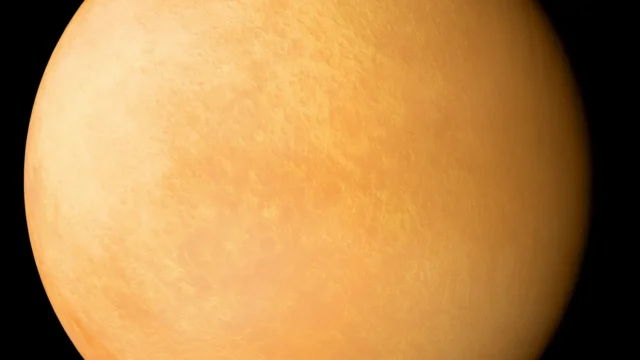
Cassini recorded the region inside the hexagon shifting from a bluish appearance in 2012 toward gold in 2016. Teams linked the change to possible seasonal growth of haze under increasing sunlight. Color therefore records more than shape: it can also reveal changes in particles above the clear clouds.
A long Saturn year gives each season many Earth years to unfold. As the north tilts toward more sunlight, the upper atmosphere has time to change.
Seasonal haze may help explain why two views of the same region look so different. Sunlight can drive chemical reactions that make tiny particles, which then affect the light a camera receives.
The word “may” matters. Teams compare views and models rather than read a complete chemical history from color alone.
Image processing matters too. Natural-color views aim to approximate the colors our eyes see, while other filter combinations highlight features our eyes would not see in the same way. A vivid science image can be real data without being a literal window view.
What does the hexagon teach us about weather?
The hexagon gives teams a long-lived example of organized flow on a giant planet. Models and lab tests explore how rotating fluids can form waves and polygonal patterns. Matching a shape is only part of the task; a useful account must also fit the observed winds, scale, and persistence.
This is where the lovely outline becomes a hard test. A model can draw six sides and still fail to describe the actual atmosphere.
Why does the wave form there, and why does it last? Scientists also need to explain how it links with nearby flow. Different approaches explore parts of that problem.
The spacecraft has finished its mission, but its record remains useful. Views from many years reveal changes that a short visit could miss.
The best view is therefore more than a strange pattern to admire. It is a weather record from far away, showing how motion can build order without anyone drawing the edges.
Frequently Asked Questions
The clearest answers distinguish the moving gas, the wider wave, and the central vortex. They also separate the date of discovery from later detailed views. Once those distinctions are clear, the real photos become easier to read without adding solid walls or hidden structures to the scene.
Is Saturn’s hexagon a solid object?
No, it is a pattern in moving atmospheric gas. Clouds reveal the wave associated with the jet stream.
Did Cassini discover the hexagon?
No, Voyager views revealed it earlier. Cassini later recorded much more detailed views of its structure and changes.
Are all pictures of the hexagon natural color?
No, scientists use varied filters and processing methods. Check each image caption to learn whether the colors show colors in visible light or highlight selected wavelengths.
Sources and Further Reading
Explore Space & Universe for more planets, cosmic discoveries, and the missions exploring beyond Earth.