
A loop of punched paper raced past a light reader, carrying a message its senders believed was secure. Nearby, racks of hot valves counted patterns at a speed no room of people could match by hand.
The Colossus codebreaking computer did not look like a desk machine. It filled space, needed trained staff, and served a narrow wartime task. Its story becomes clearer, and more impressive, when we look at the exact problem it helped solve rather than give it every later invention in computing.
Which secret messages did it attack?
Colossus helped attack the Lorenz cipher used for high-level German teleprinter messages in World War II. British codebreakers called this traffic Tunny. The machine tested number-based patterns that helped find cipher-wheel settings, forming one part of a wider operation that turned intercepted signals into readable German text.
This was not the same task as breaking Enigma. Both belong to the story of Bletchley Park, but they used other machines and methods.
That distinction also matters for credit. Tommy Flowers led the design and build of Colossus, drawing on his experience with electronics at the Post Office Research Station at Dollis Hill.
Bill Tutte's work on the structure of the cipher was another key part of the larger effort. Engineers, math experts, intercept teams, and operators each supplied something the others needed.
The machine did not replace that whole chain. It made a hard part of the work much faster, so the people around it could process more messages while the data still mattered.
How did a moving strip become data?
Holes in paper tape encoded the intercepted text, and a reader using light detected them as the loop passed through. Colossus used electronic valves to test chosen logical links and count results. Staff changed settings to run other tests, making speed useful through a human process planned with care.
The tape was a real record of symbols. Light and sensors turned its pattern of holes into signals that circuits could handle.
Related Reading

At about 5,000 characters per second, the reader let the same message pass through tests far faster than manual counting. The loop had to move well for that speed to be useful.
A large count did not by itself mean a solved message. Codebreakers had to decide which tests to run and how to interpret the results.
Think of searching a huge set of possible settings for those that leave a number-based trace. The machine helped narrow that search, while other stages of the operation completed the path to plaintext.
The output was a set of counts to examine, not an automatic English translation. That difference makes the skill of the staff and codebreakers easier to appreciate, because their decisions gave the fast electronics a useful direction.
Why were thousands of valves worth the risk?
Flowers built on practical knowledge of electronic circuits to make a large valve-based machine work well. The first Colossus worked in early 1944, and later versions expanded the effort. Its success showed the value of fast circuits for a real task, despite demands for power, cooling, maintenance, and care.
Electronic valves were bulky parts that could switch or amplify signals. A room full of them meant heat and many possible points of failure.
Making it work well was part of the design, from the start. A brilliant logical plan would do little good if its hardware failed in the middle of a run.
The first version was followed by the faster Mark II, and ten machines were in use by the end of the war. Staff kept them working through long shifts.
Women serving in the Women's Royal Naval Service were central to that work on the machines. Their skill belongs in the story alongside the circuit design, because a useful computer needs a sound way to be run.
What does the rebuilt machine show today?
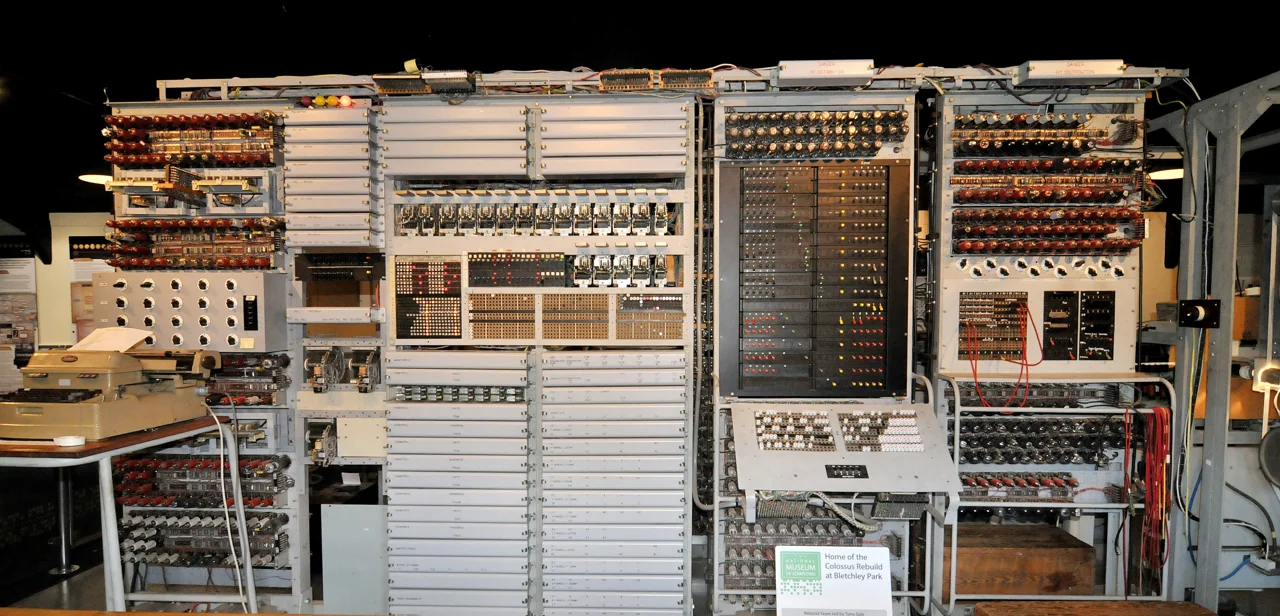
The working rebuild at The National Museum of Computing makes Colossus's real methods clear again. Led by Tony Sale, the rebuild project used surviving records and other clues to rebuild a lost machine. It is a modern rebuild, so its photos should not be labeled as wartime scenes.
Secrecy kept the feat from public view for years. That history helps explain why early accounts of computing did not always give Colossus its due place.
It also left a hard task for the rebuild team. Recovering a machine meant more than copying its shape; the circuits and tape system had to work together.
Calling it a modern stored-program personal computer would blur the feat. Its controls and purpose belonged to an earlier stage of computing.
Stand before the rebuilt racks and the scale becomes real. The striking step was not that they could do everything, but that they could do one crucial kind of work at the speed of circuits when the need was urgent.
Frequently Asked Questions
The clearest answers separate the cipher, the people, and the machine on display. Colossus served the attack on Lorenz traffic, Flowers led its engineering, and today's working version is a rebuild. Those distinctions preserve the feat without borrowing credit from other wartime projects or disguising a rebuild as an original.
Did Colossus break Enigma?
No, it helped attack Lorenz-encrypted Tunny messages. Enigma codebreaking involved a distinct set of methods and machines.
Was Alan Turing its chief engineer?
No, Tommy Flowers led the design and build. Turing did other major work in wartime codebreaking and computing.
Is the museum machine an untouched wartime original?
No, it is a working rebuild. Captions should name it as a rebuild of the wartime machine.
Sources and Further Reading
Explore Technology & Innovation for more inventions, engineering, and the ideas that turn discoveries into tools.