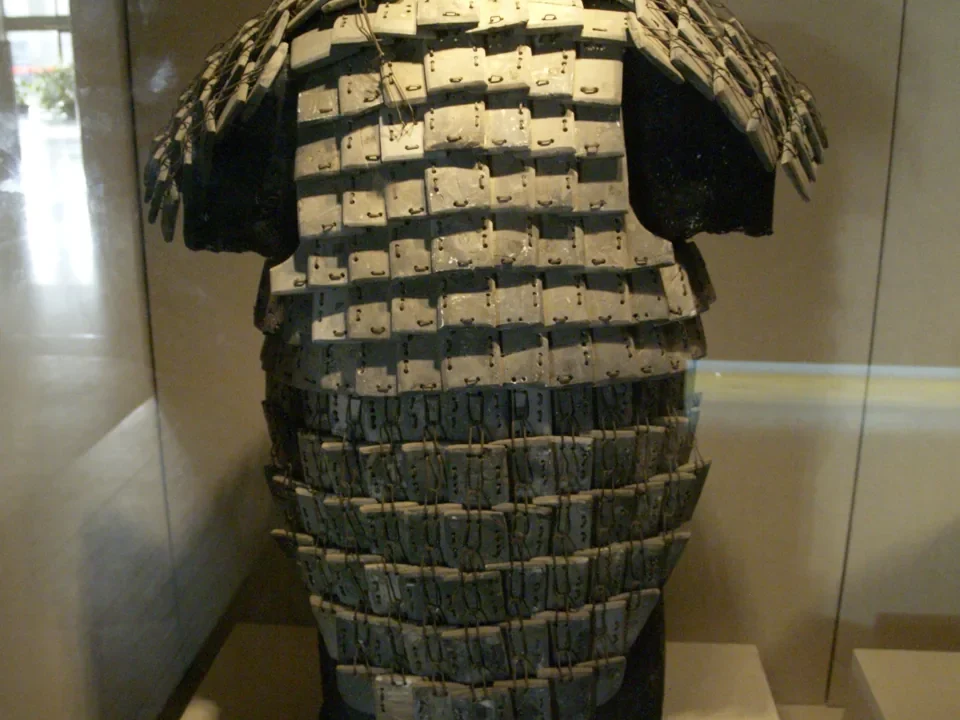

The armor looks ready for a soldier until you notice what each small plate is made of. It is stone, pierced and linked with metal wire, carefully shaped into equipment that would be a poor choice for a real fight.
Qin stone armor belongs to a world in which useful things could be remade for the dead. It is not a lost trick for war. Its value lies in the work that turned brittle rock into the shape of a soldier's gear.
The famous clay army draws much of the attention around China's First Emperor. These quieter finds lead us to the makers. We see tasks done many times, broken parts, and work left unfinished.
Their hands built a world for the dead, one plate at a time.
Armor Made for a Different Kind of Service
Stone armor found in the First Emperor's burial complex imitates protective clothing through linked limestone plates. It is generally understood as burial equipment rather than practical battlefield protection. The form recalls a soldier's gear, while the chosen material points toward a purpose beyond everyday movement, wear, and impact.
Qin Shi Huang became the first ruler of a unified imperial China in 221 BC and died in 210 BC. His burial complex gathered many forms of power and service around a central tomb.
Soldiers made of clay are only one part of that setting. Other pits and finds reveal a much broader project, with objects and figures that echo a court, an army, and the work needed to support them.
Stone armor came to light in pit K9801 in 1998. Its many small parts made it different from a single carved statue. A suit depended on the relationship between separate plates and the ties that held them together.
Limestone plates can be cut thin enough to suggest the look of armor. Thin stone can also crack. A material that survives well in some burial settings need not perform well when a living person runs, falls, or receives a blow.
That difference is the heart of the object. It resembles equipment for action, but its material makes better sense within a funerary setting. The shape carries the message.
The suit does not have to work in a real fight to serve that purpose.
A model is not always a small copy. An object can keep the scale and form of something familiar while changing the material and purpose. Stone armor asks us to look for that kind of translation.
It also warns us against a common mistake. A fine old object need not hide a lost skill that beats all modern ones. Its makers may have had a quite different goal.
The Hidden Labor in Each Small Plate
Each plate needed choices about stone, shape, thickness, and holes for its ties. Copper wire joined the pieces into a larger form. The whole suit hides much of that labor, so studying its small parts helps reveal the skill behind something that may look simple from across a room.
From across a gallery, a suit can read as a surface. Step closer, and the surface becomes a crowd of separate decisions. Edges must meet, holes must work, and each piece must fit its neighbors well enough to make the whole convincing.
Stone is not cloth. A maker cannot simply fold a corner to adjust it. Removing too much material can ruin a piece, and a crack near a hole can weaken the point where a tie must pull.
The holes are especially revealing. They turn a cut slab into a part that can join other parts. Their position affects spacing, overlap, and the way a row follows the shape of a body.
Related Reading



Copper wire forms the links. The suit can thus be built from many parts. It need not be carved as one large block.
The joins are part of the design, not a small task left until the end.
Different areas of a suit also create different problems. A broad front and a curved shoulder do not ask the plates to behave in exactly the same way. Shape and arrangement have to serve the final form.
We do not know the makers' names or how much work each did in a day. We should not invent those details. The suit still gives us tasks that someone had to do.
Each edge and hole was part of that work.
That makes the labor visible without pretending to know the maker's private thoughts. The skill survives in the fit between parts, even where the person's name does not.
A Workshop Leaves More Than Finished Objects
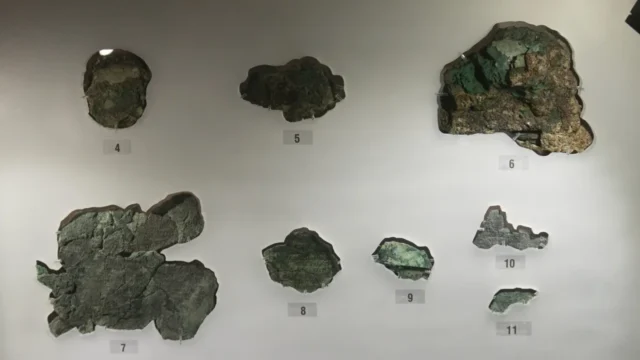
Research on the Liujiagou workshop examined stone armor production beyond the burial pits. Unfinished material and production waste can reveal stages of work that a completed suit conceals. Such evidence helps distinguish a place of manufacture from a place where finished goods were stored, used, or buried.
A fine object shows success. A workshop can show the path toward it, including pieces that stopped halfway and attempts that failed. Those less attractive remains may be the best guides to the process.
At Liujiagou, in the wider region of the Qin capital at Xianyang, finds reported after a 2019 excavation led to a study of specialized stone armor production. The research focused on how the work was organized into stages.
Imagine sorting a group of pieces by what has been done to them. Some may show the first shaping, others a more finished edge, and others the features needed for assembly. A sequence can emerge from the differences.
That is one way scholars work out how things were made. It does not put each part in a neat slot on one work line. Makers can reuse stone, change a plan, or reject a part for more than one reason.
Production waste adds another kind of evidence. Chips and rejected pieces can show that work happened nearby. A store of complete suits alone would not establish the same thing.
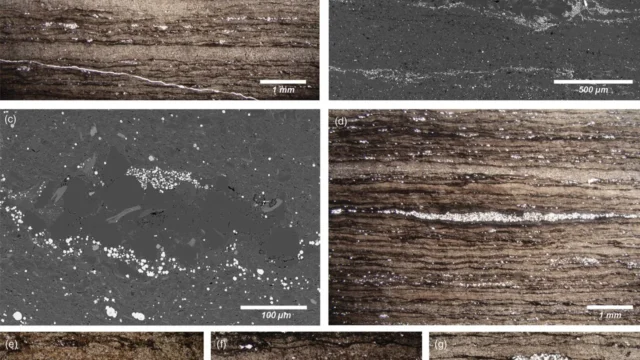
Researchers can also compare the stone itself. Its texture and chemical traits may help test possible sources. A supply route is a separate question from the location where someone shaped the final plates.
These clues show the role of craft specialization. An idea at court was not enough to make a suit. The state needed stone and skilled hands.
It also needed a way to bring the small parts together at the end.
A Fragile Object Reveals an Ambitious State
Qin stone armor shows how technical effort could serve a symbolic and funerary purpose. Its repeated parts suggest organized work, but repetition alone does not prove a modern factory system. The suits are most revealing when studied as products of their own materials, institutions, and beliefs about service after death.
The phrase mass production can be useful, provided it is not treated as a time machine. A large number of similar parts does not by itself tell us that every worker used identical tools or followed a modern assembly line.
The stronger claim is more specific. Many compatible pieces had to be made and brought together. Someone had to manage material and labor at a scale beyond a casual experiment with one stone.
That links the suit to the wider tomb project. The state could gather stone and labor for things meant to serve the dead. Power showed in how much work it could devote to them.
Yet the finished equipment can also draw attention away from that power. A guest may see only a ruler's dream. It is easy to forget who shaped each edge.
A closer look brings those unnamed makers back into the story.
It also helps separate two kinds of question. Why make the suit at all concerns its role in burial. How make it concerns craft, tools, and organization.
A satisfying account needs both, without claiming that one automatically solves the other.
The museum display adds a final layer. A supported suit shows a form that buried, broken pieces could not hold by themselves. Captions and conservation records help explain which parts are ancient and how the object is presented today.
That care does not reduce the wonder. The surprise is already real: a material chosen for stonework was made to imitate the equipment of a moving body.
The suit never needed to win a battle to deserve our attention. Its tiny plates preserve a different kind of achievement, where careful hands turned a hard, fragile substance into a lasting sign of service to a dead emperor.
Frequently Asked Questions
The most useful questions separate battlefield function, assembly, and evidence for manufacture. Stone suits imitate familiar armor while serving a different setting. Their plates and workshop remains let us study real technical skill without inventing a lost superweapon or assuming that ancient production worked exactly like a modern factory.
Was stone armor practical for living Qin soldiers?
It is generally understood as funerary equipment rather than effective battle gear. Thin stone plates are brittle and do not offer the same practical properties as materials suited to active wear.
How were the stone plates joined?
Small holes allowed the plates to be linked with copper wire. The ties and the arrangement of the plates helped create the larger shape of a suit.
Why is workshop waste important to this story?
Unfinished and rejected material can preserve stages of manufacture hidden by a finished object. It helps researchers identify where work took place and how parts were made.
Sources and Further Reading
Explore Technology & Innovation for more inventions, engineering, and the ideas that turn discoveries into tools.