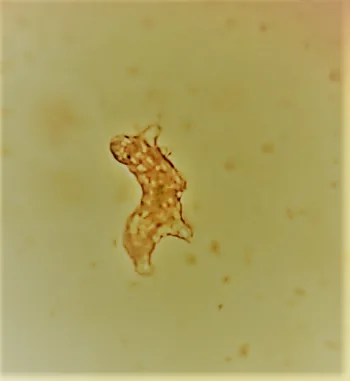

A tiny water bear can lose most of its water, draw in its legs, and wait in a state that seems close to a pause in life. Add water under the right settings. And it may become active again.
The water bear is a tardigrade, often called a water bear.
Tardigrade space survival is real enough to have been tested on space missions. The headline version, however, often goes too far. These water bears are not immortal.
And they do not live happily in open space without food or water.
Their skill is more specific and more useful to science. Some species can survive harsh tests in a protected dormant state. Grasping that state means looking at the test, the species, and the settings, rather than treating the water bear as an unbreakable toy.
A Water Bear Is Small, but Its Life Is Real
Tardigrades are tiny eight-legged animals found in places such as moist moss and soil. Active animals need water and food. Some species can become dormant when conditions grow harsh; that response helps them survive, but is different from growing and breeding normally in the same extreme setting.
The nickname water bear comes from the body and movement. Under a microscope, the water bear has a plump shape and short legs. It can seem almost well-known until the scale becomes clear.
Many are only a fraction of a millimeter long.
Moss is one well-known place to find them. But it is not their only home. The group includes species in freshwater and marine settings as well as those in damp land habitats.
A claim about one species should not stand in for each tardigrade.
Their food also differs. Some feed on plant cells or other small life. An active water bear has a working body with needs, rather than a permanent state of waiting.
Staying alive in a harsh test is only one part of its life science.
Water around the water bear allows its small body to carry out those functions. When the setting dries, some species can shift into an inactive form called a tun. The body draws inward and the normal action drops sharply.
Cryptobiosis is the wider term for such greatly reduced states of action. It is not a second kind of normal daily life. The water bear is keeping the chance to resume life when the settings improve.
That distinction solves a common misunderstanding. A creature that survives a dry period is not necessarily growing, eating, or breeding throughout it. A pause can be a useful strategy without being a comfortable habitat.
The water bear's tiny size makes it easy to overlook. But it also makes the tests clear. A team can contrast active and dormant water bears under controlled settings and ask which state protects them best.
What Space Experiments Actually Tested
Space studies have exposed tardigrades to distinct combinations of vacuum, radiation, and other settings. Some dormant water bears survived, while strong ultraviolet dose caused major losses. Results depend on the species and shielding used; Remaining a mission test does not show that tardigrades could colonize space or one more world.
The 2007 Foton-M3 mission included tardigrade experiments that helped make the water bear famous. Some tests concerned water bears within the spacecraft. Others exposed dry water bears to settings outside.
Related Reading

Those settings are distinct and should not be merged into one claim.
Space vacuum is one challenge. It removes the pressure and surroundings well-known at Earth's surface. Radiation is one more.
And it comes in distinct forms and doses. An experiment that shields one kind of dose does not test each danger at once.
Ultraviolet radiation from the Sun can damage living matter. In the exposed tests, shielding from solar radiation made a key gap. The headline that water bears survived space can be true while still hiding how much the shielding affected the result.
The time span matters as well. A test lasting days cannot prove staying alive for centuries. It tells us what happened to the water bears under those measured settings for that measured period.
That is useful evidence without being limitless evidence.
NASA later studied tardigrades through Cell Science-04 on the International Space Station. That project examined living responses during spaceflight. Living in controlled equipment within the station is not the same as floating unprotected between planets.
Microgravity, stress responses, and changes across generations can all be studied in such work. The questions concern mechanisms. Teams want to know what the water bears do and which parts of that response may help explain resilience.
The most revealing space story therefore has a few settings, not one. An exposed dormant water bear, an active water bear in equipment, and a shielded sample answer distinct questions. Keeping those settings separate makes the staying alive claims stronger and more useful.
Protection Is a Set of Tools, Not One Superpower
Tardigrade staying alive involves a few living responses, which can differ among species. Protective molecules, reduced action, and responses to damage are active areas of research. No single mechanism explains each result; Experts study which processes matter under which settings, rather than assuming all water bears share one shared shield.
Drying threatens the structures inside a cell. Water helps maintain the setting in which molecules work. Losing it can damage membranes and proteins.
A useful way to stay alive must protect more than the water bear's outside shape.
Some tardigrade proteins help protect cellular matter during drying. Research asks how those molecules behave and which changes they prevent. The work is more detailed than the claim that the water bear simply shuts off.
Oxidative stress is one more problem. Radiation and other stresses can lead to reactive molecules that damage cells. Antioxidant responses may help reduce that damage, but their role needs to be measured in the species and test being studied.
DNA damage creates a further challenge. Protecting genetic matter and repairing damage are linked but distinct tasks. A cell may prevent some harm while still needing to deal with the harm that gets through.
The water bear's state affects the whole balance. A dormant tun has very different activity from a water bear moving and feeding in water. Results from one state should not be applied to the other without testing.
Temperature limits also remain real. Heat can harm tardigrades, and the outcome depends on how hot, how long, and whether the water bear is active or dormant. Calling them indestructible hides exactly the variables experts need to study.
This is the real strength of the research. The water bear offers a few ways to investigate stress in living things. Its shielding is a set of processes with measurable limits, which is much more informative than a single label that says nothing can kill it.
Why Survival Is Not the Same as Invincibility
A tardigrade can be resilient and still have limits. Survival, later recovery, and breeding are distinct measures. Claims about alien life or human shielding need more evidence; the water bear offers insights into life, not a guarantee that an animal can endure every possible setting.
When a test ends, the first question may be whether the water bears are alive. A second question is whether they recover normal action. A third is whether they can reproduce and make healthy offspring.
Those outcomes should not be treated as one number.
A sample also contains members. Some may survive while others do not. Saying the species survived can hide a low staying alive rate, which may matter greatly when contrasting settings.
Good reports keep both the success and the losses seen.
The space result has encouraged questions about life traveling between worlds. It is a useful reason to think about transport and staying alive. But it does not prove that such travel happens naturally.
A whole chain of settings would have to work.
A water bear would need to leave one setting, endure the journey, reach a suitable place, recover, and find what it needs. Passing one part of that chain does not pass each part. A dormant water bear is not a ready-made space colony.
Possible human uses need the same care. A protective molecule may be worth studying without being a safe treatment. Its action in one cell or living thing does not tell us all the effects in a human body.
The microscope gives us a better ending than a superhero pose. There is a real water bear, small and active in a thin film of water. Its normal life makes sense of its extraordinary response to stress.
The wonder is that evolution made a way to wait through some harsh settings and return. The limits do not weaken that wonder. They give experts a clear place to begin, one measured test at a time.
Frequently Asked Questions
These questions separate measured space results from the idea of an immortal water bear. They focus on normal life versus dormancy, the role of solar dose, and contrasts among species. The answers preserve the real achievement while keeping the settings that made staying alive possible plainly in view.
Can Tardigrades Live Normally in Open Space?
No. Remaining a test in a dormant state is distinct from feeding, growing, and breeding in open space. The published results concern specific species and settings.
Does Sunlight Make a Difference to Space Survival?
Yes. Ultraviolet dose caused much greater losses in exposed tests tha settings with shielding from solar radiation. Shielding is a key part of reading the results.
Are All Tardigrades Equally Tough?
No. Species, life stage, active or dormant state, and the length of dose can affect staying alive. A result for one test should not be treated as a rule for each water bear.
Sources and Further Reading
Explore Nature & Wildlife for more remarkable species, habitats, and the science of life on Earth.