
The fossil kept much of its inside and lost parts of the outside. Tiny traces of muscles and other tissues survived, while the head and limbs that might have made the animal easy to name were missing.
The Keurbos susanae fossil turns the usual fossil puzzle around. A hard shell often outlasts a soft body. Here, the soft parts left an unusually rich record, yet some of the clearest clues to family ties were gone.
The animal lived in ancient seas around 444 million years ago. Its remains came from South Africa's Soom Shale, long before the first dinosaurs. It is a real creature caught in an unusual kind of preservation, not proof that a headless animal once swam through the sea.
A Rare Animal in an Ancient Sea
Keurbos susanae is a marine arthropod described from rare fossils in South Africa's Soom Shale. Its age is placed near the end of the Ordovician, roughly 444 million years ago. The specimens preserve unusual internal detail, but the animal's exact place among arthropod groups remains difficult to establish.
Ordovician seas did not follow today’s coastlines.
The arthropod group is vast. It includes insects, spiders, crabs, and their kin. Its roots reach far back into the sea.
An old fossil need not look like a garden bug to belong within it.
The Soom Shale formed from fine sediment in an ancient marine setting. Today, those rocks occur north of Cape Town in South Africa. The place where we find a fossil is not always the kind of place where the animal lived.
Sea and land have changed greatly since the Ordovician. The rocks provide a route back to one part of that older world. Their layers record conditions that no modern photograph of the landscape can show by itself.
The study described only two specimens after many years of collecting. That makes the animal rare in the known record. It does not tell us exactly how many lived in the ancient sea.
A rare fossil may reflect a rare animal, a rare way of preserving it, or a small chance of finding the right rock. Two finds are too few to pull those causes apart with ease.
The species was formally described in work published in 2025. Its name honors the mother of lead researcher Sarah Gabbott. The nickname Sue gives a personal note to a creature whose world is otherwise almost unimaginably distant.
The long wait before naming was not a lack of interest. The task was hard. The rock saved some tiny inner parts.
Yet the larger clues to what kind of creature this was had gone.
How Soft Parts Can Leave a Lasting Trace
Soft tissue preservation can occur when special conditions slow decay or let minerals record structures that usually vanish. These fossils keep fine inner detail while losing much of the outer body. They hold a mineralized record of tissues, not fresh flesh or a whole animal dried intact like a mummy.
When an animal dies, its body does not wait quietly for a scientist. Cells break down. Scavengers may feed, microbes use the tissues, and moving water can pull parts away.
Hard parts often last longer. A shell or a tooth may remain after most soft tissue has gone. That is one reason the usual fossil record favors some parts of life over others.
Related Reading

Under special conditions, the balance can change. Fine sediment can cover a body, and local chemistry can help record tissues that would otherwise decay. Minerals may form around or replace delicate structures.
Mineral replacement does not keep every cell alive or unchanged. It preserves a record in new material. The shape can retain information even though the substance has been transformed over deep time.
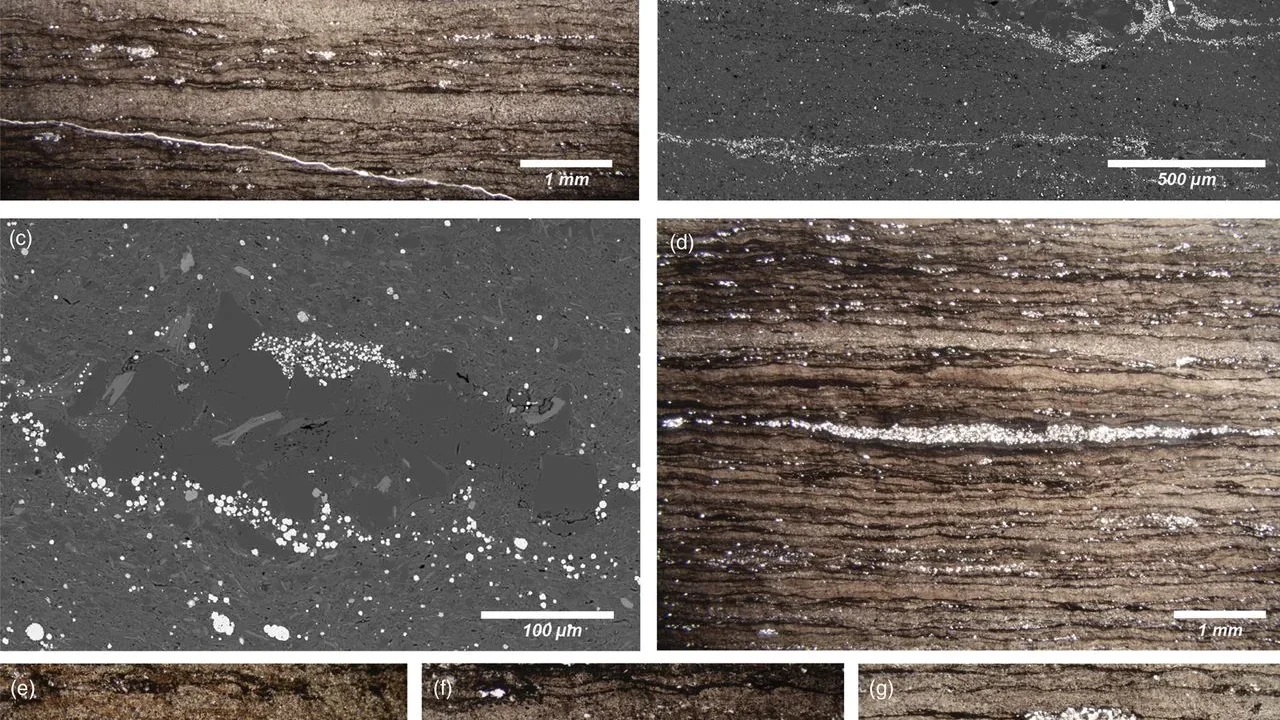
The Soom Shale is known for unusual fossils of soft parts. The sediment and chemical setting helped create a record that ordinary decay would not leave. Yet even this setting did not save all parts of every animal.
That unevenness is essential to the story. Some structures may retain fine detail while another large part disappears. Good preservation is not a simple switch that saves an entire body equally.
This is why the phrase like a mummy needs care. It makes a vivid headline. It should not make us expect fresh skin or flesh in the rock.
This creature did not wait intact inside a stone case.
Missing Head Does Not Mean Headless in Life
The specimens lack key features that would help identify the living animal, including its head and appendages. Researchers interpret those gaps as losses in the fossil record rather than proof that the species lived without them. Missing anatomy limits comparison, even when the surviving internal structures are exceptionally detailed.
Imagine finding the inside of a machine without its controls or wheels. The surviving parts could tell you how some forces moved. They might still leave you unsure what the whole machine looked like.
A fossil poses a related problem, though an animal is far more than a machine. The head and limbs often hold useful traits for comparing related species. Their shapes can help place a creature within a larger family tree.
Without them, researchers must use the evidence that remains. In this case, repeated body segments and internal structures help establish an arthropod identity. The details do not yet give every relationship a secure answer.
The label inside out describes this imbalance. It does not mean the animal normally wore its organs on the outside. It means the fossil exposes an unusually rich inner record while much of the expected outer evidence is lost.
That keeps us from inventing a monster. The strange thing is what the rock kept. It need not mean that a creature once lived with no head or legs.
It also shows why a detailed scan cannot solve everything. Better tools can reveal more of what the rock contains. They cannot recover a structure that never became part of the fossil or was lost before burial.
A reconstruction should therefore leave uncertainty visible. An artist may need to choose a head shape to draw a whole creature. That choice is not new fossil evidence simply because it appears in a realistic picture.
Why Two Puzzling Fossils Still Matter
The Keurbos susanae fossil adds rare information about internal body structure in an early marine arthropod. It also shows how preservation can shape classification. More material may clarify its relationships, but the existing fossils already reveal details that a larger collection of ordinary shells might never show.
A fossil does not have to answer every question to be important. Sometimes its value is to preserve a kind of evidence that is almost always missing. A view of old muscles can add something a thousand outer shells cannot.
The challenge is to use that detail at the right scale. A small sample can show that a structure existed. It may not show how much that structure varied across the species, its growth stages, or its way of life.
Teams compare the fossil with other forms of life. A shared trait may point to close kinship. Or two parts may look alike because they did much the same job.
Their owners need not be close kin.
A tree of life is built from traits. It is not just a row of named forebears. A new clue can move a fossil to a new branch.
The old find still matters, even when its place changes.
The study's authors left the precise relationships open. That restraint is part of the result. Naming a species does not require pretending to know every detail of its place in life's history.
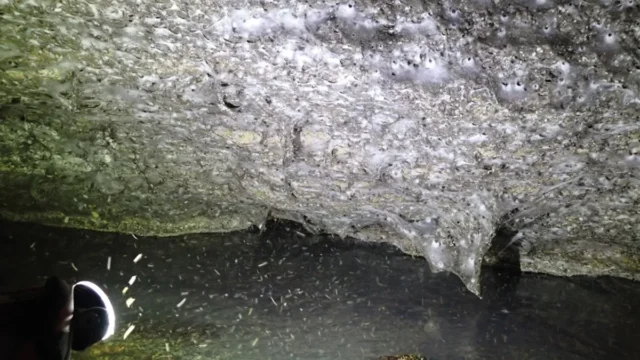
The image used here shows features of the Soom Shale sediment as geological context. It is not a portrait of the animal or an artist's finished reconstruction. The rocks and the fossil answer linked but different questions.
There may be more specimens waiting to be found. A new head, limb, or better preserved surface could change the comparison sharply. The search is valuable because the present gaps are specific enough to guide it.
For now, the animal offers an unusual kind of closeness. Its sea is gone, its world has changed, and much of its outline is missing. Yet small parts that helped the body move left marks in stone.
Science has a rare view of that life. The gaps give it a clear reason to keep looking.
Frequently Asked Questions
The key questions separate the creature's age, its lost parts, and its fossil state. It was a marine arthropod, not a dinosaur or a proven headless beast. The rock holds a changed record of soft parts, while the gaps still limit what we can say about its whole body.
Was Keurbos susanae a dinosaur?
No, it was a marine arthropod from roughly 444 million years ago. It lived hundreds of millions of years before dinosaurs appeared.
Did the animal live without a head or limbs?
The fossils do not preserve those key parts. Their absence from the specimens is not evidence that the living animal never had them.
Does soft tissue preservation mean fresh tissue remains?
No, the tissues are recorded through a mineralized fossil process. The result can preserve fine shapes without retaining fresh or living material.
Sources and Further Reading
Explore Nature & Wildlife for more remarkable species, habitats, and the science of life on Earth.